Media choices in flux as BFSI leaders weigh reach, trust and ROI
At a panel discussion at the Pitch BFSI Summit, marketers from leading financial institutions shared how they navigate ROI, regulation and relevance in today’s fragmented media ecosystem
 by
by
Published: Sep 26, 2025 1:28 PM | 8 min read
 Follow Us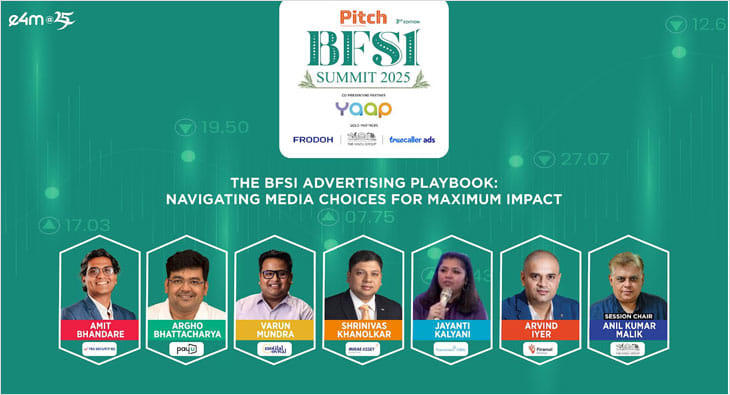

In a media world where digital dominates and every impression is scrutinised, financial marketers are rethinking how to balance performance with long-term brand building.
In this regard, industry leaders at the e4m BFSI summit debated how traditional and new-age platforms can coexist, and what truly defines effectiveness in a fragmented, post-COVID landscape.
Moderated by Anil Kumar Malik, Business Head, The Hindu Group, the discussion featured insights from Amit Bhandare, Head – Marketing & Corporate Communications, Yes Securities; Argho Bhattacharya, Head of Marketing, PayU; Varun Mundra, Group Head – Media & Innovations, Motilal Oswal Financial Services; Shrinivas Khanolkar, Head – Digital, Marketing & Corporate Communication, Mirae Asset Investment Managers India; Jayanti Kalyani, Head of Marketing – D2C, TransUnion CIBIL; and Arvind Iyer, Head of Marketing, Piramal Finance.
Setting the tone, Malik reflected on the changes that have unfolded in the advertising mix since the pandemic. He asked panellists how their market priorities had shifted, particularly when it came to English versus regional markets, and whether traditional media was losing relevance.
Bhandare opened the discussion by underlining the tilt towards digital. “Post-COVID, media budgets are more diverted towards digital channels. Around 25–30% of our budgets go into digital. At the same time, I believe in balance. We are also investing heavily in content and experiential marketing, creating IPs because the brand needs to be humanised. In BFSI, touchpoints are trust points, and finance is built on trust.”
He pointed out that much of the recent growth has been fuelled by smaller towns. “The demand for accounts has surged exponentially, from four crore to 20 crore in the last four years. A big chunk of this comes from tier 2 and tier 3 towns. So yes, we are working on regional content and taking experiential marketing to places like Guwahati, Ranchi and Raipur. But I don’t believe traditional media is becoming irrelevant. Both traditional and digital will remain equally important to create an impression.”
Mundra offered a perspective shaped by both agency and brand-side experience. “In the last four years, what we’ve seen is pure disruption. Content consumption has gone through the roof. With internet penetration becoming almost like a superpower in the hands of the common man, certain channels have lost relevance while others are on the rise,” he said.
He noted that unexpected formats had moved into the mainstream. “Because of this unique consumer behaviour, formats like vlogging have erupted in a big way. No one thought it would be taken seriously, but today even financial services brands are engaging with creators. That’s the kind of shift we’re witnessing.”
Kalyani stressed that credibility still anchors the media mix. “The principle remains the same: find your customers where they are and speak to them in a language they understand.” Print and television still hold a lot of credibility when it comes to building brand trust and authority and Kalyani believes that that’s not going away.
While COVID accelerated digital adoption, she argued that the real shift began earlier. “The catalyst was 2016, when cheaper data drove the movement. I’m a newspaper reader myself so I don’t believe print and TV are disappearing. But digital has evolved significantly, especially with the rise of influencers. Earlier, you’d tell your agency to run programmatic or affiliates. Today, it’s about finding where consumers are asking the questions you want to answer. Sometimes it’s Instagram, sometimes Reddit, Quora or search. So daily digital campaigns, the bread and butter, are changing rapidly.”
The conversation then turned to measuring advertising effectiveness. Malik asked what benchmarks mattered most today, with digital metrics having evolved from impressions to clicks to cost-per-acquisition.
Khanolkar explained why effectiveness must be judged over time. “At the end of it, you need to see whether subscriptions are going up and whether sales are growing. Certain products give immediate results, but for investment products it’s a behavioural journey. People invest when their mindset changes, when a milestone or life stage shifts. It doesn’t happen immediately.”
He cited the example of a successful launch during the pandemic. “When international tech was delivering great returns during COVID, we launched a product called Frank. It sold like hot cakes. But otherwise, these things take time.” Investment is a long-term behavioural play.
For him, the true test lies in longevity. “It’s like a classic movie, if people are talking about it years later, it means the campaign has worked. Consistency over time will resonate back and eventually reflect in numbers. For us, the key questions are: does it impact brand value? Is the AUM growing? Are more customers connecting and investing with us? If the answer is yes, then everything we’re doing is falling into place.”
When asked about measuring the effectiveness of influencers, Bhattacharya explained, “There are metrics like CPC, CPM and CAC, but we divide results into two parts: a 30 feet result and a 30,000 feet result. At the 30 feet level, we focus on short-term impact. To avoid one metric being dressed up because another isn’t working, we compartmentalise responsibilities across the funnel. One team ensures the right customers come in, another ensures conversion into paying customers.”
He added that his team now obsesses over identifying the wrong customer. “In India, niches are as big as entire countries. If a customer is not right for us, we ask whether it was the content, the platform, or spillover.” Each dollar saved from acquiring the wrong customer improves ROI.
On influencer marketing, Bhattacharya shared that it depends on where a brand is in its journey. “We started with small, technical influencers and then moved to those with larger followings. The way we look at it is costly versus expensive. Costly isn’t always bad and it may still deliver value. Expensive means you’re paying a lot but not getting value.”
The discussion then turned to content innovation in the BFSI sector. Khanolkar said regulations should be seen as guide rails, not limitations. “Regulations are written in blood. With money, it’s about safeguarding interests. Staying within boundaries doesn’t mean innovation stops. It just means you know where not to go. Our SIP campaign was called ‘Sapna in Progress’, a simple line that resonated.” The most effective campaigns are simple and connect with people.
Bhandare added, “Constraints are the mother of invention. Finance is complex, so we simplified it through a comic series for kids. Simplification builds clarity, clarity builds confidence, and confidence builds trust.”
He also took a contrarian stance on measurement. “We are too obsessed with CPCs and conversions. Brands are losing sight of long-term brand building. Nike stopped investing in brand building after COVID, focusing only on performance, and sales have plummeted.”
Bhandare stressed that short-term metrics like CPCs and conversions often distract from what really matters. He argued that brands need to focus on penetration and brand salience, whether a customer thinks of the brand at the moment of purchase, as these are the true levers of long-term growth, citing KitKat as an example of relevance built consistently over decades.
On the relevance of traditional media, Iyer noted that television continues to work because of robust measurement systems. “There’s been debate around statistical significance, but data shows why it works. The real challenge lies with print. The last IRS survey was years ago, so in the absence of updated data you rely on gut and surrogates. For us, we use a customer-backed design, tracking lifts and medium performance closely.”
He pointed out that radio has been innovating in tier-2 and tier-3 markets. “They don’t see themselves as just audio; they create community engagement. When measured, we’ve seen 200 basis points lift in salience. It is valuable given the kind of budget constraints we operate under. If you’re targeting a city like Muzaffarpur, it’s about sharp choices and checking whether the activity built salience, consideration, or trust.”
On print, Iyer admitted it remains difficult to justify, noting that while the opportunity exists, proposals are often not bite-sized or customer-focused, and relevance would require breaking them down step by step.
Kalyani agreed that television is here to stay. “Measurements are solid. We haven’t used radio recently but are exploring it. For print, it’s largely used for one central brand campaign in a year. Day-to-day spends go into digital, so traditional media has to find ways to play in the daily performance space.”
She added that proving ROI on print is an increasing challenge. “We’ve tried QR codes and triangulating data, and while we’ve seen brand lift from regional campaigns, convincing the CFO about long-term impact is tougher than ever. We need the industry to innovate and make a stronger case.”
Read more news about Marketing News, Advertising News, PR and Corporate Communication News, Digital News, People Movement News
For more updates, be socially connected with us onInstagram, LinkedIn, Twitter, Facebook, YouTube & Google News