'I don’t just create events; I conceptualise experiences that resonate deeply'
Sanjeev Bhargava, at the e4m Red Carpet Experiential Marketing Event, recounted his journey and philosophies in creating cultural marvels
 by
by
Published: Dec 30, 2024 1:08 PM | 4 min read
 Follow Us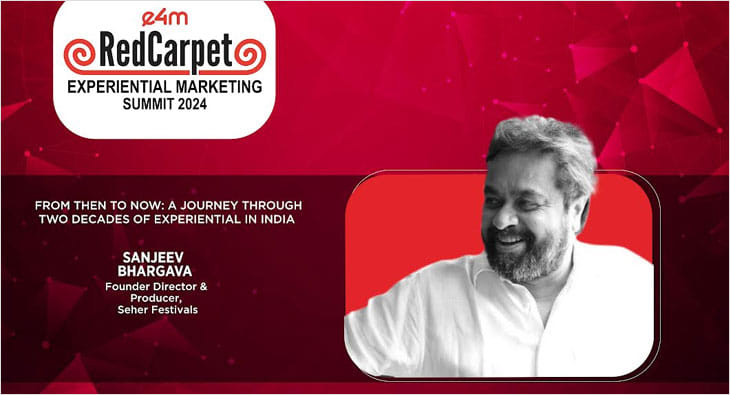

At Purana Qila, he breathed life into classical dance festivals, turning a struggling art form into a vibrant celebration attended by diplomats and dignitaries. In London, he stopped traffic on Regent Street to showcase Bollywood and Indian culture to half a million people. In Paris, his "Namaste France" festival brought Indian artisans to the global stage. From transforming historic landmarks into immersive cultural experiences to orchestrating events that draw hundreds of thousands, Sanjeev Bhargava has proven time and again that creativity knows no bounds.
Known for his ability to weave tradition, simplicity, and innovation into unforgettable spectacles, Bhargava, at the e4m Red Carpet Experiential Marketing Event, recounted his journey and philosophies in creating cultural marvels.
“I don’t just create events; I conceptualise experiences that resonate deeply,” Bhargava declared during his session. One of his earliest milestones was the launch of the Ananya Dance Festival in 2002 at Purana Qila. Classical dance events at the time struggled to attract even 400 attendees. However, Bhargava’s innovative approach—group choreography, expert lighting, and the majestic backdrop of Purana Qila—drew 1,500 attendees in its debut year, a number that grew to 2,500 in subsequent editions.
“When Delhi couldn’t muster an audience for classical dance, we turned Purana Qila into a must-visit destination,” he recalled. “We even lit the monument innovatively from inside the minarets. Two people got snake bites because those doors hadn’t been opened in years, but we delivered something extraordinary.”
This meticulousness extended to international stages. At Trafalgar Square in London, 25,000 people gathered for an Indian cultural festival he organised in a single day. Regent Street saw 500,000 people immerse themselves in Bollywood, Indian cuisine, and more—a feat that made India the talk of the town in London.
One of Bhargava’s defining achievements lies in his ability to blend scale with emotional resonance. His Bhakti Music Festivals redefined audience engagement, drawing over 10,000 attendees from diverse backgrounds. “When Pepsi’s chairman asked me to pull 10,000 people for a classical event, I thought it was impossible. But with bhakti, we brought everyone—young, old, Sikhs, Tamilians, Bengalis—together under one sky.”
Inclusivity became a hallmark of Bhargava’s events. His venues were designed to be wheelchair-friendly, and volunteers ensured senior citizens and people with special abilities were escorted seamlessly. “It wasn’t just about music; it was about creating a shared experience for everyone,” he emphasized.
Through SEHER Festivals, Bhargava’s cultural diplomacy has garnered global recognition. During India’s 60th United Nations anniversary, he collaborated with Pandit Hariprasad Chaurasia and Shiv Kumar Sharma to create a unique composition, Shanti Raag. Despite swollen feet, Chaurasia performed sitting on the ground. “That performance defined what true dedication looks like,” Bhargava said.
Against skepticism from Italian officials, Bhargava brought Italian opera to Purana Qila. “They said an opera with 80 musicians outdoors wouldn’t work. But I said, ‘Let it happen—it will be the best opera ever.’ And it was,” he said proudly.
Bhargava’s aesthetic revolves around saadgi (simplicity), a philosophy reflected in his use of marigold, sunflower, and symbolic elements like the “white tree.” “Even though I don’t believe in some traditions today, I wanted the white tree to symbolise peace and purity,” he explained.
Speaking about his festivals, he said, “Whether the Chief Minister of Delhi was there or not, we started at seven sharp and finished by eight. At 8:15, not a single person remained in the venue.”
Despite offers from the wedding industry—including a request from Sharmila Tagore to manage Saif Ali Khan and Kareena Kapoor’s wedding—Bhargava has stayed true to his vision. “Weddings don’t align with my idea of creating meaningful cultural events,” he shared.
“My profession is my passion, and my passion is my profession. If your work doesn’t come from the heart, it will remain superficial,” Bhargava remarked, summarising the ethos that has guided his illustrious career.
Read more news about Marketing News, Advertising News, PR and Corporate Communication News, Digital News, People Movement News
For more updates, be socially connected with us onInstagram, LinkedIn, Twitter, Facebook, YouTube & Google News