How contextual advertising influences brand marketing in the cookie-less future

At the Silverpush conference, industry experts shared insights on leveraging first-party data in the cookie-less world, and about Generative AI and predictive tools making advertising more effective

e4m by exchange4media Staff
Published: May 16, 2023 2:06 PM  | 4 min read
Silverpush

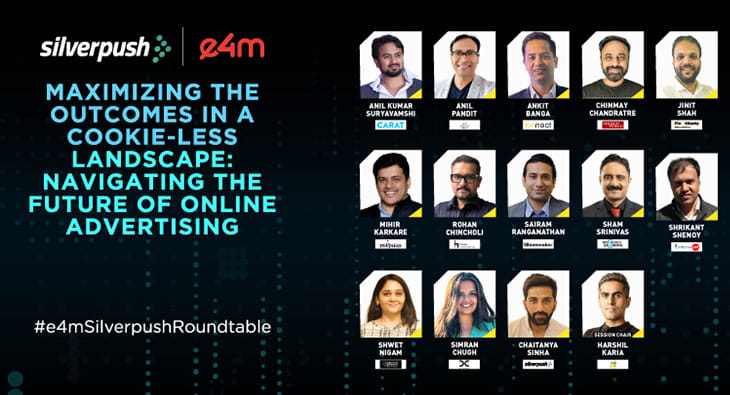
The Silverpush conference saw industry leaders speaking about maximizing the outcomes in a cookie-less landscape and navigating the future of online advertising.

Continuing the conference, the panellists expressed their views around contextual advertising, alternatives to third-party cookies, the Impact of AI on digital marketing, privacy implications of advertising in a cookie-less world, and bringing publishers and advertisers to one table to discuss relevant ad placements in the cookie-less world.

The list of the panellists includes Anil Kumar Suryavamshi, Associate Vice President- Planning, Carat; Anil Pandit, Senior Vice President, Lead-Precision (Programmatic), India, Publicis Media; Ankit Banga, Chief Business Officer, Kinnect Online; Chinmay Chandratre, General Manager, Madison World; Jinit Shah, Director-Media, PivotRoots; Mihir Karkare, Co-Founder & EVP, Mirum; Rohan Chincholi, Head-Digital Services, India, Havas Media Group; Sairam Ranganathan, National Head-Digital Services, Wavemaker; Simran Chugh, Associate Director, Media-Dentsu India; Sham Srinivas, Vice President, Marketing, Research, and Ranking; Shrikant Shenoy, Associate Vice President, Lodestar UM; Shwet Nigam, Director-Media and Marketing, Experience Commerce, a Cheil Company; Chaitanya Sinha, Business Head-India, Silverpush. The session was chaired by Harshil Karia, Founder of Schbang.

While opening the session, Karia questioned the panelists to differentiate between contextual advertising and third-party cookies. Answering the question, Anil Pandit said, “Third Party cookies are the mechanism to track the user data whereas contextual advertising is more about comprehending and strategising the content preferred and consumed by the audiences.”

Describing the repercussions faced by brands in the cookie-less world, Chincholi said, “Eradication of third-party cookies results in more investments by brands on the customers to understand their behavioral patterns.”

Taking the discussion forward, Ranganathan shared some alternatives for third-party cookie advertising. He said, “Utilizing the first-party data more efficiently and effectively, will stand out the brand in the clutter of the advertising market.”

Adding on other alternatives other than first-party data, Nigam, shared “Contextual advertising is the way forward. Moreover, understanding and embracing the audience after delving into their interests and demands, sets a brand apart in the cookie-less future.” Apart from this, “Associating with brands to share and reshare data is another alternative in the same series.” said Anil Kumar.

On challenges the brands are facing while measuring the data, Chandratre believes that the web data collection methodology is different from that of the app methodology. Moreover, apps will continue using remarketing strategies in the future. Nonetheless, brands will face challenges while adopting the whole set of ecosystems. 

As for Banga, the programmatic will be the sufferer as the cost goes up. He further mentioned that the first-party data is more efficient in enhancing reach and targeting, however, contextual works well in making conversions and profits. Elaborating on the various ways to use first-party data, Karkare shared “Apart from using first-party data in making conversions, the brands must use this data in remarketing their audiences.”

Describing how the creative industry looks forward to first-party data, Chugh said, “We as a creator never bifurcate people as targeting and non-targeting because that is more technical. We focus more on human emotions while fabricating campaigns for people to build an in-depth connection with them. Moreover, we believe that contextual advertising helps us understand the nuances of what customers are looking out for in the market.”

Continuing the discussion on making first-party data more authentic and creating more brand personalisation, Shah mentioned that leveraging contextual advertising and creating personalized experiences using AI can work collaboratively to scale and to make conversions. Focusing more on digital brands and their ad spends, Srinivas shared that the digital-first brands have to invest more in first-party data strategically as compared to other offline brands. 

Shenoy shared, “We as a business focus more on attention planning and how to measure the customer attention span on digital and other media platforms in the cookie-less future. Apart from working on metrics like reach and research, we introduced a new concept of tracking the attention span to plan our advertising spending more strategically. As a result, personalisation helps understanding consumer wants and converts that into conversion.” Sharing more about contextual advertising, Sinha talked about how contextual advertising is more about than just a buzzing word. At a broader level, it includes customer retargeting, transparency, relevancy, and synchronization of content to generate more engagement, traffic and conversion.

Moving towards the conclusion and slightly shifting from first-party data to Media measurement; Generative AI; customisation and personalisation, the experts shared the key pointers on how all three have collaborated to create better user experiences. The pointers include: Enhancing customer retargeting using predictive analytics: maintaining a balance between consumer privacy and personalisation: Using contextual advertising in supplementing first-party data: Reaching relevant customers: Measurement of media spend and Investing more in market research.

Read more news about (marketing news, latest marketing news,internet marketing, marketing India, digital marketing India, media marketing India, advertising news)

For more updates, be socially connected with us on
Instagram, LinkedIn, Twitter, Facebook & Youtube

‘Consumer behaviour is shaped by cultural influence’

At Pitch CMO Summit-Delhi, Rajeev Jain, Vice President - Corporate Marketing, DS Group, spoke about how brands have over the years used cultural influencers to their strength

By exchange4media Staff | Jun 16, 2023 12:47 PM   |   3 min read

Jain

Marketing has been for a long time an understanding of a particular set of people and targeting them based on their cultures and behaviours. Cultural marketing has been adopted by brands as they wish to connect with their audience on an emotional level. During Pitch CMO Summit, Rajeev Jain, Vice President - Corporate Marketing, DS Group spoke to the audience about the many facets of cultural marketing and how brands have over the years used it to their strength, and may have sometimes faltered as well.

In the session called, ‘Cultural Marketing For Building Successful Brands’ Jain used many examples of his own company and other brands to explain the depth at which cultural marketing is extremely essential.

Speaking about the time when Saudi Arabia just introduced a law to allow women to drive and other brands didn’t speak on that, Coca-Cola came up with an advertisement focusing on the new found freedom of women and catered to the audience there. Jain said, “So interestingly if you're saying that Saudi Arabia, which is a more conservative country, that driving by females were not allowed. One fine day, they decided that women should also drive. While most of the brands kept their silence, assuming that it might backfire, Coca-Cola took the bold step. They launched a campaign aligned with the new evolved culture of the particular country. They were able to dole out a 22% higher score while measuring the love for the brand. So that is the beauty of studying culture, and aligning your brand proposition and communication authority.”

Jain also spoke about the Indian audience and why they are different from the West. “We see that for individualism, the USA has a high score and India has a very low score. Reason being we Indians, we believe in family cultures, family values, we take decisions in consultation with a family, we have respect for them and we celebrate with families. So that's why in India, the individualism is very low. In the USA, it is self-motivation, self-happiness and self-celebration. So that's why it's very important for a marketing person to understand the different cultural dimensions of the different countries.”

About cultural marketing, Jain explained, “Marketing is all about consumers and consumer behavior is shaped up by cultural influence. At times, companies study the culture, develop consumer insight and brand proposition and sometimes they miss also. Sometimes the companies launch products with certain assumptions and hypotheses. At times the brand gets success and sometimes not. That's all because we don't study the consumer properly.”

To summarize, he said, “Study of culture of the target audience is extremely important. Bias is in human nature. Combination of experience and emotion creates an imprint. Culture keeps evolving. Companies may make blunders if they don’t study the consumer properly, particularly when they cross borders. Indians love a little of Indian taste in their ads with which they have grown up. This is our learning. This is our hypothesis.”

Read more news about (marketing news, latest marketing news,internet marketing, marketing India, digital marketing India, media marketing India, advertising news)

For more updates, be socially connected with us on
Instagram, LinkedIn, Twitter, Facebook & Youtube

Industry experts talk ‘purpose’ and ‘personalisation’

The e4m Pitch CMO Summit-Delhi saw a panel of industry heads share insights on ‘leveraging customer data and personalisation strategies for purpose-driven marketing’

By exchange4media Staff | Jun 16, 2023 11:29 AM   |   4 min read

Pitch CMO Summit

An engaging panel discussion held at the e4m Pitch CMO Summit, Delhi, brought eminent leaders from the industry to discuss and share their respective views on the topic ‘leveraging customer data & personalisation strategies for purpose-driven marketing’.

The panel comprised Deepinder Singh, Vice President Marketing, Pristyn Care; Esha Nagar, Managing Director, Nepa APAC; Ishwindar Singh, General Manager – Marketing, Pernod Ricard India; Joydeep Mukherjee, Chief Marketing Oficer, Adda52, and Madhur Acharya, Vice President – e-commerce, Lenskart. The session was moderated by Tanisha Doshi, Director - Growth & Strategy, WebEngage.

In today's day and age, it is important for businesses to leverage data in a meaningful way. Speaking on how he is leveraging customer data for purpose-driven marketing, Deepinder said, “It is important for us to understand that personalisation is super critical in the business, specifically a business which spans over 40 cities and over 50 specialities. So, a person reaching out to me for a speciality cannot land on another. My communication cannot be incorrect. Being a digital-first company, we are able to track what a person is searching for – that is the point of our data journey.   Being a digital-first company, we are able to track what a person is searching for, what he is doing on a website and what actions he is taking. And every time, there are data interpretations that need to be taken out, that what a person is looking for and what you are showing him, and is that even useful for the person.”

Elaborating on the trends she observes in the ecosystem today, Nagar said, “At Nepa, we are a research firm – consumer science firm – so the theme is as much of an opportunity in the ecosystem as also a confusing place to be in. The words ‘purpose’ and ‘personalisation’ have brought in reverse trends in research. To quote some examples, we are seeing that the rule of personalisation says that treat people not like data number but with human identity. It is easier said than done. We are seeing that as much as quantitative data, a lot of big segmentation and a lot of quantitative work that has been the pulse of research industry.”

Ishwindar shared how he leverages data, “We have certain data points which are regulated so we do not look at that. There is a very important fundamental piece here – that there is a lot of data out there. And if not rightly looked at or segmented and if the right segments are not derived, it will lead to a stage where you look at the scale of data and it could paralyse you. And we have seen that happen in a lot of projects, where you have so much data and try to make sense out of it. But the nuances in the data, it starts telling you of potential areas that comes out of the quantitative and then when you put a qualitative lens around it and go deeper into finding the insight, is where the magic happens.”

Mukherjee talked about how he leverages data at Adda52, “Data plays an important role but till the time you apply the layer of qualitative insights on it, there is precious little you can do with data. And I have the privilege of coming from organisations where you really have a lot of data which comes in very quickly and you can act on it. Now, how does data help you? Data helps you in making communication with consumers extremely contextual and immediate. Because with the kind of systems we have, I am able to talk to a customer about something which the customer probably involved in right now.”

Acharya added, “You have a lot of data coming out from all the channels you have been working – from a sales standpoint and from a marketing standpoint. If you do not know what to do about it, it is going to be wastage. And we as marketers do not talk about the analytical part of collecting data; I think we all agree that in the boardroom, the problem we have to face is the limitation of budget we have and how we are going to use it.”

Read more news about (marketing news, latest marketing news,internet marketing, marketing India, digital marketing India, media marketing India, advertising news)

For more updates, be socially connected with us on
Instagram, LinkedIn, Twitter, Facebook & Youtube

e4m-Mobavenue roundtable delves into content marketing, distribution & collaboration

During the roundtable discussion held in Bengaluru, industry leaders discussed strategies that brands could use to engage with customers and the most effective approaches

By exchange4media Staff | Jun 16, 2023 1:25 PM   |   3 min read

Mobavenue

Customer acquisition and retention are two crucial factors for building a successful business. Both require equal attention to make the process efficient and easier. Last Thursday, a roundtable discussion by e4m and Mobavenue took place in the startup capital city, Bengaluru. The panellists shared strategies and discussed targeting both new and existing customers.


The discussion, titled "Unlocking Brand Growth: From Acquisition to Retention", was chaired by Jayant Basantani, Senior Sales Director at Mobavenue. The panel included:


• Arpan Biswas, AVP of Marketing at Reliance Ajio
• Gaurav Tyagi, GM of Marketing at Adani Digital Labs
• Jani Pasha, Co-Founder & CEO of Lokal
• Nilesh Gupta, Senior Director of Growth at Meesho
• Prasanth Naidu, CMO at Moneyview
• Rahul Dayama, Head of Marketing at Urbanic
• Shwetha Iyer, SVP and Head of Marketing at RING and KISSHT


Ishank Joshi, CEO of Mobavenue, opened the roundtable by explaining the company's operations and global presence. He introduced Mobavenue as a Growth & Tech platform that empowers brands, agencies, and publishers with MadTech (AdTech and MarTech) solutions for better business growth.


"Beginning with campaigns which lead to customer acquisition, then retaining the customer by retargeting them and utilizing social media along with collaborations are some of the ways in which customer growth is possible," stated Jayant Basantani at the outset of the discussion.


Shwetha Iyer, speaking about targeting and distributing Tier 2 and Tier 3 customers, emphasized the significance of customization in outreach. She states, “It is not hard if there is customization in your outreach. We need to look at vernacular content and alternate channels, not just sticking to Facebook and Instagram but also going to video apps. In heartland India, the penetration of Sharechat and all have increased, so those alternate channels have worked well for us. Plus, we rely heavily on our merchant network. We do a lot of offline work with them and that is a channel of acquisition. But nearly 80% of our acquisition happens through digital.”


Rahul Dayama, discussing the impact of influencer marketing on Urbanic's growth, explains, “Last year, we worked with 2800 content creators. Our influencer marketing is very detailed. We calculate ROI for each influencer. There are influencers who have got me sales for like Rs 1.8 crore. Last month we received 16000 organic content on Instagram. So, the whole community plays an important role for us.”


Addressing performance marketing, coupon codes, and customer retention strategies, Gaurav Tyagi states, “From a digital perspective, in a very subtle way, we are doing performance marketing on Google. It is our preferred channel generally. We are getting decent cost per acquisition from our unit economics-wise. So, these are the things which we track.”


He further explains, “We are also building some kind of channel-level pricing, which means if you're coming from any channel, you will see a different kind of coupon code as per your past references so that I can enable that AI-driven logic that will get you the respective discount. Through these metrics and amalgamation of product mix changing and how you operate, is how we can get repeat customers,”

The roundtable conference provided an excellent opportunity for industry experts to share valuable insights on how brand growth can be leveraged from acquisition to retention through effective strategies.

Read more news about (marketing news, latest marketing news,internet marketing, marketing India, digital marketing India, media marketing India, advertising news)

For more updates, be socially connected with us on
Instagram, LinkedIn, Twitter, Facebook & Youtube

‘Any tool that makes marketers more efficient is an interesting technology disruption’

At Pitch CMO Summit Delhi 2023, industry experts discuss ‘Marketing in the Era of Technological Disruption'

By exchange4media Staff | Jun 16, 2023 9:16 AM   |   3 min read

Pitch CMO Delhi

The Pitch CMO Summit Delhi 2023 saw an interesting panel discussion on ‘Marketing in the Era of Technological Disruption’. Marketers from different industries spoke about their experience in the digital era and how they are putting in efforts to get the attention of tech-savvy consumers. 

The session was chaired by Avik Chattopadhyay, Co-founder & Partner, Expereal. The panel members were Ashish Tiwari, Chief Marketing Officer, Home Credit India; Charu Malhotra  Bhatia, Vice President - Marketing, Hindware Limited; Gaurav Mehta, Chief Marketing Officer, Noise; Mukesh Ghuraiya, Chief Marketing Officer, Modi Naturals; Sachin Vashishtha, Chief Marketing Officer, Paisabazaar.com

The discussion started with Tiwari giving the audience a glimpse of what it is to be a marketer in the times of fast-changing technology.

“The life of a marketing person in the event of technology is like being on a treadmill which is only increasing the speed. When I started my professional life, the Chief Marketing Officer of a company would have three campaigns and a couple of creatives.”

“But now, an average company with two digital assets, which can be a Facebook page or a website, creates 600 creatives a year. In simplistic terms, your marketing fundamentals are the same. The only thing is that the depth of understanding of the marketing fundamentals has grown multifold. Information is ubiquitous as long as somebody has a device and data connectivity.”

Sharing his take, Mehta said, “Data doesn’t flow as rapidly here as any of my previous organizations, but then the biggest part of working in an omnichannel organization like Noise is that a large part of our place comes from marketplaces. Also, we have our own D2C channels as well as offline mode. Everyone is speaking about first-party data, but 80% sales come from places where first part data isn’t available.”

When asked why there is only a 2% conversion rate in the online BFSI category, Vashishtha, said, “We get roughly 20% of the industry but we can only convert two percent and that is a gap of around 90%. What my fellow panelists are saying is right, but for me, the role of the marketer hasn’t changed. From text ads 20 years ago, to now conversational AI, we have come a long way, but the role of a marketer is to be present at the right time and at the right place with the right message, how do you do it keeps on changing whether it is only a channel.” 

He went on to say that because of earlier practice of distribution channels, there is a huge gap of 90% and the conversion rate is only 2% and they are trying to solve this. 

Representing a traditional business, Malhotra of Hindware said, “The way this whole tech-led marketing environment is changing has also changed the consumer mapping journey. Today, there are a lot of tech-led data-led interventions that are required at the right places. I represent a company, in a manufacturing-led industry. The way you communicate with consumers has undergone a transformation. “

Ghuraiya said that the digital disruption has helped them to be efficient in their approach. “Interestingly, the technological disruption for our category would be two fold. One part is how we as a marketer use it; my team uses technology internally to maybe optimize our work. I think we are busier now than we were ever in our professional life and any technology, any tool that saves us time and makes us more efficient is an interesting technology disruption for us.”

Read more news about (marketing news, latest marketing news,internet marketing, marketing India, digital marketing India, media marketing India, advertising news)

For more updates, be socially connected with us on
Instagram, LinkedIn, Twitter, Facebook & Youtube

No appetite for marketing? Why food delivery apps saw a bland IPL this year

Softer demand for online food ordering on platforms like Swiggy and Zomato during tournament season could be due to their focus on profitability and penetration, say experts

By Nilanjana Basu | Jun 16, 2023 8:47 AM   |   5 min read

food delivery

Online food delivery companies saw a softer rise in ordering demand this IPL season compared to previous years, and it could be due to the companies trying to double down on profitability and cut on costs, experts suggest.

In a report by a consulting firm Redseer, The OFD companies recorded a 7% increase in online food delivery orders during the IPL matches in 2023 compared to the 50%+ increase seen in the IPL-2020 season.

The report said, “Continuing their focus on profitability, OFD players adopted lighter campaigns in IPL 2023, largely limiting to in-app promotions. This was unlike the IPL seasons 2017-2020, wherein platforms made a significant presence on prime-time television through their advertisements. They enticed viewers with attractive discounts ranging from 50% to 60% at a wide array of restaurants. Additionally, they integrated their offerings with OTT platforms and created customized advertisements for maximum impact.”

IPL has been a major source of income for brands across the years of its existence. Online food delivery applications like Swiggy and Zomato did not fall behind in making the most of this period by marking their presence in every other media channel. But lately, especially this year, the range at which their offers and ads appeared to the audience mostly just stuck to our mobile phone notifications.

Could this be why the applications saw modest online demand compared to previous years? Experts say the OFD companies cutting down on costs and trying to move towards profitability, which they are doing successfully, could lead to lesser visibility and hence, tighter demand growth during times like the IPL. It could be working since Swiggy recently said their food business has become profitable while Zomato is also seeing near-term growth as their losses narrowed.

Reasons for softer demand during IPL 2023

Rashid Ahmed- Chief Digital Officer, Infectious Advertising believes lack of aggressive advertising directly impacted demand this year.

“During the 2023 IPL season, large Food Delivery Companies (FDOs) like Zomato and Swiggy seem to have largely shied away from aggressive advertising, resulting in a lacklustre orders spike of 7% as compared to spike highs of over 50% during the 2020 IPL. It is likely that FDOs relied on captive audience direct digital marketing. While metropolitan audience ordering behaviour may have plateaued out during the IPL period, users from smaller towns and cities seem to have ordered over twice as much during the IPL than metro users, despite little-to-no advertising.”

“Advertising, especially where impromptu decision-making may be triggered, can have a significant positive impact on segments like Food Delivery, during significant events like the IPL where entertainment, gatherings, and F&B pretty much go hand in hand. Unlike earlier industry formation years during which advertising and desirable discount demand drivers saw spikes upwards of 40% and even above 50% during IPL-13, the lack of advertising may have directly impacted the spike in orders during the 2023 IPL season,” Ahmed added.

Karan Taurani of Elara Capital says both the reach of a respectable penetration level and the companies chasing profitability could have impacted this demand slowdown during IPL.

“I think two things are happening over the last three years. One is that in terms of penetration, they have reached a respectable level. So, the base is something that was kind of catching up on this revenue growth that has come down. That's one broad reason, in terms of why this fifty percent number became seven percent. The other supplementary reason for it is that most of these companies are now kind of chasing profitability. So, I think they are playing around with levers around marketing and around customer creation. That is why this reduced marketing campaign strength as well. That is why even the growth is compound.”

Not all bad news

Although a lack of advertising, the companies did not shy away from offerings and deals during the season while engaging customers on their application through various gimmicks. Swiggy’s Match Day Mania offers and Zomato’s IPL quizzes made up for good engagement.

Samit Sinha, Managing Partner, Alchemist Brand Consulting, says “Watching television, be it entertainment or sports, goes hand in hand with the convenience of ordering food at home, as in many instances people are so glued to the screen as to not have time to spend in the kitchen. So, food delivery services like Zomato and Swiggy address the opportunity as the modern version of the TV Dinner.  The co-branding with Star Sports was a unique (as well as relevant) aspect, which made them almost complementary to televised sports and entertainment.”

Viren Razdan, Managing Director at Brand-nomics, believes the rewards and cashback played well for the applications. “IPL has become a major window and increasingly marketed well by F&B as an accompaniment. Both delivery brands delivered well on engagement region specific too. This was also in some sort of a post-Covid celebration of people getting back with a vengeance. Apart from advertising, the apps had some really good interactive elements with rewarding cash back plans and deals.”

Read more news about (marketing news, latest marketing news,internet marketing, marketing India, digital marketing India, media marketing India, advertising news)

For more updates, be socially connected with us on
Instagram, LinkedIn, Twitter, Facebook & Youtube

We are working towards a circular economy & sustainability: Vikram Garga, Apollo Tyres

At Pitch CMO Summit Delhi 2023, Garga, Group Head, Marketing – APMEA, spoke extensively on how Apollo Tyres was making its manufacturing renewable with the help of latest technology

By exchange4media Staff | Jun 16, 2023 8:31 AM   |   2 min read

Apollo Tyres

The Pitch CMO Summit Delhi 2023 saw an enviable collection of brand leaders, marketing mavens, and industry leaders sharing their experiences, observations and insights. As part of a spotlight session, Vikram Garga, Group Head, Marketing - Asia Pacific, Middle East Africa (APMEA), spoke about Apollo Tyres’ efforts to contribute to the environment and its innovations.

“When it comes to the automobile industry, it becomes immensely important for us to determine what is happening around.”

Speaking of how taking care of the environment was key for sustainability, Garg said, “The largest tyre dump yard can be seen from the air, so can we call it the 8th wonder of the world? What are we doing to solve this problem as an industry? Apollo Tyres has been working very hard in terms of circular economy, sustainable resources of raw materials and working with partners and ensuring on how our manufacturing is renewable and using the latest technology all this will help us to become carbon neutral by 2050.”

He spoke about how the company was using technology and other strategies to reduce waste, for protecting the environment and how Apollo Tyres was working on new products to reduce fuel wastage and save the environment. “We have all heard of the Ev-isation in the mobility space. We are amongst the first to develop tyres for Electric Vehicles, two-wheelers and four-wheelers. We have made that technology to make really EV-ready vehicles,” he added.

“I also want to talk about how we are discovering products early before we buy them. At Apollo Tyres we also have an e-commerce platform for ‘buying online and fit offline’, which is tailor-made for consumers to discover the right products. I think one of the biggest innovations that we are seeing is the digitisation of the tyre records that exist, we have launched a digital app called ‘Avolve’, which offers end-to-end tyre management services. Today with the help of our app Avolve, we are able to generate more than 50 data points for a tyre.”

Watch the full session here:

Read more news about (marketing news, latest marketing news,internet marketing, marketing India, digital marketing India, media marketing India, advertising news)

For more updates, be socially connected with us on
Instagram, LinkedIn, Twitter, Facebook & Youtube

'History has shown data-led decisions have the highest probability of success'

During a fireside chat with Vivek Malhotra at Pitch CMO Summit, Shashank Shrivastava said it is crucial to allow employees to experiment and make mistakes to foster innovative thinking

By exchange4media Staff | Jun 15, 2023 4:04 PM   |   4 min read

Shashank Shrivastava

It is crucial to empower employees by granting them the freedom to experiment and make mistakes if innovative thinking needs to be fostered, said Shashank Shrivastava, Senior Executive Officer- Marketing and Sales, Maruti Suzuki.

Speaking at the Pitch CMO Summit held in New Delhi on Wednesday on the theme ‘Reimagining Purpose in a Tech-Enabled World’, Shrivastava said technology is exciting and a supportive culture can promote inter-organisation innovation.

“How can we foster innovative thinking in our own teams and leverage the incredible power of technology for generating growth within our organisation. The answer lies in creating a supportive culture that promotes and champions inter-organisation innovation.

“To achieve this, first, it is crucial to empower employees by granting them the freedom to experiment and make mistakes. Second, invest in our communication system and make sure team members feel comfortable. Third, clearly defined goals with constant supportive feedback and guidance are essential in achieving an innovative culture. Finally, encourage supportive collaboration among employees by opting for tools such as online communication systems, document sharing services, virtual project spaces etc.” Shrivastava said.

He said that these are exciting times as far as technology is concerned as it presents huge opportunities for businesses and customers alike.

“I cannot help but marvel at the wonderful age of technology we live in. It is truly a time brimming with potential and opportunities for both customers and businesses alike.

“One of the most significant ways digital transformations have accelerated innovation in marketing is through the emergence of powerful research tools that enable vast amounts of data to be processed quickly and efficiently. Today marketing professionals have a wealth of information on their fingertips which allows them to make more informed decisions than ever before,” he said.

During his fireside chat with Vivek Malhotra, Group CMO and COO - Consumer Revenue, India Today, Shrivastava spoke about digital transformation in Maruti Suzuki and stressed on the need to shift mindset.

“Shift in mindset is necessary. Fundamentally, history has shown, data-led decisions have the highest probability of success. If you imbibe this philosophy, you would like to have as much data as you have before making decisions. If you are convinced about it, you will build a good database to start with. That is the transformation we are looking at.

“Technology is very exciting and you must keep up with its pace of change. We started with NEXAverse with the Grand Vittara launch and spread it to ARENAverse. We have more than 100,000 sessions so far and it is great. We want to do more things like 3D comparison of vehicles, virtual test drives, POC etc. We are hopeful it will get very big,” he said.

Shrivastava said that Maruti Suzuki has 17 models in its portfolio.

“10 in ARENA and 7 in NEXA. One of the challenges is geographical reach. We have 3800 physical showrooms and 9000 digital showrooms. In the ‘phygital’ world we live in, physical showrooms are also important. People now in villages also want cars. We have 650,000 villages in India and Maruti Suzuki has sold at least one car in 410,000 villages. But I wonder why the remaining villages have not bought a single car so far,” he said.

Speaking about the advantages of technology in marketing and innovation, Shrivastava said it has empowered businesses by expanding market sizes exponentially by reducing entry barriers for new players with information that is available at a click of a button and social media democratising communication.

“People from across the globe can access markets which were considered out of reach. Creating a culture of innovation in the age of technology is not just a choice but an imperative for organisations to thrive and stay ahead of the curve.

“Let us embrace diversity faster, open communication and leverage technology to pave the way for the future where creativity and technology intertwine seamlessly,” he said.

He also told Malhotra that Maruti Suzuki will continue its visibility at Comic Con as GenZ and millennials are the ultimate buyers.

“GenZ and Millenials are about 83-84 % of the total sales in the industry. GenZ are a large chunk in our case about 28 % of our total sales. Median age of people in Comic Con is 21 years. They have such a huge reach. We will continue our digital content creations there as GenZ and Millenials are the buyers of the future. So better to build brand image with them,” Shrivastava said.


Read more news about (marketing news, latest marketing news,internet marketing, marketing India, digital marketing India, media marketing India, advertising news)

For more updates, be socially connected with us on
Instagram, LinkedIn, Twitter, Facebook & Youtube