Privacy is becoming a unifying force: Bharat Khatri, Omnicom Media Group
At the Real Time Programmatic Advertising Conference, Bharat Khatri, CDO for APAC at OMG, discussed the importance of personalisation and automation, and the growing relevance of privacy
 by
by
Published: Sep 19, 2024 1:18 PM | 5 min read
 Follow Us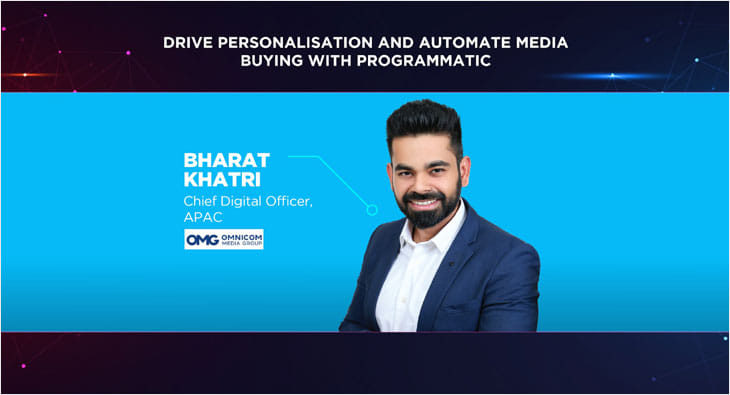

Bharat Khatri, Chief Digital Officer for APAC at Omnicom Media Group, addressed the audience at the Real Time Programmatic Advertising Conference, shedding light on the evolving complexities of personalisation in programmatic advertising, the role of automation, and the challenges posed by privacy regulations.
He began by recalling how the initial goal of programmatic advertising was to automate the buying and selling of ads. However, over the past decade, the increasing complexities of technology have presented numerous challenges, including the need for transparency and a deeper understanding of ad tech elements.
Khatri emphasised that the central focus of this session was to explore the factors driving personalisation in programmatic advertising and the significant disruption currently underway in the industry. Before diving into solutions, he highlighted some of the pressing challenges facing the ecosystem today. One of the most significant shifts involves the depletion of traditional advertising signals, such as cookies, device IDs, and other tracking methods.
Khatri also spoke about the recent announcement by Google regarding the depreciation of third-party cookies and the broader industry debate about data privacy.
"Privacy is becoming a unifying force, with consumers becoming more aware of how their data is used. Many browsers, including Safari and Firefox, have already phased out third-party cookies, while Google Chrome has allowed users to control their data-sharing preferences, which he considers a smart move to navigate regulatory pressures," he noted.
The increasing complexities aren’t limited to data privacy alone. Khatri also touched upon the growing concern of “walled gardens,” where media platforms are becoming more protective of their consumer data, creating additional challenges for advertisers looking to personalize their campaigns. He noted that while some markets are heavily invested in CTV and using first-party data and device IDs, the broader ecosystem is becoming more complex, and the industry’s primary focus remains on consumer targeting.
He emphasized the critical need for brands to understand how their media investments will be affected by these disruptions. Without proper measurement and attribution models, advertisers risk wasting their ad dollars.
Khatri urged marketers to conduct audits to assess the impact of these changes on their investments, as every brand’s strategy varies based on market conditions and funnel stages.
The session also highlighted the challenges posed by signal loss in media planning, activation, and measurement. With traditional signals vanishing, the dream of a 360-degree consumer view seems increasingly elusive. Cross-platform measurement and attribution are facing significant hurdles, leading to potential inefficiencies and fragmentation in media spending.
Khatri then transitioned to discussing adaptive capabilities that could drive personalisation and automation in media buying. He introduced the concept of audience creation as a vital component of the future. Brands need to develop their audience strategies, leveraging first-party data and partnerships with retailers like Amazon to harness retail data and create audience graphs. Probabilistic project graphs were also mentioned as a tool to enhance reach efficiency across the internet.
One of the most intriguing elements of Khatri’s talk was his focus on how creative is becoming the new form of targeting in programmatic advertising. With declining attention spans, particularly among younger generations, consumers expect hyper-personalised content. He argued that creative will soon be the key driver of targeting, as it moves beyond traditional demographic and geographic segmentation. To address these challenges, Khatri advocated for the use of generative AI, which is already transforming the way brands create content and automate media buying.
Generative AI, Khatri explained, is now being harnessed to create demand and drive incremental business advantages for brands. While AI has long been used in the media industry to improve cost efficiency, this is the first time it’s been applied to creative development. Brands are increasingly turning to AI to not only streamline media planning and buying but also to supercharge creativity.
At Omnicom, they’ve developed an AI task force to ensure diversity, compliance, and transparency in how AI is used. Khatri clarified that the goal is not to replace human creativity with AI but to amplify it. Omnicom has created a solution called OMNI Assist, a global open orchestrating marketing platform with AI-driven capabilities. The platform integrates AI into media planning, buying, activation, and analysis, helping brands navigate an increasingly fragmented ecosystem.
The next focus of Khatri’s presentation was media activation, which he noted has become increasingly complex due to fragmentation. To address this, Omnicom developed OMNI Activation AI, a tool designed to help automate media activation. The tool acts as a plug-in for traders, navigating different platforms and customizing AI solutions for clients. Khatri highlighted three key levers for building AI solutions: inclusion and exclusion lists, inventory curation, and workflow automation. By leveraging these capabilities, brands can improve performance and achieve better results.
Khatri concluded by emphasizing the importance of adapting to the challenges posed by privacy regulations, signal loss, and the growing complexity of the media ecosystem. By focusing on personalization, automation, and creative innovation, brands can navigate these disruptions and continue to thrive in the evolving programmatic landscape.
Read more news about Marketing News, Advertising News, PR and Corporate Communication News, Digital News, People Movement News
For more updates, be socially connected with us onInstagram, LinkedIn, Twitter, Facebook, YouTube & Google News