e4m Confluence 2026: who decides what metrics to look at in the attention economy?
In an ecosystem where search metrics are being challenged by AI chatbots, a panel of experts at e4m Confluence 2026 discussed the metrics that are still worth measuring
 by
Published: Nov 24, 2026 5:09 PM | 4 min read
 Follow Us

- The panel at e4m Confluence 2026 discussed the relevance of traditional media marketing metrics such as views, frequency, and reach in the context of a rapidly evolving digital landscape.
- Panelists unanimously agreed that consumer behavior has dramatically changed, with a shift from a scarcity of supply to a scarcity of human attention, driven by increased competition in the digital space.
- The rise of digital advertising has transformed marketing strategies, with companies now focusing on accountability and return on investment rather than just visibility.
- While traditional metrics remain important for establishing a baseline, there is a growing need for new indicators that measure customer experience and engagement, highlighting the absence of a unified metric across different platforms.
The metrics that traditional media marketing has long relied on are still around: views, frequency and reach. But are these still the right metrics to track? This was the pertinent question that panellists at e4m Confluence 2026 sought to address.
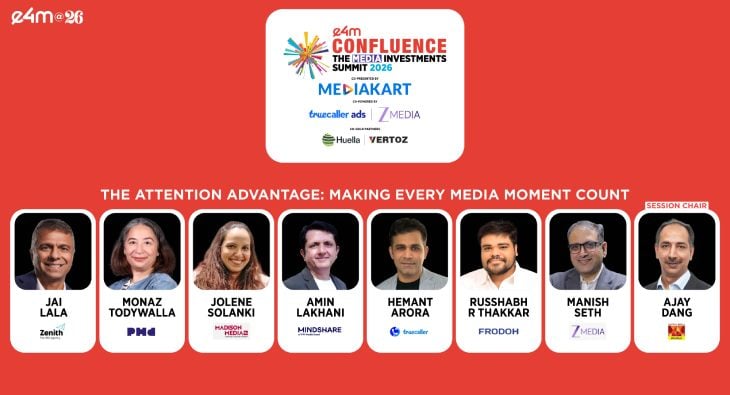
The session titled ‘The Attention Advantage: Making Every Media Moment Count’ was chaired by Ajay Dang, President, Head - Marketing, Ultratech Cement.
Jai Lala, CEO of Zenith Media; Monaz Todywalla, CEO of PHD Media; Jolene Solanki, COO of Madison World; Amin Lakhani, President of Client Solutions, WPP Media South Asia; Hemant Arora, VP, Global Head, Truecaller Ad Business; Russhabh R Thakkar, Founder & CEO, Frodoh; and Manish Seth, Chief Revenue Officer of Zee Media were the panellists.
The changing digital landscape
Ajay Dang, President, Head - Marketing, Ultratech Cement, started off the session with a simple rating game. He asked the panelists to rate, out of 10, how much the consumer has changed from when they started their careers.
The answer was a unanimous, and predictable, 10 from each member. The entire panel agreed that the consumer ecosystem has changed dramatically in the past few decades even though the fundamentals have remained the same.
“The principles of marketing haven't changed. What has changed is that there was a scarcity of supply in the past but now there’s a scarcity of human bandwidth,” said Hemant Arora, VP, Global Head, Truecaller Ad Business.
Jolene Solanki, COO of Madison world, pointed out that this scarcity of attention is also because of how competitive the landscape has become since the evolution of the digital space. “Even a few years ago, large brands were competing against large brands. Now, digital has helped build competition. As media agencies, if we are not keeping up with the change, a small brand comes up from nowhere and changes the playbook,” she said.
And companies recognise this. As more people have turned their attention from paper to screen, more and more companies have followed their gaze. “A total of 60% of our ad expenditure today is driven by digital and 60% of this 60% is actually mid and bottom funnel,” said Amin Lakhani of WPP Media.
This rise in digital has changed the business completely, according to the panelists.
“We’ve grown up in a world where distribution was the moat for a lot of companies and, therefore, they controlled what went out to the consumer. But D2C, UPI has democratised all of that. Therefore, whoever that has intent, find a relevant proposition, and give a new story to the consumer, the consumer is willing to buy,” said Lakhani.
Evolving indicators
This has made things tricky in the marketing space. “Earlier visibility was good enough for the clients but today that’s not the story. When I started my career, it was more of a relationship now it’s more accountability. Now, they need a return out of every penny they are spending,” said Manish Seth of ZEE.
And the idea of branding has gone beyond the frequency metric. “Every planner now knows that you have to plan for a better customer experience. There are different KPIs for that customer experience. I’m not saying reach frequencies don’t matter. They absolutely do. You have to be meaningful at scale,” said Monaz Todywalla, CEO of PHD Media.
Then why are we still measuring supply metrics– impressions, reach, frequency, etc?, asked Ajay Dang as he moved the discussion forward.
The simple answer, according to Russhabh R Thakkar of Frodoh, is that it’s still a metric worth considering. “Reach and frequency is also important to set up a base. Moreover, to see effectiveness, every medium will have a different metric,” he said.
But for the agencies, it is also driven by how the clients view the success of a campaign. “Some of the internal KPIs for their internal team was the percentage of pens that you put on your brand digital. An agency was described as legacy or futuristic based on how much digital they spent on rather than the outcomes they delivered,” said Lakhani.
Even then, Todywalla insisted that agencies have put a lot of effort in developing metrics for measuring attention and depth of engagement. But she also concedes that these metrics might be different for different platforms and a unified measuring metric for all platforms is still missing.
Ajay Dang then closed the session with an open question, ‘Are we asking the right questions? Are our existing assumptions the right ones for us or are these past their expiry date?
Read more news about Marketing News, Advertising News, PR and Corporate Communication News, Digital News, People Movement News
For more updates, be socially connected with us onInstagram, LinkedIn, Twitter, Facebook, YouTube & Google News