Is this the end of Search advertising?
Advertisers must now compete for visibility within AI-generated recommendations, comparisons and transactional experiences, where relevance depends on context rather than keywords alone
 by
Published: Nov 24, 2026 9:16 AM | 10 min read
 Follow Us


- Google has redesigned its desktop homepage, replacing the traditional Search button with AI-powered features, signaling a shift in how users interact with the platform and how advertisers may need to adapt their strategies.
- The new AI-driven approach allows users to engage in conversational interactions, potentially changing the dynamics of search advertising from keyword-based to context-driven recommendations, which raises concerns about attribution and measurement for advertisers.
- Despite Google's strong revenue from search advertising, the transition to AI-mediated discovery may challenge the traditional model, as consumers might not express explicit intent through keywords, complicating advertisers' visibility and strategies.
- The redesign has implications for publishers, as Google’s ability to provide direct answers may reduce traffic to their websites, impacting their monetization opportunities while also raising questions about the future of search advertising in a landscape increasingly dominated by AI.
For nearly three decades, humanity has been asking Google questions. Some intelligent, some important, and a rather extraordinary number that probably shouldn't be committed to one's browsing history.
Google answered them. Or, more accurately, it pointed us towards websites that might answer them, with a few sponsored suggestions along the way of late.
Related reports:
Google is a verb. So why is Search now just 49.7% of Alphabet's revenue?
Google is putting Search on the front page as AI starts selling ads of its own
It was an arrangement that worked rather spectacularly. We received information, advertisers received access to people actively looking for things, and Google received trillions (yes, with a t and an r) of dollars for introducing the two.
Now Google appears to be reconsidering the arrangement.
On November 19, the company began rolling out a redesigned desktop homepage globally, replacing the familiar Google Search button with shortcuts for AI-powered features, including image generation, file analysis and brainstorming. A new sidebar allows users to revisit earlier AI conversations rather than beginning every interaction with a fresh search.
The search bar remains. Pressing Enter still works. And conventional results have not been consigned to the dustbin of internet history.
But the symbolism is remarkable.
Google is removing the button that told the world what Google did.
And somewhere in an advertising agency, someone is presumably still preparing a presentation about optimising keywords.
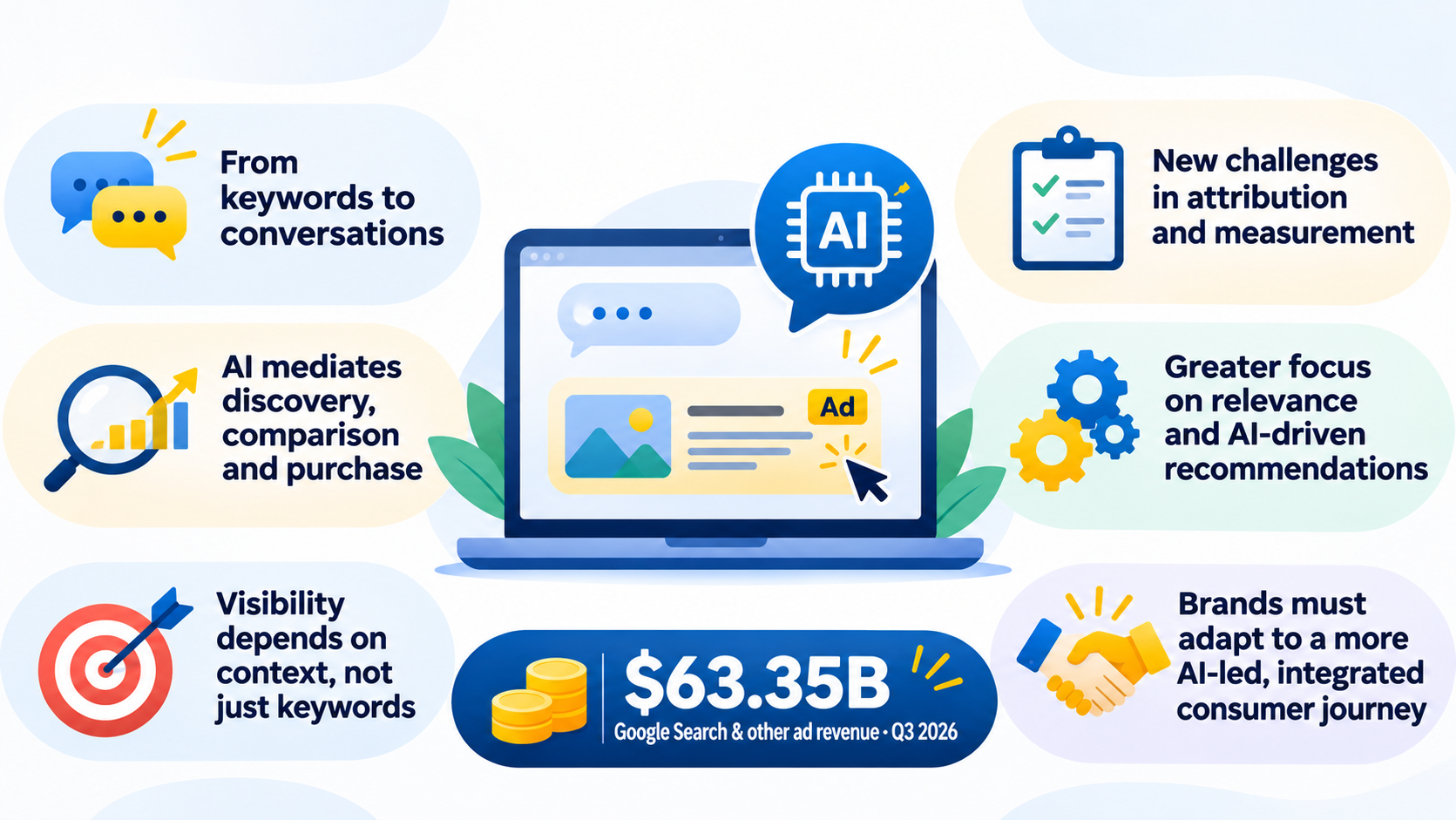
What does it mean for advertisers?
For advertisers, the implications extend well beyond Google's homepage redesign. Traditional search advertising was built around a relatively straightforward transaction: consumers expressed their intent through keywords, and brands paid to appear at precisely those moments.
AI-mediated discovery changes that equation. A consumer might begin by asking for holiday recommendations, move into comparing hotels and eventually make a booking, all within the same conversation, without ever conducting a conventional commercial search. Advertisers must now compete for visibility within AI-generated recommendations, comparisons and increasingly transactional experiences, where relevance depends on context rather than keywords alone.
This raises uncomfortable questions about attribution, measurement and even the distinction between paid advertising and organic discovery. As platforms increasingly interpret and influence consumer intent rather than simply respond to it, the industry's familiar search advertising model risks becoming something quite different.
The question is no longer simply where a brand ranks, but whether the AI considers it worth recommending in the first place.
The most profitable question in the world
Search advertising was, and remains, one of the great commercial inventions of the internet age.
Consider the elegance of the arrangement. A consumer looking for a refrigerator tells Google they want a refrigerator. Advertisers selling refrigerators compete for the privilege of being noticed.
Unlike television, where an advertisement for a refrigerator might interrupt someone watching cricket, search advertising reaches consumers when they have already expressed an interest in buying one.
That distinction helped turn Google into an advertising powerhouse.
In the third quarter of 2026, Alphabet reported $63.35 billion in revenues from Google Search and other advertising, an increase of 12% year-on-year.
That's approximately $690 million a day, although Google would presumably prefer that we didn't divide its quarterly revenues quite so casually.
More importantly, the company reported its strongest year-on-year growth in search queries in five years. Hardly evidence of an industry dying.
Except that Google's latest redesign raises a question that advertisers may eventually find difficult to avoid.
What happens when people stop telling Google precisely what they want, and instead ask it to figure that out for them?
From keywords to conversations
Imagine planning a holiday.
Previously, the process might involve searching for flights, comparing hotels, examining restaurant recommendations, checking the weather and discovering that the supposedly affordable accommodation is located approximately three geological epochs from the nearest public transport.
Each search represents an opportunity for an advertiser.
A hotel might bid against a competitor. An airline might promote a fare. A travel insurance provider might appear somewhere along the way.
But conversational AI changes the experience.
Instead of conducting half a dozen searches, the consumer can tell an AI assistant where they want to go, how much they're prepared to spend, what they enjoy doing and what they would rather avoid.
The AI can compare options, refine recommendations, remember the conversation and potentially help complete the purchase.
The consumer's intent has not disappeared. If anything, the AI may understand it more comprehensively than a traditional search engine could.
But the individual search queries that advertisers have spent decades learning to monetise become less important.
The advertising opportunity shifts from responding to isolated expressions of intent towards understanding a developing conversation.
And this is where things become particularly interesting. Because Google is already selling advertising within that conversation.
(Sidebar: as someone on holiday at present, I can confirm that conversational AI in general is often, objectively, a moron, which will give great itineraries and leave out flood warnings.)
The answer is sponsored. Sometimes.
On October 28, Google announced that advertisements in AI Mode were expanding to ten markets, including India.
It also introduced multiturn advertisements in the United States, allowing ads to appear as consumers ask follow-up questions.
According to Google, AI Mode queries are, on average, three times longer than traditional searches.
More revealingly, Google's advertising documentation explains that advertisements can be matched not only to the original search query, but also to the context of the AI-generated response.
Consider someone asking why the water in their swimming pool has turned green.
A conventional search engine might return articles explaining algae, chlorine levels and maintenance procedures. An advertiser could bid against relevant keywords.
An AI assistant can explain the problem, suggest possible remedies and, when appropriate, display sponsored products relevant to those recommendations.
The consumer wasn't necessarily shopping when the conversation began.
By the time it developed, however, there was something to sell.
There is an important distinction here. Google maintains that paid placements do not influence the organic answers its AI generates. Sponsored recommendations are labelled, and advertisers cannot simply purchase a place in an AI's supposedly independent response.
Nevertheless, the commercial opportunity is changing.
The advertiser is no longer necessarily waiting for the consumer to formulate a purchase-related query. The platform can identify commercial relevance as the conversation develops.
Google has also been experimenting with Conversational Discovery ads, Highlighted Answers and AI-powered Shopping formats, while developing ways for consumers to complete purchases without leaving AI-assisted experiences.
Search is gradually becoming discovery, recommendation and commerce within the same interface.
Which raises an awkward question: If that is what search now does, why are we still calling its advertising business search advertising?
A $63 billion identity crisis
There is a delicious irony to Google's predicament.
The company that perfected the economics of selling search advertisements is actively developing an alternative experience that it cannot yet monetise as effectively.
During Alphabet's October earnings call, Chief Business Officer Philipp Schindler acknowledged that the strong growth in AI Mode queries had affected Search revenue growth because monetisation within AI Mode remained lower.
To be clear, this was not the principal reason for the slowdown. Currency movements were the largest factor, alongside changes in advertising expenditure across sectors.
But the admission matters.
Google is encouraging consumers to adopt a new search experience even though that experience currently generates less advertising revenue.
The company believes it can improve monetisation as the product evolves, and it has pointed to encouraging results from advertising experiments.
Perhaps it will.
Google successfully navigated the transition from desktop search to mobile, after all. But this transformation is fundamentally different.
Mobile changed where people searched. AI is changing how they discover information and potentially how they make decisions.
For an advertiser, the distinction is considerable.
The original search advertising model monetised a clearly expressed desire. Conversational AI can participate in forming that desire.
And the company controlling the interface becomes the intermediary between the consumer's question, the information they receive, the products they consider and possibly the transaction itself.
That is rather more influence than deciding which sponsored link occupies the top of a results page.
What exactly are Indian advertisers buying?
India's inclusion in Google's October AI Mode advertising expansion makes the question especially relevant for domestic brands and agencies.
And the practical implications are already somewhat peculiar.
Advertisers do not need to establish separate AI Mode campaigns. Existing eligible Search, Shopping and Performance Max campaigns can automatically participate in AI advertising placements.
They cannot independently target AI Mode or exclude those placements. And performance metrics for AI Overviews and AI Mode are currently included within standard campaign reporting.
In other words, an Indian advertiser could be purchasing visibility inside a conversational AI experience while examining performance through the familiar reporting infrastructure of search advertising.
The consumer experience is changing faster than the media-buying categories used to describe it.
For marketers, this raises questions about measurement, attribution and the value of traditional keyword strategies.
Product feeds, website information, creative assets and conversion data become increasingly important when Google's systems are deciding how commercial messages relate to a conversation.
Meanwhile, for publishers, the implications may be considerably less cheerful.
The consequences are already visible in India. According to Similarweb data, Indian publishers accounted for four of the six steepest year-on-year traffic declines among the world's 50 largest English-language news websites in October 2026. News18 recorded a 58% fall in visits, followed by Hindustan Times at 50%, Indian Express at 42% and India Today at 40%.
Together, these four publications attracted approximately 246 million fewer monthly visits than a year earlier. The declines cannot be attributed solely to AI, with Google's algorithm updates, changing discovery patterns and shifting consumption habits also playing a role. But the commercial problem is unmistakable: Google can increasingly deliver the information without delivering the reader, leaving publishers with fewer opportunities to monetise the content that makes those answers possible.
If Google provides the answer directly, consumers have less reason to visit the websites that helped make the answer possible.
For publishers dependent on search referrals, that is an obvious commercial concern.
For Google, it could mean retaining more of the consumer's attention.
For advertisers, it introduces the possibility that the most valuable position in digital discovery may no longer be on a results page at all.
The search for a business model
Of course, there are reasons to resist declaring conventional search dead.
People will continue looking for specific websites, products, directions and information. Keywords still matter. Advertising auctions haven't disappeared, nor has cost-per-click pricing.
And Google is hardly going to abandon a business generating more than $60 billion every quarter simply because conversational interfaces have become fashionable.
But perhaps the most consequential changes in technology are not the ones that eliminate old behaviours overnight.
They are the ones that make those behaviours gradually less central.
For months, the advertising industry has been discussing AI shopping agents, zero-click discovery, the future of search optimisation and the ownership of the consumer relationship as though they were separate developments.
They are increasingly becoming different parts of the same commercial problem.
Who controls the consumer's journey when the consumer no longer needs to navigate that journey alone?
And how much of the advertising industry, built around capturing attention and responding to expressed intent, survives unchanged when an AI assistant begins interpreting that intent on the consumer's behalf?
Google may well remain the dominant player. It has the infrastructure, distribution, advertiser relationships and financial resources to reinvent the market it created.
But the company appears to have reached an extraordinary conclusion.
The future of its advertising business may depend on teaching consumers to interact with Google in a way that looks progressively less like traditional search.
There is one final irony.
The redesigned homepage reportedly retains the other famous Google button: "I'm Feeling Lucky."
Given what the company is attempting with the business that made it rich, perhaps that is the more appropriate one to keep.
Read more news about Digital Media, Internet Advertising, Marketing News, Television Media, Radio Media
For more updates, be socially connected with us onInstagram, LinkedIn, Twitter, Facebook, YouTube & Google News