Demonstrable value for marketers, not scale, will decide who wins in advertising: PK
Speaking to Nawal Ahuja at e4m Confluence, Prasanth Kumar called for agencies to prioritise quality over quantity, reduce duplication, improve information sharing and manage expectations better
 by
Published: Nov 23, 2026 6:57 PM | 3 min read
 Follow Us
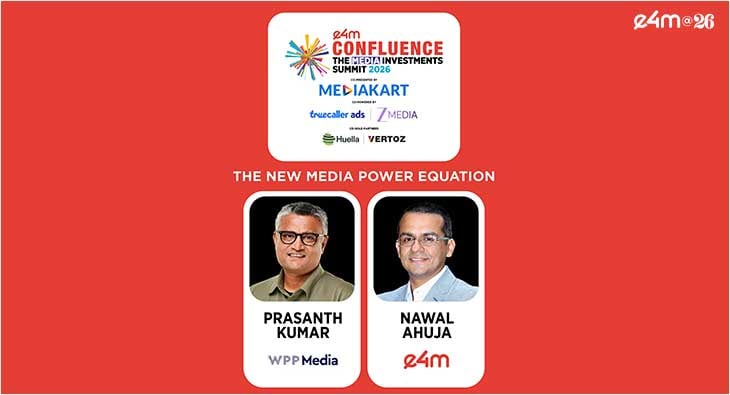

- Prasanth Kumar, CEO of WPP Media South Asia, emphasized that demonstrable value for marketers, rather than sheer scale, will determine success in the evolving Indian advertising market, projected to grow 8.8% this year.
- He noted the significant rise of digital advertising, which has increased its share from 12% to 56% over the past decade, and suggested that the landscape will become more complex as consumer choices expand.
- Kumar highlighted the importance of accountability in measurement across the advertising ecosystem and called for neutral validation to ensure effective spending of clients' resources.
- He discussed the potential of AI in marketing, advocating for a focus on progress rather than perfection, and outlined five key areas of commerce, stressing the need for brands to assess whether commerce efforts yield incremental growth.
Who captures the growth in Indian advertising has no tidy answer, and that, according to Prasanth Kumar, CEO, South Asia, WPP Media, is precisely the point. In a fireside chat with exchange4media Co-Founder Nawal Ahuja at e4m Confluence: The Media Investments Summit 2026, Kumar argued that demonstrable value for marketers, not sheer scale, will decide who wins.
Ahuja set the context: a market of roughly ₹2 lakh crore, growing 8.8% this year by WPP's estimate, with digital's share of ad spend rising from 12% to 56% over the past decade. Kumar expected the picture to grow more complex before it settles, as consumers gain choices in both products and media. "I don't think the question is about who is winning," he said. "Any activity that shows value for the marketer will start winning." He foresaw "collective progress" rather than victory for one or two entities.
On brands' dependence on a few platforms, Kumar said he did not believe platforms had taken anything from brands, pointing to clean rooms as one way data can now be protected. A brand's task, he said, is to grow its business by winning in the right cohorts, markets and subcategories. Platforms, in turn, have a duty of their own: "You are not here only to monetise consumers; you are also here to build your own brands and your own business."
Measurement drew his most candid remarks. "Our journey on measurement has not moved by leaps," he admitted, adding that the whole ecosystem, from advertisers to agencies to publishers, shares responsibility. "If the maker and the checker are the same person, we have an issue," he said, calling for neutral validation while urging every platform, digital or traditional, to be accountable for how clients' money is spent. With 2030 and 2035 in view, he said, "It is high time" the key pillars of the ecosystem addressed it. He also cautioned that sales outcomes are only part of the picture, and that brand-health metrics matter for sustaining equity.
On data, Kumar said brands are scaling their efforts in both depth and width, cleaning up first-party data and combining it with second- and third-party sources. The Digital Personal Data Protection Act, he said, is an opportunity, and the real test lies beyond the top 300 clients. "The day every advertiser can see the significance of brand safety and viewability is the day we can call this a sophisticated and confident ecosystem."
On AI, he urged realism. "I don't know how much we have to chase perfection in this space. In my view, we should chase progress," he said. AI today offers choices and scenarios faster, but "the decision of how I want to win in my category is still with me", meaning the marketing team. For agencies, he said the "second audience", the algorithm, opens up new utility across targeting, creative and engagement, and the metrics will change just as run rates did when T20 followed ODIs.
Commerce, which Ahuja said is projected to grow 29%, was the other big theme. Kumar described five legs of commerce: e-commerce, marketplaces, D2C, the creator ecosystem and content-to-commerce. With about 300 million online users, he said, it will not reach full penetration, and its current pressure is on hypermarkets and supermarkets rather than kiranas. For brands, the test is whether commerce delivers incremental growth or "is just channel evolution".
Asked what the agency world should upgrade, Kumar pointed to quality over quantity, less duplicative work, better information handover and tighter expectation management, along with risks taken "in a very assessed manner". And what keeps him going after more than two decades in the group? "If you don't have a problem, you get bored," he said. Winning clients is "great oxygen and adrenaline", he added; losing them "is just not amazing".
Read more news about Marketing News, Advertising News, PR and Corporate Communication News, Digital News, People Movement News
For more updates, be socially connected with us onInstagram, LinkedIn, Twitter, Facebook, YouTube & Google News