Media agencies must speak the language of CEOs, not just CMOs: Dentsu's Harsha Razdan
At e4m Confluence, Razdan said agencies need to develop a deeper understanding of client businesses, strengthen technology capabilities & bring more talent to earn a place in boardroom conversations
 by
Published: Nov 23, 2026 3:03 PM | 7 min read
 Follow Us
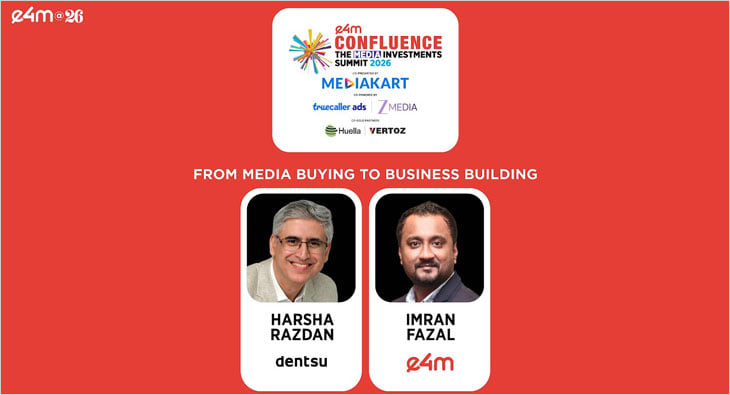

Media agencies will have to move beyond traditional media planning and buying to become business consulting partners for brands, with a sharper focus on growth, profitability and business outcomes, said Harsha Razdan, Chief Executive Officer – South Asia, dentsu.
Speaking during a fireside chat titled ‘From Media Buying to Business Building’ at e4m Confluence 2026, Razdan said the evolving expectations of chief executive officers (CEOs) and chief financial officers (CFOs) are fundamentally changing the role of media agencies and chief marketing officers (CMOs).
He argued that agencies can no longer measure their contribution through metrics defined by clients or limit conversations to media reach, campaign delivery and cost efficiencies. Instead, they must understand the business challenges confronting their clients and demonstrate how their services contribute to revenue growth and profitability.
"Eventually, media or creative agencies are consulting. They are selling nothing but consulting services," Razdan said, explaining why he views the marketing and advertising business increasingly through the lens of technology-led consulting.
According to him, the pressure on CMOs to demonstrate accountability has increased as CEOs and CFOs demand greater justification for every rupee spent on marketing. While CFOs continue to retain their influence over business decisions, CMOs need to evolve their capabilities to become more accountable for business outcomes.
Razdan observed that while some CMOs have adapted to the changing environment and are increasingly involved in strategic discussions, others continue to operate within traditional marketing functions.
He rated CFOs at seven or eight on a scale of 10 in terms of their current influence, while placing most CMOs at around five, adding that some evolved CMOs have moved to eight or nine.
Agencies need to understand the CEO's agenda
Razdan said his interactions with client CEOs have reinforced that their primary priorities remain growth, profitability and better cash turns.
However, these priorities are not always translated effectively into marketing objectives or communicated to media agencies. This disconnect often results in agencies focusing on simpler deliverables rather than addressing the larger business challenges.
"The bigger thing is, are you adding value at the right level as a services company? Are you just evaluating yourself by metrics which have been defined by the client, or are you adding to the client's growth or profitability?" he asked.
He said agencies need to develop the ability to engage directly with the senior-most leadership of client organisations rather than restricting their relationships to marketing teams.
"If you are not able to have a discussion across the table, then you are fooling yourself and the industry is getting commoditised," Razdan said.
He added that agencies would need to upgrade their talent and business understanding to participate in conversations around the client's overall business priorities.
The shift is also changing the way brands evaluate agency partnerships. Razdan said the growing trend of CEOs directly engaging with consulting and agency leaders before formalising partnerships is not entirely new, having been prevalent in the consulting industry for years.
In India, he believes the approach could gain traction because a significant part of the corporate sector, particularly outside fast-moving consumer durables, remains promoter-led and relationship-driven.
While procurement processes will continue to play a role, he said clients are increasingly looking for partners they trust to deliver value rather than simply selecting agencies based on the lowest commercial proposal.
CFOs are demanding greater accountability from marketing
The increasing involvement of CFOs in marketing decisions is also influencing the duration and nature of agency pitches, according to Razdan.
He said that in the past, marketing leaders often kept finance teams at a distance, expecting them to focus primarily on approving expenditure. That dynamic has changed, with CFOs now asking marketing teams to demonstrate what they have delivered against the money spent.
"The current world is about can you connect to delivering more growth, better cost, or better tax returns, as any CEO says. If you can't deliver to that, automatically it goes to the CFO," he said.
Razdan added that companies are increasingly turning to consulting firms to evaluate agency capabilities and marketing investments because they want an independent assessment of the value being delivered.
He said agencies should respond by bringing business-oriented professionals into pitches instead of relying exclusively on media and creative specialists.
The objective, he explained, should be to demonstrate a broader understanding of the client's business and establish credibility with both consulting firms and senior management.
India-specific technology will be critical
On the role of artificial intelligence and technology in transforming media services, Razdan said dentsu follows a dual approach in India: adapting global technology solutions to local requirements while developing India-specific solutions that can eventually be deployed in international markets.
He cited dentsu.Connect as an example, explaining that the global solution required customisation to address the complexities of the Indian market.
According to Razdan, regulatory requirements, data privacy considerations and data localisation requirements, particularly in sectors such as financial services, make it difficult to deploy global technology solutions without modifications.
"We cannot do without India-based innovation or India-based technology being generated in today's world," he said.
He added that some of dentsu's technology solutions, including those related to performance, audience intelligence and product intelligence, have been developed in India and are also being deployed outside the country.
Razdan attributed this opportunity to India's complexity, characterised by multiple languages, diverse markets, different consumer behaviours and high price sensitivity.
"If you get something working in India, it's almost like getting it to work across multiple countries in Europe or some other parts of the world," he said.
He also pointed to dentsu's Global Services Centres in Bengaluru and Mumbai, where technology development is taking place, describing India as an important base for building solutions that can be scaled globally.
Thinking, technology and talent will define future agencies
Looking five years ahead, Razdan identified three essential ingredients for building the media agency of the future: thinking, technology and talent.
The first, he said, is a client-centric approach in which agencies begin with the client's business problem rather than the services they want to sell.
This could even mean advising clients against spending money immediately and recommending that investments be redirected or deployed at a later stage if that better serves the business objective.
The second ingredient is an interoperable technology ecosystem that can integrate internal platforms with solutions developed by external technology partners and clients.
The third is talent diversification. Razdan said agencies would need to recruit professionals from sectors such as FMCG and banking to bring stronger commercial and business understanding into client conversations.
"If we have the same people doing the same work, we'll get the same result," he said, adding that agencies must become more open to bringing different skill sets into their organisations.
He also emphasised the importance of regularly refreshing talent and creating opportunities for younger professionals rather than allowing employees to remain in the same roles and client assignments for extended periods.
Media, technology and consulting will converge
In a concluding discussion on the future of Indian media services, Razdan identified the convergence of technology, marketing and consulting as one of the biggest shifts likely to reshape the industry.
With consulting firms expanding into media and marketing companies strengthening their technology capabilities, he expects traditional boundaries between these businesses to become increasingly blurred.
He also highlighted the need for agencies to become less insular and more receptive to external talent and expertise.
According to Razdan, agencies should recognise that they may not always have the right answers internally and should be willing to bring different specialists together to solve client problems.
On the question of whether media agencies have earned a place in the boardroom, Razdan offered a more measured assessment, saying the industry still has considerable ground to cover.
"We think we have a boardroom seat. But I don't think it's that important a boardroom seat," he said, arguing that agencies first need to strengthen their capabilities, bring in new talent and demonstrate their relevance to business leadership.
He added that the industry should acknowledge that it does not yet have all the answers and must continuously upgrade itself to remain relevant.
Read more news about Marketing News, Advertising News, PR and Corporate Communication News, Digital News, People Movement News
For more updates, be socially connected with us onInstagram, LinkedIn, Twitter, Facebook, YouTube & Google News