‘Fragmentation is permanent; agencies, creative and partnerships are the answer’
Leaders from Madison World, WPP Media, LS Digital and Huella spoke at e4m Confluence on scattered attention, data, creative and partnerships, and more
 by
Published: Nov 24, 2026 1:58 PM | 4 min read
 Follow Us
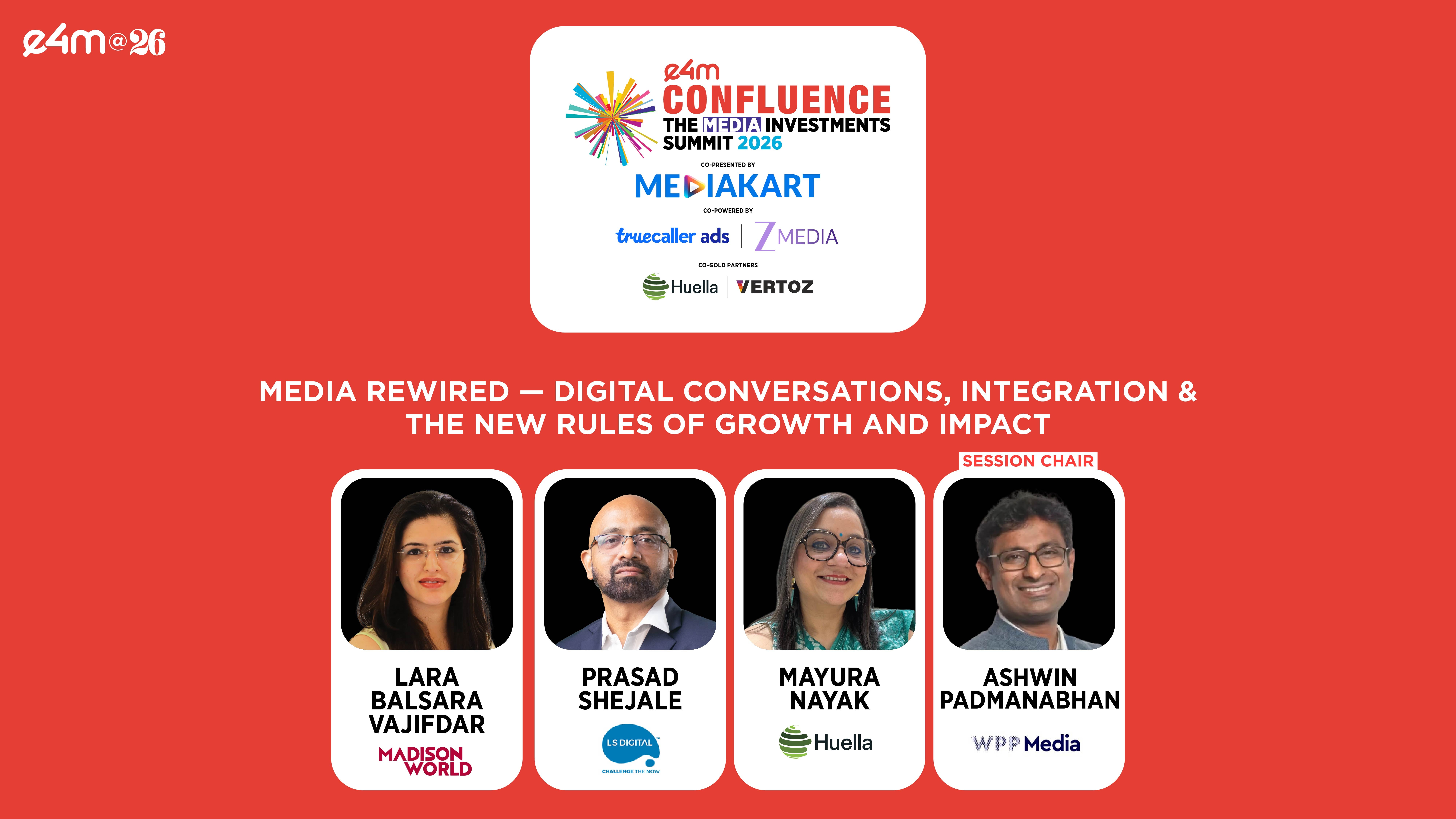

- The panel at e4m Confluence: The Media Investments Summit 2026 discussed managing scattered attention in media, emphasizing that it is a condition to be managed rather than a problem to be solved.
- Panelists highlighted the importance of integrating AI into workflows, with a focus on listening to consumer conversations and linking data across teams to drive growth.
- The role of agencies was underscored as crucial in navigating the complexities of digital advertising, with a call for agencies to act as trusted growth advisors amidst increasing fragmentation in media.
- The discussion also emphasized the need for collaboration among brands, agencies, and technology partners to enhance consumer experiences and adapt creative strategies effectively across various platforms.
Scattered attention is a condition to be managed, not a problem to be solved. That was the shared view of the panel at e4m Confluence: The Media Investments Summit 2026. The session, "Media Rewired: Digital Conversations, Integration and the New Rules of Growth and Impact", was chaired by Ashwin Padmanabhan, COO, South Asia, WPP Media. The panellists were Lara Balsara Vajifdar, Executive Director, Madison World; Prasad Shejale, Founder and CEO, LS Digital; and Mayura Nayak, Co-Founder and CRO, Huella.
Padmanabhan opened by calling this one of the most difficult times to plan and reach audiences meaningfully. It is also, he said, "the best time to be an agency", because every brand needs an advisor to navigate the noise.
Vajifdar offered a different reading of fragmentation. "The audience is not really fragmented," she said. "We are still all after the same family who used to gather around a television screen. It's just that now different people in the home have different screens." AI, she said, is doing the heavy lifting of listening to millions of social conversations, which she called "free research", while human intelligence must turn it into consumer insight. She cited a recent client example in which social buzz around Saif Ali Khan came first and the brand then appointed him as its ambassador. "You don't always follow a linear approach," she said.
Shejale reframed the challenge. "It's not about fragmentation. It's about how you manage the fragmentation," he said. The first requirement is a brand's ability to stitch its scattered data together, before AI even enters the picture. The second is where AI sits. "AI has to be part of the workflow, not on top of it. I generally don't say human in the loop. I say AI in the loop." Has the industry cracked it? "I don't think so. There are miles and miles to go."
Asked how brands can turn conversations into growth at scale, Shejale offered a three-part playbook: listen, link and prove. Listening is the easy part, he said, as tools are widely available. Linking is harder, because influencer, analytics and creative teams often work in silos, on both the agency and client sides. Proving is hardest. "Ultimately, the CFO is the one who will ask whether you are doing this right," he said. He described work for a commerce company selling health products, where influencer impressions were being tied to movement on the D2C side through models that are "not deterministic, but probabilistic".
Nayak, the only ad tech voice on the panel, argued that the industry's narrative should move from the media mix to the creative. "We call ourselves a creative ad tech company," she said, "with a very purposeful intent." Fragmentation is real and will continue, she said, but "how you make that media relevant depends on the creative you use". AI, in her view, brings media intelligence as well as automation, helping identify which format works for which cohort. Integration, she added, does not come from running the same creative everywhere. "It comes when you look at every format and its relevance, and adapt it in its own way."
On the role of agencies, Vajifdar admitted she might be biased, but said "the role of agencies is even more important today than it ever was". With digital now almost 60% of advertising, and each platform bringing its own audience and metrics, clients need "an independent, third-party, objective view". She added: "It's every platform's job to make the advertiser believe that they only need their platform." Human judgment matters more as data and jargon multiply, she said, noting that cross-platform measurement has barely moved and that even basic TV ratings are in question. Clients should see agencies as "their trusted growth advisor".
Nayak pointed out that fragmentation is also happening on the supply side, with technology partners entering the ecosystem to claim a share of ad budgets. She called for a "tri-party partnership" of brand, agency and a media or technology partner. Shejale added that both intelligence and AI usage are being democratised, with falling token prices putting tools in everyone's hands. "A few years down the line, we're not going to talk about AI," he said. The agencies that understand customers and marketing, he argued, "will flourish".
On stitching together consumer experiences, Vajifdar said brands must "break all those silos" and focus on the end consumer, with the advertiser driving it by calling all partners to a joint briefing. Shejale said experience now carries more weight because price and selection have been squeezed for everyone, and that no single agency can deliver it alone. It takes tools and partners.
Closing with dream projects, Shejale asked for "the most complex client with data all over the place", Nayak wanted a seat in the room with influencers when campaigns are first conceptualised, and Vajifdar wanted a simple consumer insight carried through creative and media to measured results. Padmanabhan summed it up as insight, creative idea, media deployment and business outcome.
Read more news about Marketing News, Advertising News, PR and Corporate Communication News, Digital News, People Movement News
For more updates, be socially connected with us onInstagram, LinkedIn, Twitter, Facebook, YouTube & Google News