Breaking the silos: How integration is reshaping brand marketing
As brands look beyond fragmented media metrics and isolated creative interventions, Publicis Media's Lalatendu Das argues that integration must go beyond bringing specialists under one roof
 by
Published: Nov 24, 2026 3:01 PM | 7 min read
 Follow Us
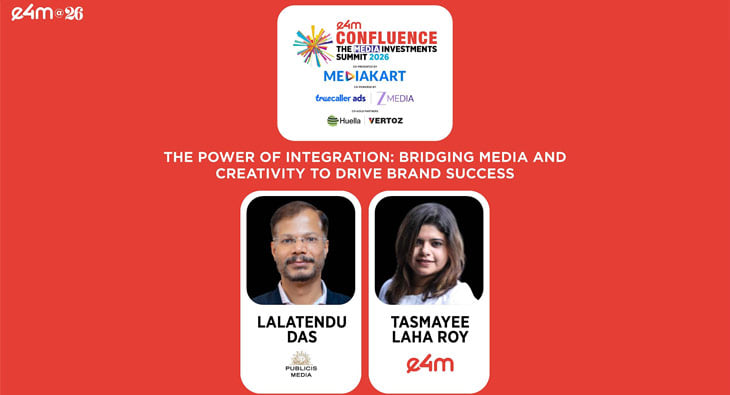

- Lalatendu Das, CEO of Publicis Media South Asia, emphasized the importance of integration in advertising at the e4m Confluence: Media Investments Summit 2026, arguing that it should connect intelligence, creativity, and media towards common business objectives rather than merely combining different agency functions.
- He highlighted the need for a unified source of insights and shared KPIs to ensure that all teams work towards the same goals, citing successful campaigns like Cathay Pacific's "Takeoff Takeover" as examples of effective collaboration across creative, data, and media teams.
- Das noted the shift towards influencer-led affiliate marketing in retail, suggesting that brands leverage micro and nano influencers for better sales outcomes, while also acknowledging the complexities AI introduces into the integration process, despite its potential to enhance efficiency.
- He concluded that while specialization in advertising remains vital, the key to successful integration lies in creating a shared intelligence layer that facilitates communication and collaboration among different teams, ultimately aligning efforts to solve business challenges.
At e4m Confluence: The Media Investments Summit 2026, Lalatendu Das, Chief Executive Officer, Publicis Media, South Asia, addressed the topic ‘The Power of Integration: Bridging Media and Creativity to Drive Brand Success’ in a keynote session chaired by Tasmayee Laha Roy, Editor, exchange4media.
Integration has become one of advertising's most frequently used industry terms, often appearing alongside conversations around AI, data and evolving media capabilities. But for Das, the concept goes considerably beyond bringing different agency functions together.
With brands increasingly seeking measurable business outcomes from their marketing investments, Das believes the real opportunity lies in connecting intelligence, creativity and media through a common understanding of what a brand wants to achieve.
"Integration is not just getting people from different skill sets in one room. That's the starting position, necessary but not sufficient," he said.
For Das, meaningful integration rests on two pillars: integration of intelligence and integration of outcomes. While different teams may bring specialised expertise to a campaign, the absence of a common data source can prevent them from working towards the same objective.
"There is a separate insights team who will tell you we are growing X percent in Maharashtra versus the team who is doing creative. They have no idea that I'm going to target this market," he said.
He believes agencies need to establish a single source of truth for insights, alongside a unified business KPI that connects media and creative teams to the same outcome, rather than measuring their contributions independently.
Integration is not the same as consolidation
Das does not see integration as a case for eliminating specialisation or necessarily bringing every capability under one roof. Instead, he believes specialists must retain their expertise while working with a common understanding of the brand's business objectives.
He cited Publicis Media's Cathay Pacific campaign, Takeoff Takeover, as an example of how creative, data and media can work together.
The campaign was built around the airline's product advantages, including legroom and in-flight entertainment. Rather than simply communicating these features through conventional advertising, the teams explored contextual opportunities at airports, targeting travellers considering competing airlines.
Media identified the relevant airport touchpoints, while data analytics helped establish where and when competitor airline passengers could be reached. Creative then translated those insights into contextual messaging.
Das believes the campaign demonstrated what becomes possible when the brief is shared across functions rather than divided into separate media, creative and data assignments.
"Even if you may have specialization, I'm a strong believer that people really need to specialize but the key here is if you can have a clear unified KPI which is business outcome and a standardized source for truth so that everybody kind of builds up on that," he said.
Neither media budgets nor creative should work in isolation
The relationship between media investments and creative direction remains another challenge for integrated marketing. Das believes neither should dictate the other's decisions.
"I don't want the media budget to influence creativity because frankly at the end of the day the creative input to any brand kind of goes a long way. At the same time I don't want even the creative input to determine how much working media left so that I know I don't even reach the right audience," he said.
Instead, he believes the starting point should be the brand objective and the metrics against which success is measured. He pointed to the importance of media sufficiency, arguing that even the strongest creative idea can fail if it does not reach enough of the intended audience.
"You may have the greatest creativity if people are not seeing it so wasted money right," he said.
For Das, the balance comes from developing the creative and media approach together, with both working towards the same business outcome.
Performance marketing moves towards influencer-led commerce
Another shift Das is observing is the movement of some retail performance budgets towards influencer-led affiliate campaigns. He explained that large retail platforms traditionally invested in app download and engagement campaigns, including Google UAC campaigns. However, platforms with access to sales data can increasingly explore affiliate partnerships with micro and nano influencers.
Unlike larger influencers who typically command upfront payments, these arrangements can be structured around actual sales generated through individual creators. "Instead of spending money on UAC, if you have data of what actually got sold through your platform, the affiliate campaigns based on a large set of micro nano influencers works better," he said.
However, Das stressed that the approach depends on the ability to complete the measurement loop and identify which creator or code actually resulted in a sale.
AI can accelerate intelligence, but adds complexity
While AI is increasingly being adopted across agency functions, Das believes it is also adding complexity to the integration process. Its value, however, lies in helping teams process information and act on it faster.
One application he highlighted was the use of synthetic personas for creative testing. Drawing on first-party data, brands can develop representations of different consumer groups, including trialists and repeat purchasers, to obtain early feedback on creative concepts.
Traditionally, brands would rely on research agencies to assess whether a creative idea was likely to work. Synthetic personas can help accelerate the initial process, although Das cautioned against treating them as a replacement for real audience testing.
"You may still have to go and test your creativity with real audiences. But what AI is giving you is, can I iterate faster? Get some early insights," he said.
He also sees opportunities in using AI to analyse markets at a more granular level. For large pan-India brands, breaking down performance beyond state-level averages into smaller markets can be a cumbersome exercise. AI, he believes, can make such analysis more manageable and scalable.
Integration must be built around the business problem
Das also cited the Eno Game On campaign to demonstrate how integrated thinking can address marketing challenges beyond conventional media buying. With the challenge of building a presence around the IPL without purchasing IPL advertising inventory, the teams explored cultural conversations around watching cricket and eating food.
The campaign brought together influencers, creative and media, while Samsung ACR data helped identify households watching the stream and enabled subsequent retargeting.
According to Das, the campaign delivered a 23% search lit during the campaign period. He believes such outcomes become difficult when brands divide their requirements into separate briefs for creative, media and influencers. "I think that is what is stopping the industry to bring the best," he said.
Interestingly, Das believes integration is already a natural starting point for many startups, which tend to approach agencies with a straightforward business objective rather than separate functional requirements.
The challenge becomes more pronounced with larger organisations, where media, brand, insights and creative teams often operate independently.
Specialisation will stay, but shared intelligence is the missing link
Despite the growing emphasis on integration, Das does not believe specialisation is losing relevance. "I don't think integration is an antithesis of specialization. Specialization, I think is here to stay and it will become more prominent as we get into more technology in our space, our industry, in advertising," he said.
What needs to change, according to him, is how specialists exchange information and translate it into action.
For instance, if quick-commerce sales decline in a particular market, that information should reach the brand team quickly enough to trigger a response. Similarly, if a creative asset is underperforming on Meta, the performance insights should feed back into the creative process.
"Create a shared intelligence layer where all this data gets fed in so that the right expert says, okay, here is a problem. Let me fix it," he said.
Ultimately, Das believes integration is as much an organisational challenge for brands as it is an agency capability. While agencies can bring specialists together, brands must also rethink how they structure briefs, share data and define success.
The real measure of integration, therefore, is not how many capabilities an agency houses, but how effectively those capabilities work together to solve a business problem.
Read more news about Marketing News, Advertising News, PR and Corporate Communication News, Digital News, People Movement News
For more updates, be socially connected with us onInstagram, LinkedIn, Twitter, Facebook, YouTube & Google News