CTV meets entertainment - targeted, measurable, unmissable
At the e4m Connected TV Conference, industry leaders explored how streaming platforms are transforming entertainment consumption, techcapabilities, targeting precision & emerging opportunities
 by
by
Published: Jun 17, 2025 12:25 PM | 6 min read
 Follow Us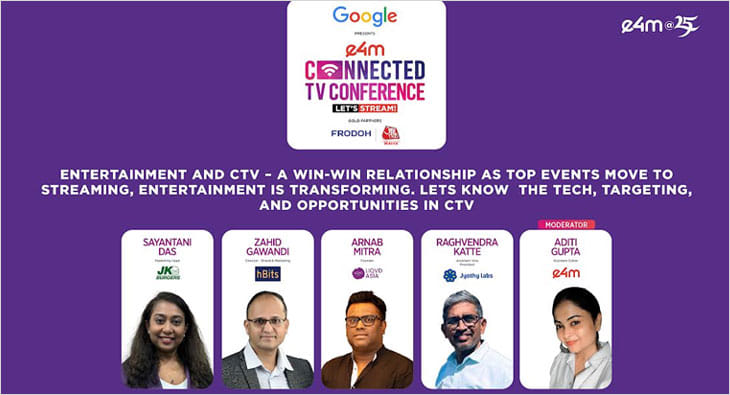

A panel of industry leaders at the e4m Connected TV Conference delved into the evolving relationship between entertainment and Connected TV (CTV). The discussion focused on how streaming platforms are reshaping traditional television consumption patterns and creating new opportunities for targeted advertising.
The panellists included Sayantani Das, Marketing Head at Jumboking; Zahid Gawandi, Director of Brand & Marketing at hBits; Arnab Mitra, Founder of Liqvd Asia; and Raghvendra Katte, Assistant Vice President at Jyothy Laboratories Ltd. The session was moderated by Aditi Gupta, Assistant Editor at e4m.
The discussion began with Katte outlining the fundamental shift from traditional television to connected platforms. "TV means FMCG, FMCG means TV, depending on which spectrum you are seeing. I'll tell you from my Indian context, 33 crores of households, of which 100 crores are paid and another 40 crores are connected, another 30 crores are free dish," he explained.
He highlighted the transition challenges, noting, "If you come from television to connected TV, actually, we have lost the measurement. If you go from digital to measurement, then we said that we could have done sharp targeting, now we can do device targeting. So it's a kind of a trip for FMCG. It solved our issue of premiumisation."
Mitra shared his perspective on the evolution of advertising formats over his career span. “Ads keep on changing their format. In the last 20, 22 years that I have been associated with the industry, I have seen that it has kept on changing from print to TV to digital and from digital to now the fragments of digital," he said.
He emphasised the shift in measurement priorities, adding, "What is extremely important is seeing how the metrics have shifted from viewability to engagement, finally. And I think CTV is a fantastic platform where visibility and engagement somehow come together."
Gawandi discussed the targeting advantages of CTV compared to traditional television. "If you look at the earlier traditional television, advertisers used to spray and pray. But CTV is allowing us to be more targeted towards the audience," he observed.
He further explained the medium's unique positioning, stating, "It's a confluence of entertainment and appointment TV. This means that there are live big-ticket events (like IPL) and shows which are specifically designed and are premiered on OTTs. All that is catching attention, and the best part is we know who our audience is, who is viewing what, therefore we should be there."
Das provided insights from the food brand perspective, revealing strategic preferences for CTV allocation. "For any brand, especially food brands, the preference is always CTV over traditional media and maintaining a 60-40 split in favour of CTV over other platforms, especially during live events like IPL," she said.
She elaborated on the strategic timing considerations, noting, "Another important thing is the slots when you are placing the ads. For example, during IPL, the second innings of the match is more crucial because the engagement of the viewers is very high and also the campaign that you are using. So during IPL or any live events, the campaign features mostly the cricket stars or Bollywood celebrities, tapping into their fan loyalty and regional pride."
When the discussion turned to the targeting capabilities of CTV, Katte raised important questions about precision.
"Is it really precise targeting? Earlier, TV audiences were classified by ownership, TVs, refrigerators, etc., under NCCS. Now, with devices, we don’t know exactly who’s watching," he explained.
"We can do device-level targeting, say, Samsung TV vs another brand, but there's no control over what's delivered on each device. You’d need deals with platforms like Netflix or Hotstar. Aggregators offer combined measurement, but that too depends on commercial terms, and they can pull out."
"So, precision targeting remains a myth in some ways. We need better measurement science."
Gawandi offered a more optimistic view of CTV's targeting capabilities. "CTV helps us reach the right audience. Earlier we used to do performance marketing campaigns on digital platforms, but this is a new medium right now which we are trying," he said.
He highlighted the storytelling advantage, explaining, "But what works here is basically how do we merge storytelling with data. So it's a little better than what used to be earlier because right now it gives us targeting capabilities."
However, he acknowledged existing limitations, noting, "It has a lot of gaps still of attribution. But definitely we know who is our audience and we know whom we are targeting and therefore we are leveraging that right now and we are spending less advertising money compared to normal television ads."
The panel also addressed the potential for commerce via entertainment on CTV platforms. When asked about conversion opportunities, Mitra provided a candid assessment. "The long and short answer is no, not yet. And I'm just giving it India-specific because that's largely what the audience is here. We haven't really been able to move the interaction needle to conversion as yet here," he stated.
Despite this, he outlined the potential for future development, explaining, "Having said that, as an advertising agency, we are privy to opportunities where various brands have different kinds of requirements. So we have done campaigns where some simple actions like QR codes or SMS have been added.”
Mitra remained optimistic about the future of CTV, particularly its data potential. “I think the possibilities are huge, because what we’re seeing with CTV is something we’ve never had before, where the OEM is ready to provide a layer of platform data right down to the device level. Plus, you also have your own first-party data. So there’s definitely scope for meaningful data mining,” he said.
He concluded by reflecting on the industry's progress toward full-funnel visibility. “What we want is 100% trackability — from the moment an ad goes live to the final purchase. That complete funnel still isn’t fully connected, but I think we’re getting very close.”
Das highlighted one of the major challenges in CTV adoption i.e. the inconsistency in measuring return on investment. “When we are talking about CTV, the challenge aspect is very, very important. Right now, measuring ROI is a real issue because we don’t get the same kind of reports from all CTV platforms,” she explained.
She illustrated the problem with a specific example. “If you’re running ads on IPL across different platforms, one might give you a detailed analysis, QR code conversions, video completion rates, and so on. Another might just provide an impression count. So, it becomes very difficult to measure an entire campaign holistically as a brand.”
Despite these hurdles, she remained hopeful about the future of measurement on CTV:
“We have to depend on third-party measurement standards for now. But with the evolution of infrastructure and interactivity, I believe we’ll start seeing more ROI-driven campaigns in the future.”
Read more news about Marketing News, Advertising News, PR and Corporate Communication News, Digital News, People Movement News
For more updates, be socially connected with us onInstagram, LinkedIn, Twitter, Facebook, YouTube & Google News