Building investor trust in a digital-first BFSI world
At the e4m BFSI Summit, leaders, brands and agencies discussed how the sector has been building investor trust through safety-first communication, education, and technology-led engagement
 by
by
Published: Sep 29, 2025 12:48 PM | 5 min read
 Follow Us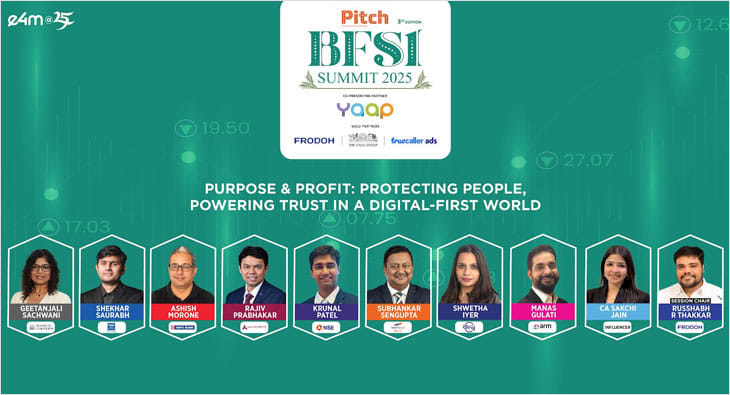

At the e4m BFSI Summit, industry leaders came together to discuss how the sector can safeguard investors and build trust in an increasingly digital ecosystem. The panel titled “Purpose & Profit: Protecting People, Powering Trust in a Digital-First World” was chaired by Russhabh R Thakkar, Founder & CEO, Frodoh, and featured insights from senior marketing and business leaders across the BFSI landscape.
Opening the conversation, Thakkar posed a question on the rising threat of scams and the behavioural changes required for investor protection. Responding, Geetanjali Sachwani, VP & Head – Marketing, Franklin Templeton Asset Management, stressed that safety must go beyond compliance. “In a country with a growing number of investors across mutual funds, banks, insurance and stock markets, putting in security measures and running campaigns is not just compliance, it is the need of the hour,” she said.
She emphasised the importance of simple, relatable content over “flamboyant campaigns with wide reach.” Sachwani explained, “We focus on real content creation for our investor base. For instance, Franklin Templeton Academy runs multiple investor education videos, helping people make informed and safer decisions.”
Targeting women and Gen Z has been a consistent focus. “Women have always been natural savers. They look at safety first, whether it is driving a car or driving their investment strategy,” she said. Bite-sized content, and regular engagement have been central to Franklin Templeton’s approach. “Rather than promoting our products, we make sure that the first piece of communication is about how safe they should be while transacting across any platform,” she added.
Sachwani highlighted that safety messaging is embedded across every touchpoint, from websites and account statements to call centres. “If that trust is not there, our basic hygiene is not in place,” she said, adding that Franklin Templeton continues to invest in webinars and educational campaigns to reinforce this priority.
On connected TV (CTV), she noted its growing importance. “CTV is where our customer is. We already have 50 million users on CTV, and for Gen Z especially, it’s a status symbol. If you are not present there, you’re not relevant,” she said. While emphasising a mixed-media approach, mainline, CTV, influencers and social, she pointed out that strategies must be customised. “If your target audience is senior citizens or Bharat, then you may have to reconsider CTV,” she explained.
Krunal Patel, Head of Marketing and Corporate Communication, NSE, expanded on how scale and trust are the exchange’s biggest strengths. “India has 23 crore investors. Our reach covers 99.85% of pin codes, barring 28 where we can’t do KYC, most of them airports,” he said. One in four investors today are women, he noted, adding that per capita income has grown from ₹11,000 thirty years ago to ₹2.34 lakh today.
Despite relatively low disposable income, Patel underlined that trust in the capital market remains strong. “A brother may not trust his brother to lend money, but people trust companies getting listed anywhere in India and are willing to invest,” he said. NSE’s strong listing record, beating NASDAQ and NYSE with 268 listings last year, was cited as proof of this trust.
For Patel, technology and trust are the two pillars that define NSE. “Our response time is in nanoseconds, faster than leading global platforms. We built this ecosystem 30 years ago, even before the words DPI and FinTech were coined,” he said. This positioning has shaped NSE’s marketing approach. “Our brand archetype is the sage personality. We can’t be too preachy or promotional. Our focus is on education; guided messages about what to do and what not to do.”
He explained that NSE invests in more than 14,000 on-ground investor awareness camps every year, far more than most consumer brands do for product sales. “Our complete media mix drives towards investor protection. That’s how we reach different demographics, identify scams, and use multi-level targeting to build awareness. CTV plays a role, but always as part of a 360-degree approach,” Patel said.
From an agency perspective, Manas Gulati, Co-Founder & CEO, #Arm Worldwide, pointed out that fraud awareness requires collaboration across brands. “Most brands today are coming together to raise awareness of what is right and wrong, and even talk about RBI guidelines,” he said.
He explained that campaigns must be built around personas most vulnerable to scams. “In the financial space, elderly people and kids can be scammed very easily. So we create use cases for each persona. You’re not always saying ‘buy my brand’, but reassuring customers that you are a safe brand,” he said.
Gulati also underlined the role of design and technology in consumer safety. “From two-factor authentication to DigiLocker and KYC, brands have invested significantly in safety. But it needs to be communicated. Customers must know that these efforts exist to reassure them,” he concluded.
Read more news about Marketing News, Advertising News, PR and Corporate Communication News, Digital News, People Movement News
For more updates, be socially connected with us onInstagram, LinkedIn, Twitter, Facebook, YouTube & Google News