'Authenticity is the key factor in every piece of communication'
At the Pitch Brand Talk 2024 summit, experts talk about building and maintaining brand salience and trust among in-market, tech-savvy consumers
 by
by
Published: Oct 16, 2024 3:50 PM | 7 min read
 Follow Us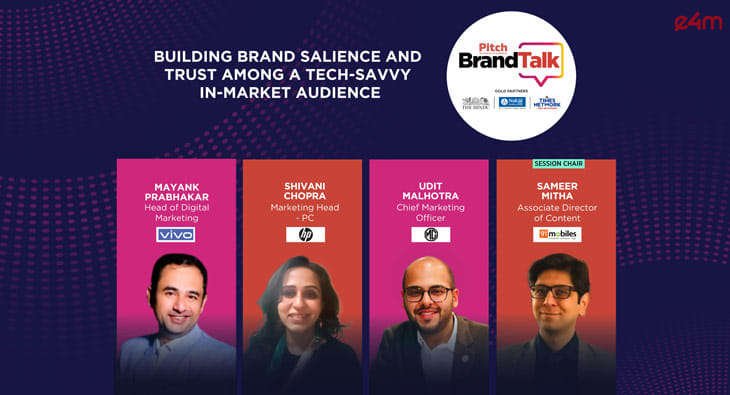

In a world where consumer expectations are rapidly evolving, fuelled by the rise of digital platforms and tech-savvy audiences, brands are under constant pressure to stand out and maintain relevance. At the Pitch Brand Talk 2024 summit, a panel of marketing leaders from the automotive, PC, and smartphone sectors came together to address the core challenge of today’s branding landscape: how to build and maintain brand salience and trust among in-market, tech-savvy consumers. The discussion, chaired by Sameer Mitha, Associate Director of Content at 91mobiles, centered on the importance of authenticity, consistency, and consumer engagement in a time when leaks, misinformation, and rumors have become part of the brand narrative.
Udit Malhotra, Chief Marketing Officer at MG Motors, opened the session with a powerful insight into the nature of trust in the automotive industry. “When you look at the brand tracks, the most important source of awareness is not TV or billboards; it’s word of mouth,” he emphasized. “Your maximum car sales are coming from reference.” In an industry where a car purchase is often the second most aspirational buy after a home, the stakes are high. “Brand trust isn’t built in a day. It takes years to build, seconds to break, and forever to repair,” he continued, highlighting that car buyers are increasingly relying on peer recommendations and real-life experiences rather than traditional advertising channels.
Malhotra also drew attention to how miscommunication and misinformation can severely impact brand perception, especially in the automotive space. “Leaks are part of the plan,” he said. “But miscommunication in those leaks can give you a bad image.” To counteract this, MG Motors focuses on transparency and consumer education. One recent example he shared was their introduction of the “battery as a service” (BAS) model, where customers only pay for the battery during the car’s use rather than as part of the upfront purchase price. “We went to the extent of educating everybody that there is no catch. You can buy a BAS program at zero kilometers, and there is no cap on usage.” This approach, he explained, has been pivotal in building consumer trust in their innovative product offerings.
Shivani Chopra, Marketing Head at HP India, expanded on Malhotra’s points, focusing on the significance of being genuine in all brand communications. “The leading principle, in my opinion, while we are formulating the brand, remains how you are being authentic to the customer in your communication,” she said. “Authenticity is one of the key factors in each and every piece of communication.” For Chopra, authenticity isn’t just a marketing buzzword but a cornerstone of HP’s strategy, especially in a market where consumers are bombarded with information from various sources.
Chopra pointed out how the digital ecosystem has made it easier than ever for brands to lose credibility if they aren’t careful. “Consumers today are much more aware and skeptical,” she noted. “If your product is not delivering, if your staff is not trained, if you’re not authentic in your repair services or customer support, that trust diminishes rapidly.” To avoid this, HP ensures that every touchpoint with the customer is consistent and transparent. “It’s not about an ORM (online reputation management) command center sending you a robotic response. It’s about building functions in after-sales and quick response management that genuinely care for the customer.”
Shivani further elaborated on how HP leverages influencers and content creators to strengthen its brand narrative. “Today, leaks and rumors are inevitable, especially in tech,” she said. “But how you respond to them can make or break your brand image.” She acknowledged that the rise of digital creators has transformed how brands communicate, noting that “new-age creators play a big role” in shaping consumer perceptions. “In automotive and PC segments, these creators are building trust by connecting with audiences on a personal level.”
Adding to the discussion, Mayank Prabhakar, Head of Digital Marketing at Vivo India, emphasized the role of after-sales service in building trust. “For us, it’s about listening and response management,” he said. “Trust takes time. You have to deliver each and every time.” Prabhakar stressed that Vivo’s approach goes beyond just selling products—it’s about creating long-term relationships with customers. “When a customer is stuck on the road or has an issue with our product, how we respond defines whether they’ll stay loyal or move on.”
Prabhakar also shared Vivo’s strategy of empowering real users to build the brand’s credibility. “We have almost 1,000 people who are part of our Quality Leaders (QL) community,” he explained. These individuals are actual customers who use Vivo devices to showcase their real-life experiences, sharing them on social media and other platforms. “These are the people who help build trust by sharing real stories. When a consumer sees someone like them capturing a great image on our camera, they believe it.”
He further added, “Today, brands are no longer just talking about innovation for the sake of it. The consumer will see through that. It’s about demonstrating how the innovation adds value to their lives.” Prabhakar pointed out that innovation in the tech space is often scrutinized, especially by a skeptical audience. “When we launched a new camera feature in our latest smartphone, the first question from the media was, ‘Is this a gimmick?’ That’s where trust comes into play—we educate the consumer that it’s not a gimmick, but a feature that truly delivers DSLR-like quality.”
As the panelists explored the nuances of trust-building, one recurring theme was the importance of consistency in every interaction with the consumer. “It’s like a relationship,” Malhotra remarked. “You do one thing wrong, and the trust breaks. Nobody remembers the hundred things you did well; they remember the one time you didn’t come through.” He stressed that for brands to succeed, especially in high-stakes industries like automotive and technology, there can be no room for misleading claims or half-truths. “The moment you mislead or try to hide behind fine print, you lose the consumer.”
The conversation also touched on the role of new technologies like AI and how they are reshaping brand-consumer interactions. “AI has changed the game,” said Prabhakar. “But it’s also raised consumer expectations. They want more personalized experiences, and if you don’t deliver, you lose their trust.” Chopra echoed this sentiment, adding that while AI and other innovations offer incredible potential, they also require brands to be even more transparent. “If the consumer feels like they’re being tricked or manipulated, they’ll switch off immediately.”
All three panelists agreed that building brand trust is an ongoing, multi-faceted process. It requires a deep understanding of the consumer, a commitment to authenticity, and a willingness to adapt to the rapidly changing digital landscape. “Building trust isn’t a one-time activity,” Chopra concluded. “It’s a continuous process, and it requires brands to be vigilant at every touchpoint, from product development to after-sales service.”
Read more news about Marketing News, Advertising News, PR and Corporate Communication News, Digital News, People Movement News
For more updates, be socially connected with us onInstagram, LinkedIn, Twitter, Facebook, YouTube & Google News