Apparel giants ramp up ad spends up to 44% in FY25; influencer collabs take centerstage
In recent financial reports, market leaders like Aditya Birla Fashion, Arvind Fashions, Shoppers Stop, have mentioned Gen-Z influence, social commerce, digitisation, personalisation & sustainability
 by
by
Published: Sep 12, 2025 9:12 AM | 6 min read
 Follow Us

India’s leading fashion and apparel companies collectively raised their advertising spends in FY25, underscoring how marketing has become central to brand visibility, consumer engagement and category leadership.
While Aditya Birla Fashion and Retail Ltd (ABFRL) led in absolute outlay, Trent posted the sharpest rise in percentage terms. Furthermore, Page Industries, Arvind Fashions, Vedant Fashions and Shoppers Stop each carved distinctive strategies aligned to their brand portfolios.
According to annual report data, ABFRL (Operator of Van Heusen, Allen Solly, Pantaloons, Reebok etc in India) spent Rs 591.15 crore on advertising and promotion in FY24-25 compared to Rs 446.11 crore in FY23-24, a 32.5 per cent increase.
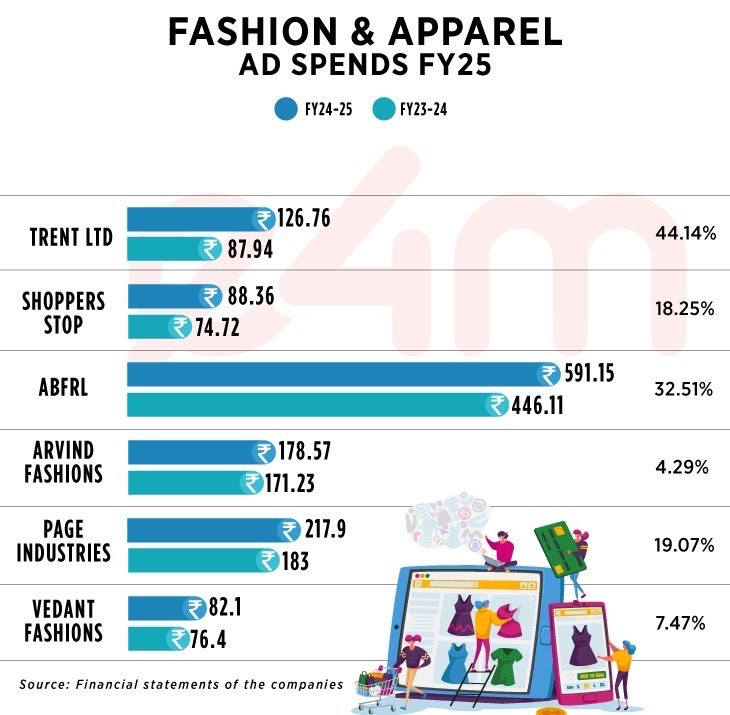
Page Industries, which markets Jockey and Speedo, reported advertising expenses of Rs 217.9 crore in FY25, up from Rs 183 crore, a 19.1 per cent rise.
Arvind Fashions (Operator of US Polo Assn, Arrow, Calvin Klein), which spent Rs 178.57 crore in FY25 against Rs 171.23 crore in the previous year (up 4.3 per cent),
Vedant Fashions (Parent company of Manyavar, Twamev, Mohey) raised ad spends to Rs 82.1 crore from Rs 76.4 crore, a 7.5 per cent increase. On the other hand, Shopper’s Stop spent Rs 88.36 crore compared to Rs 74.72 crore last year, an increase of 18.3 per cent.
Meanwhile, Zudio, Westside, Zara’s parent company Trent Ltd, recorded the steepest rise in percentage terms, with ad and promotion spends up 44.1 per cent to Rs 126.76 crore from Rs 87.94 crore. Its strategy, however, differed from peers.
Stitching the strategies
ABFRL noted, “Marketing efforts have been significantly scaled up, with national television campaigns and strategic collaborations with influencers to amplify brand reach and deepen consumer engagement. These initiatives are crafted to enhance Van Heusen’s visibility in its category and strengthen its connection with India’s evolving lifestyle-conscious audience.”
The rise in spend mirrors broader industry shifts, from the surge of Gen-Z influence and social commerce to end-to-end digitisation, personalisation, and sustainability, all of which ABFRL flagged as critical to long-term brand building.
Page’s report highlighted: “Marketing strategy was anchored in building brand salience, strengthening category leadership and connecting with consumers through high impact, multi-platform storytelling.”
The company doubled down on digital and social media with “data-driven content, creator collaborations and performance marketing,” while also continuing investments in TV and outdoor. It emphasised “consumer-centric storytelling,” “Gen Z focused engagement,” and experiential marketing, with significant effort on D2C channels and quick commerce.
Arvind Fashions noted that “higher investment in marketing and advertisement along with strategic engagement with influencers and celebrities on social media has substantially amplified the brand’s visibility and appeal for US Polo Assn.”
The company also flagged its push into Tier 2 and Tier 3 markets, with the report stating, “Improved connectivity, rising disposable incomes, and increasing brand awareness in these regions have made them ripe markets for fashion retail. The company has identified this opportunity and is expanding aggressively its geographical presence.”
Vedant Fashion’s focus was on celebrity-led, emotionally resonant campaigns. “Collaborations with celebrities such as Ram Charan, Janhvi Kapoor, and Avinash Tiwary have enhanced brand visibility and consumer resonance across aspirational and style-conscious segments,” the company said.
Campaigns ranged from Avinash Tiwary’s “Aap Kab Ban Rahe Hain Manyavar” to a region-specific Ram Charan-led initiative promoting South Indian attire, reinforcing cultural relevance.
Anand Narang, Chief Marketing and Digital Officer, mentioned, “Vedant Fashions advanced its leadership through innovation in digital, marketing, and omni-channel retail. With personalised experiences, AI-powered tools, and expanded product offerings, the company deepened its consumer engagement.”
For Zudio, the mass-market growth engine, the company disclosed that “Zudio avoids price-discounting or heavy marketing spends and instead has taken approach to marketing and building brand visibility through expanding its presence in micro-markets.” The retailer underscored its robust supply chain and in-house brands as levers to ensure freshness, quality and price stability.
Shoppers Stop positioned marketing as central to premiumisation. “Our strategy was anchored in two core pillars, brand equity and customer centricity. We continued to invest in building distinct, ownable brand IPs that resonate with evolving Indian aspirations, from curated fashion narratives to regionally rooted festive campaigns,” its annual report stated.
The retailer also highlighted a challenge confronting the sector. “As competition in digital marketing grows, soaring customer acquisition costs make ROI-driven influencer partnerships and organic brand-building strategies essential.”
Profitability check: Ad spends vs earnings
The ad spends of these fashion majors look even more telling when mapped against their topline and profitability. Trent Ltd, with revenues of Rs 17,134.61 crore in FY25 (up from Rs 12,375.11 crore), spent Rs 126.76 crore on advertising (about 0.74 per cent of its operating revenue). The Tata group retailer delivered a profit after tax (PAT) of Rs 1,534.41 crore, broadly steady against Rs 1,477.46 crore a year ago, indicating that its sharpest ad spend increase did not come at the cost of margins.
At ABFRL, advertising spends stood at Rs 591.15 crore, translating to nearly 8 per cent of its Rs 7,354.73 crore revenue from operations in FY25. While the company trimmed its losses to Rs 624.17 crore from Rs 907.02 crore in FY24, the elevated marketing investments underline a strategy of brand building despite near-term profitability pressures.
By contrast, Page Industries balanced its Rs 217.9 crore ad outlay, which was 4.4 per cent of its Rs 4,934.9 crore revenue, with strong bottom-line gains, posting a PAT of Rs 729.1 crore, up from Rs 569.1 crore.
Among the mid-sized players, Arvind Fashions allocated Rs 178.57 crore towards marketing, about 3.9 per cent of its Rs 4,619.8 crore revenue. Its PAT slipped to Rs 34.4 crore from Rs 106.59 crore, suggesting profitability headwinds despite controlled ad growth.
Vedant Fashions, with revenues of Rs 1,386.4 crore and ad spends of Rs 82.1 crore (5.9 per cent of operating revenue), maintained healthy profitability with Rs 388.4 crore PAT, though marginally lower than last year’s Rs 414.1 crore.
Shopper’s Stop spent Rs 88.36 crore on marketing, about 1.9 per cent of its Rs 4,627.64 crore topline, but saw its PAT plunge to Rs 10.89 crore from Rs 77.25 crore, reflecting the pressure of expansion and rising digital costs on earnings.
Beyond the runway: Where growth is headed
Across the board, two industry themes stood out. First, the tilt towards digital-first and creator-led storytelling, with companies from ABFRL to Page to Vedant investing in influencer collaborations and immersive experiences despite acknowledging rising costs of customer acquisition.
Second, the push into Tier 2 and 3 cities as organised retail gains ground. ABFRL and Arvind were explicit about tapping smaller-town consumers, while Vedant relied on hyperlocal activations alongside national campaigns.
The numbers also underline the widening gap in strategic posture. While ABFRL and Page Industries continue to rely on scale and multi-platform presence, Trent’s Zudio is keeping marketing lean and visibility footprint-driven. Vedant is doubling down on celebrity-powered cultural connect, and Shoppers Stop is building proprietary brand IPs.
FY25, therefore, was not just about higher spends but also about sharper choices between national reach and regional relevance, digital efficiency and mass media presence, celebrity clout and creator credibility. The next year will reveal which bets translate into sustained consumer loyalty in India’s increasingly competitive fashion landscape.
Read more news about Marketing News, Advertising News, PR and Corporate Communication News, Digital News, People Movement News
For more updates, be socially connected with us onInstagram, LinkedIn, Twitter, Facebook, YouTube & Google News