‘AI is not just hype - it's amplified intelligence transforming business’
At the e4m Martech India Conference 2024, industry experts examined AI’s applications in content creation, hyper-personalization, contextual targeting and more
 by
by
Published: Dec 13, 2024 12:42 PM | 9 min read
 Follow Us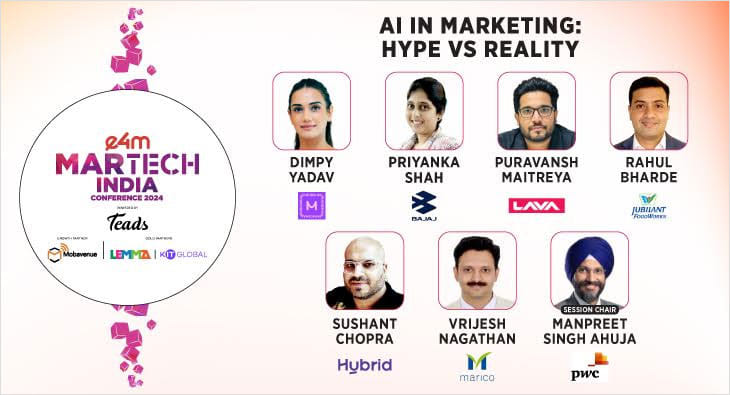

At the e4m Martech India Conference 2024, a diverse panel of industry leaders explored the transformative impact of artificial intelligence (AI) on marketing. The discussion, titled ‘AI in Marketing: Hype vs Reality’ was chaired by Manpreet Singh Ahuja, Partner at PwC.
The panellists included Dimpy Yadav, Head of Strategy – Digital at Mindshare India; Priyanka Shah, Head of Digital Marketing at Bajaj Auto Ltd.; Puravansh Maitreya, Marketing Head at Lava International Ltd.; Rahul Bharde, SVP and Chief Analytics Officer at Jubilant Foods; Sushant Chopra, Director of Sales, North India and Gujarat at Hybrid; and Vrijesh Nagathan, Chief Digital and Information Officer at Marico Ltd.
Setting the stage, Ahuja described the current perception of AI, likening it to “the overhyped Ivy League intern that creates a lot of promise but often doesn’t meet the crazy deadlines you have to meet.” He outlined key themes for the discussion, including the potential of hyper-personalization, predictive insights, operational efficiencies, and the ethical dilemmas AI presents.
“There’s this whole madness around hyper-personalization to a level that sometimes begins to scare you—the world around seems to know more about you than you yourself,” Ahuja remarked. He emphasized the significance of predictive insights, stating, “It’s about getting to predict things ahead of time, creating competitive advantage.”
Operational efficiency and ethics were other critical areas of focus. Ahuja pointed to concerns about data privacy and the balance between leveraging AI for business outcomes and respecting consumer trust. “How much can you leverage without treading on the lens of impacting data privacy?” he questioned, adding that the panel would also explore the future of AI in marketing. “The last 20 months have seen rapid advancements, but what would the road ahead look like for the next three to four years?” he concluded.
Ahuja roped the panellists in by asking Bharde how is it that they are driving customer loyalty and love through analysing data and taking decisions
In response, Bharde highlighted how AI is revolutionizing personalization in the quick-service restaurant (QSR) sector.
“In a world where content surrounds us and attention is fragmented, every interaction with a customer is a chance to tell a story,” Bharde noted. He emphasized the importance of connecting with customers at a personalized level, adding, “Food is a very indulgent and involved category. It could be about the occasion, the time of day, or simply a moment to relax.”
Bharde explained how data is leveraged to create a detailed “customer DNA,” understanding preferences, habits, and behaviors. “It’s about predicting what a customer will buy next and tying that insight back to marketing and CRM engines,” he said. AI plays a critical role in recommending the right products, sending timely messages, and ensuring seamless ordering experiences. “From engaging the customer at the top of the funnel to helping them build their order and resolving complaints, AI is integral—and its usage is only going to increase,” he concluded.
Shah shared innovative examples of AI in action within the automotive industry. Referencing a recent campaign for the launch of the NS400C motorcycle, Shah described how AI enabled a unique, interactive approach. “We created a two-and-a-half-minute ad commercial and used AI, in collaboration with Meta, to let customers feature themselves in the ad,” she explained.
She noted that this approach significantly boosted engagement. “If I’m in the ad, the virality of that content is far higher than just sending out a generic video,” she said. AI and WhatsApp technology made this personalization possible, while influencers amplified the campaign’s reach. “We landed the message of the bike, its specs, and the emotional connection—all through AI,” Shah added.
She also discussed another AI-powered initiative for Bajaj Chetak, the company’s leading electric vehicle. “We partnered with DV360 and integrated live petrol price APIs to create mass campaigns showcasing the savings of using a Chetak versus a regular scooty,” Shah explained.
These hyper-targeted ads were tailored to specific geographies and launched during IPL to capture the attention of their target audience. “AI helped us not only with mass creation but also in identifying and reaching the right audiences effectively,” she said.
In the highly competitive world of electronics, where vast amounts of data are readily available, AI has become a critical enabler for smarter marketing and enhanced customer engagement. Maitreya reflected on the tangible impacts AI has had on their operations, outlining three key areas of transformation.
“I’d say AI is delivering real results,” Maitreya began. He shared that AI has significantly improved content creation processes. “The turnaround time for creating long and short-format content has reduced drastically,” he explained. Highlighting a recent example, he said, “We were working on a video that would have required extensive shooting and a hefty budget. Using AI, the agency delivered a video that surprised us with its quality—almost indistinguishable from a traditional shoot—and at just 30% of the time it would have taken otherwise.”
Maitreya also emphasized AI’s role in enabling mass customization, recounting a campaign launched during Diwali. “We have a network of nearly 60,000 retailers and 1,000 distributors. To personalize our Diwali greetings, we created an AI-driven tool that allowed retailers to input their details and generate customized video greetings,” he shared. Initially, the team anticipated about 500 videos to be created, but the final count exceeded 10,000. “Mass customization like this is making a big impact, and other brands are excelling in personalizing marketing messages at scale,” he added.
The third area where AI has transformed operations is real-time optimization. “Tools like DV360, YouTube, and Meta now enable real-time customization of ad campaigns,” Maitreya explained. These platforms use real-time feedback to optimize ads, selecting those that perform well and discarding the underperformers. “We’re even seeing capabilities emerge where AI creates new ads similar to successful ones, both static and video,” he noted.
By leveraging data and real-time insights, Lava has been able to refine its marketing strategies effectively. “This isn’t just a trend—it’s growing. AI is delivering measurable results, and I don’t see it fading away like some earlier technologies did,” Maitreya concluded.
While brands are innovating with AI, agencies, which sit at the intersection of strategy and execution, have their own unique perspectives on the technology's transformative impact. Yadav, representing the agency side of the panel, shared her insights on how AI is reshaping media planning, campaign execution, and measurement.
“AI isn’t just hype—it’s amplified intelligence,” Yadav began, highlighting how AI combines human creativity with advanced data analysis to drive impactful campaigns. She underscored the importance of a structured framework for success. “Having great ideas is one thing, but execution requires careful planning before and measurement afterward,” she explained.
One standout example she shared was a campaign for Disney aimed at promoting inclusivity and respect for the transgender community in India. “We identified contexts where slangs, often used light-heartedly, were disrespectful. Using AI, we tracked conversations, pinpointed these keywords, and launched a contextual campaign to spread awareness,” she said. This approach showcased AI’s ability to bring nuanced conversations to the forefront of advertising.
Yadav also debunked the misconception that AI is synonymous with digital advertising. “India is still heavily reliant on TV as a backbone for media, unlike more digitally advanced markets like China. Even in TV planning, AI is helping us optimize investments. For instance, we’ve built models to identify the point of diminishing returns—figuring out where additional spend on TV might be better allocated to digital for greater impact,” she explained.
Measurement, Yadav noted, remains a complex challenge, particularly as goals differ across industries. “An equity brand may measure success by app installs or website engagement, while FMCG brands focus on offline sales through dealerships. AI helps us attribute outcomes to specific campaigns, bridging gaps in monitoring and measurement,” she said.
She concluded with a reflection on AI’s role in maximizing value with limited resources. “Ultimately, we all want to achieve more with less. AI is building that bridge for us—across mainline and digital media, planning and measurement,” she stated, adding that while AI may not provide all the answers, its practical use cases are already proving invaluable.
For AI-focused organizations, leveraging the technology to enhance precision, efficiency, and customer engagement is a given. Chopra shared a real-world application of AI in programmatic advertising through a successful campaign for MG Motors.
“The challenge was to optimize for key performance indicators (KPIs) like click-through rates (CTRs), footfalls, and inquiries for the MG Comet EV,” Chopra explained. AI-enabled predictive analysis played a pivotal role in shaping the strategy. By identifying patterns—such as increased EV content consumption by government officials and a surge in engagement among 30- to 40-year-olds over weekends—the campaign dynamically allocated budgets to these high-impact segments.
This data-driven approach delivered results. “We achieved a CTR of 2.6%, well above industry benchmarks, and met all performance goals, earning recognition from MG Motors,” Chopra added. Beyond performance metrics, he emphasized how AI enables hyper-personalization, offering distinct narratives tailored to individual user preferences. “AI lets us show creatives that align with each user’s unique interests, from fitness to food cravings—like a timely pizza notification right when it’s most relevant,” he said, humorously tying AI’s precision to everyday moments.
The interplay between marketing insights and broader organizational functions was highlighted by Nagathan, who spoke about AI’s role in reshaping supply chain dynamics in the FMCG space.
Traditionally, inventory and stock levels were maintained at fixed points in the supply chain. Now, AI facilitates multi-echelon inventory optimization, dynamically determining whether inventory should be concentrated at factories, evenly distributed, or moved closer to the market based on seasonal or campaign-specific demand.
Nagathan also emphasized the emergence of demand sensing, which goes beyond traditional demand forecasting. “At a retailer level, AI can identify micro-level demand fluctuations, enabling businesses to manage dispatches more effectively,” he explained. This granular approach ensures product availability aligns with real-time consumer needs, creating a seamless feedback loop between supply chain management and marketing.
Read more news about Marketing News, Advertising News, PR and Corporate Communication News, Digital News, People Movement News
For more updates, be socially connected with us onInstagram, LinkedIn, Twitter, Facebook, YouTube & Google News