‘The Indian reader is as demanding as the Indian voter’
In today’s edition of Headline Makers, Moneycontrol's Managing Editor Nalin Mehta shares insights on financial journalism in digital media, banking on audience data, content credibility and more
 by
by
Published: Dec 3, 2024 8:43 AM | 11 min read
 Follow Us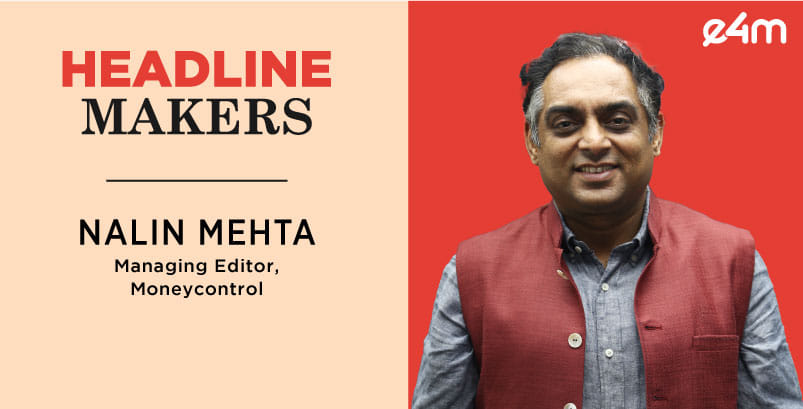

Moneycontrol's Managing Editor Nalin Mehta dissects the evolving landscape of financial news in the digital age. In a candid interview, he addresses the challenges of maintaining credibility, the importance of data-driven decisions, and the platform's innovative approach to content and growth.
Excerpts:
What are the biggest challenges and opportunities facing financial journalists in today's content-saturated digital landscape?
There's been a seismic shift in the environment in which financial news operates, in the nature of the audience, and consumption. For example, Moneycontrol now has 100 million unique monthly visitors. That's a benchmark not just for Moneycontrol, but also for the business of financial news space. If you see the numbers for, say, the traditional pink dailies, they are not even in the same ballpark.
What that means is that the audience has shifted to digital, completely or to a large extent. That changes what we do. There is a huge hunger in this country for business intelligence, and as more and more people get into the formal economy, there's a huge demand for understanding these concepts. But that is happening on digital. So those who can capture the digital market are the ones who are leading this game right now.
Moneycontrol has more than doubled its audience in the last 10 months alone, just in this calendar year. That's the nature of growth, that's how fast it is changing. In 10 months, we have more than doubled our unique monthly viewers as well as our paid subscriptions. And on this scale, which is unprecedented, that tells you how fast it is changing.
Basically, there is a huge hunger in India for actionable information that investors can use because the equity culture is becoming more and more widespread and people are looking for credible sources of information. That is the gap that, for example, we think that we fill, because people look for reliable, trustworthy intelligence to inform investment decisions. So now the players who can provide that are the ones who are getting the audience. That requires both reliability and speed on a scale that is unprecedented. That's the big difference in the game.
We crossed the 1-million mark of paying subscribers for MC Pro. To put this number and the 100 million number in context, you will see the rest of the media environment is extremely challenging. Audiences are declining for most of the players. In this tough media environment, our subscription numbers are now in the top 15 in the world. That puts us neck and neck with the Financial Times, with platforms like Barron's, like Caixin. So, the opportunity is huge, but also what it means is that the work required also becomes more because the Indian reader, I think, is as demanding as the Indian voter.
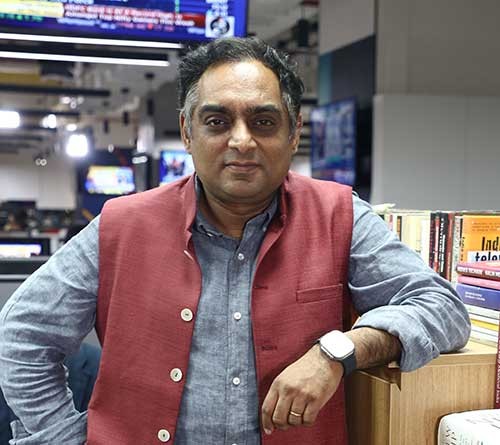
How involved are you in analysing audience data, and how does that data influence your editorial decisions?
Data is absolutely fundamental to everything that we do. Essentially, the reason why we have broken these records in subscription numbers—and 1 million is not just in the top 15 in the world, it is significantly higher than any other media platform in India in terms of paying subscription numbers in the news space—is because Moneycontrol has reduced the arbitrage on information for retail users who are looking to invest smartly. So, the kind of information that used to be available to institutional investors earlier, is now available to retail investors, the common user, at a fraction of the cost. That's what Moneycontrol does. Our data offering and our database tools are central to that. That's one core use of data. Data is at the centre of the way we look at our content.
The second is that we also, obviously, constantly on a live basis, track our user base and how our readers are reacting to what we are putting out. So we are constantly interacting with readers, and on a real-time basis, we are getting feedback, understanding what content they are looking for, and we are adjusting our offerings to respond to market needs.
I, for example, spend a lot of my time looking at data. Fundamentally, traffic – and how user patterns keep changing constantly – is something that we continuously track. As content creators in today's day and age, I don't think editors can produce content without looking at the traffic patterns, without being accountable and responsible for whether they're getting an audience or not. If you are not getting an audience, there is no point producing that content. It's as simple as that.
How do you ensure credibility and maintain the highest quality content and talent?
Firstly, there is no substitute for quality. Ultimately the readers are looking for quality. If you don't have quality, nobody will come to you. For example, a lot of platforms try and fool readers by offering lots of deals: "You take this and you get 10 more things." You can fool readers once, you can't fool them the second time. Because when the person has to renew a subscription. It is not easy as India is a very price-sensitive market. People will only pay for something which they genuinely value, especially if they're renewing it. So your content has to be good enough.
Therefore, we believe that a million subscribers, 10 lakh Indians, bought our subscription and are paying, continuing as subscribers, is a huge vote of confidence in the quality of our content as a trusted source for market intelligence for investors on India's equity markets.
How do we do that? We are constantly creating cutting-edge products, which give market intelligence to our readers. Our driving impulse is: how can we make people invest their money more smartly? Everything that we produce is built with that filter in mind, to make it actionable content, produced fast - and in time - and tailored to different demographics.
For example, our audience stretches across first-time investors who are first-time earners and are looking to invest in the stock market, to very seasoned market players, and right up to institutional investors, traders and brokers, and all of that. So therefore, we have a multiplicity of products. For example, we have ‘Expert Edge’ where we do daily trading calls and weekly investment ideas. We have ‘Trade Like a Pro’ where we offer a lot of technicals, technical data, ratings, trends, ‘Spot the Winners’ where we have something like 200 powerful stock scanners, ‘Deep Dive’, which is quant-based insights. Then you can track the portfolios of big players in the market. Several things like that.
At the center of this, we have a very strong research team, research analysts who cover about 270 major Indian companies across 25 different sectors to provide insights. All of them are certified by SEBI to invest in stock. We are very particular about what we are recommending and how, and only people who are qualified and certified by SEBI are allowed to do that. That's something that requires specific skill and certification, and our research team comes from that.
Our research team also puts out thematic portfolios for investors, which, by the way, consistently outperform the benchmark indices. All this adds up to user trust.
Fundamentally, the user will only look at you if they think that the information that you are producing is adding value to their lives. By value, I mean real value, and it is continuing. If you mess up on this, the reader will not come back to you.
Also, we are now expanding our footprint in the fintech space. For example, readers on our platform can now track their bank accounts, they can track their ratings, they can take loans, they can take fixed deposits, and they can essentially check credit scores, and so on. So you can basically get everything. We are now India's largest financial platform by a margin. Nobody else is in the same ballpark. We are offering a multitude of things across news, business intelligence, market intelligence, and tools that people can use to make investments.
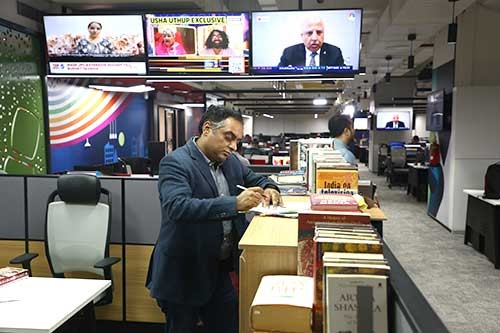
How are technologies like AI and automation influencing financial reporting?
I think financial journalism has been impacted by tech and AI long before any other form of journalism. For years, information around finance and business has been automated. This is basically because business is one stream of content which lends itself to predictability, fixed periodicity of data, and large data points.
In terms of automation, what you can automate is what's happening on the markets. What you can automate is indicators. That, everybody and anybody can do. Today, even an 18-year-old coder can set up the same thing that large teams of 200 coders can do, or which large media can do. So in that sense, I think it's very much a level playing field.
The data will tell you what is happening. It will not tell you why it is happening. It won't tell you what may happen. So to answer the why is where the knowledge and expertise come in, which is why there's a very high premium now on knowledge and understanding, and that's where we come in.
One of the reasons why we are growing and we have doubled our audience is because we have really invested in writers, and in experts, and in players in the market who really understand this and who write content which adds value to investors.
How do you stay ahead of the curve with content formats and storytelling? How often do you reassess your approach?
We are constantly monitoring our consumption patterns across different platforms, from different social media platforms, for example, what's happening on Telegram, on WhatsApp, on Twitter, on podcasts, on YouTube, basically all the off-platform stuff and the platform stuff. Both are critical to us in different ways because they are all different touch points to our audience.
Very often we get critical feedback very quickly on social media, for example. The forums on Moneycontrol, on the platform itself, are huge. If you track our forums, those are great places where a lot of people with different expertise will come and share notes, and so on. If you track that conversation, you get to know something very fast.
Fundamentally, in digital, the great advantage is that you can see what's happening to your audience in real-time and in absolute numbers, not in some small estimations, and you can immediately see how the audience is reacting and where it is moving. For example, if I put out a story, I know in two minutes whether the story is being read or not and whether it's going up or down. So it immediately tells you whether you got it right. It immediately tells you whether it's hitting a chord with the audience or not. It tells you whether you should change something, whether we should play with the words a bit more, and so on.
That's a great advantage of digital, but it also means that you have to be far more nimble, and you have to be a lot more humble, because a lot of times editors think that they know everything. I think that's the worst thing to think, because the audience knows a great deal, and you're constantly listening to the audience.
How would you describe your experience leading Moneycontrol over the past 10 months?
It's been a fantastic journey. Moneycontrol has always been a big brand. It has long been a major media platform. It always was right up there. What we have done is that in the last 10 months, as part of Network18, we have doubled the audience, we have doubled the subscription base. That's been a fantastic rollercoaster ride. We have built on the platform that was there and added many more new layers to it. We have added new content, we have added new categories of tools, of content types. We have gone much deeper in our core offerings, and we've gone wider in our content basket as well.
That, I think, has been a very fulfilling experience. We have also taken on board many new people because the audience is expanding very fast. It's not just good enough to have the content, you also need to respond to the needs of the audience in real-time and fast enough. One of the great joys and one of our great successes has been that we managed to build these new kinds of content and expand our offerings on a large scale and at a very fast speed. And I think the audiences have responded to that.
Read more news about Digital Media, Internet Advertising, Marketing News, Television Media, Radio Media
For more updates, be socially connected with us onInstagram, LinkedIn, Twitter, Facebook, YouTube & Google News