Programmatic Advertising: Balancing reach & media efficiency for full-funnel engagement
At e4m Real-time Conference 2024, experts discussed how programmatic advertising is evolving to enhance media efficiency, address brand safety concerns, and better navigate the consumer journey
 by
by
Published: Sep 25, 2024 11:27 AM | 7 min read
 Follow Us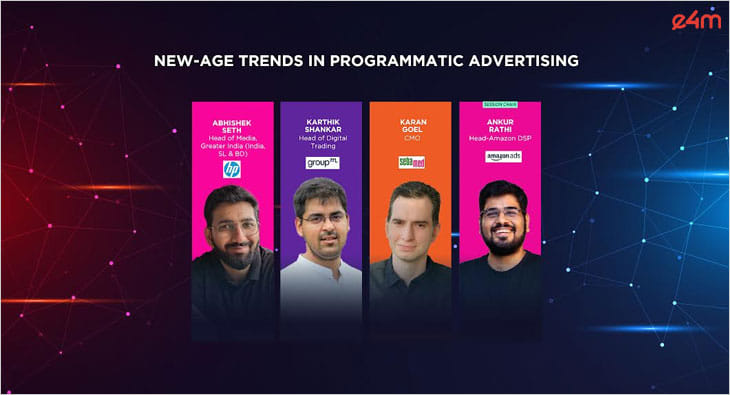

The e4m Real-time Programmatic Advertising Conference 2024 saw a distinguished panel of industry leaders explore the transformative trends in programmatic advertising. The discussion delved into audience strategies, planning techniques to improve media efficacy, retail media's growing role, and holistic measurement's significance.
The panel featured insights from Abhishek Seth, Head of Media for Greater India at HP; Karan Goel, Chief Marketing Officer at Sebamed; and Karthik Shankar, Head of Digital Trading at GroupM. The session was chaired by Ankur Rathi, Head of Amazon DSP at Amazon Ads.
Rathi set the stage by highlighting the evolving significance of programmatic advertising within the digital media landscape. "We are all practitioners, influencers, and decision-makers in this domain, and it’s becoming a significant chunk of where the money is getting routed overall in digital media. Programmatic advertising is roughly at 40%, according to one of the industry reports, of overall digital media spends, and expected to be around 50% by 2025."
He continued, "It’s an exciting space, but it comes with its own challenges and complexities. In this session, we’ll try to understand the inputs going into the final decision-making process and what we expect this to solve for us now and in the near future."
Rathi then directed the conversation to Karthik Shankar, asking him how programmatic differs from traditional media buying and how retail media unlocks new opportunities for the programmatic landscape overall.
Shankar replied, “Programmatic essentially helps in super agility. So, you can get the signal right on time that the brand wants and start unlocking it across—reaching the right audiences at the right time and place, is what we get to unlock.”
He continued, “With everyone moving towards business goals like profitability, retail media accelerates that process. Instead of reaching a broad affinity audience, you can define the exact audience to engage with. The insights are is accurate and allow you to activate it across various channels, reaching the right audience at the right time.”
Seth agreed with the previous points, stating, “Retail media is where the insight and audience intelligence rest. As businesses focus more on profitability, top and bottom lines become crucial. Retail media is becoming the preferred choice for marketers and media professionals because it provides the right insights to justify media investments.”
He added, “It gives businesses, brands, marketers, and agencies confidence that their efforts are directionally correct and showing tangible results. That’s a significant role it plays.”
Next, Goel discussed the challenge of building awareness for Sebamed, noting that despite the brand’s recognition, many consumers still don’t shift to purchase. He emphasised the role of programmatic advertising in addressing this issue: “Programmatic advertising helps address this by capturing signals that drive consideration, not just bottom-funnel sales. It allows us to reach relevant consumers, driving awareness and conversions.”
He also highlighted the competitive landscape in premium baby care and how programmatic signals are vital for maintaining growth. Regarding Amazon DSP, Goel commented, “Amazon DSP has been instrumental in helping us reach our target audience effectively. It not only enhances awareness but also drives conversions by allowing us to identify where our audience spends time and how best to engage them.”
Seth highlighted the shift in planning terminology and strategy for media efficiency. He explained how the industry has evolved from traditional top or mid-funnel reach and frequency (R&F) campaigns to a more sophisticated approach. Seth noted, “We’ve progressed far ahead of using R&F terminology. Now, we place greater emphasis on audience signals and their weightage within R&F campaigns. It’s not just about reach but about reaching relevant audiences based on their signals and prioritising frequency for those audiences.”
He emphasised that programmatic channels are now preferred for their ability to qualify audience signals more effectively, driving greater efficiency. “Programmatic channels allow us to better qualify these audience signals, making them a preferred choice for driving efficiency when that is our goal,” he added.
Goel discussed the shift from platform-focused planning to a more consumer-centric approach enabled by programmatic advertising. He noted, “Earlier, planning was often centered around platforms with mass reach, assuming large audiences were on specific platforms. Now, programmatic allows us to support the consumers on their journey rather than a specific platform. Consumers might be on an entertainment app today and shopping tomorrow.”
He added that this approach helps in optimising R&F by aligning with the consumer’s varied activities. “Programmatic enables us to plan based on where the consumer is at any given moment, rather than sticking to one platform,” he concluded.
Seth was asked about the planning process for programmatic campaigns. He described how the HP media team is adapting to the evolving ecosystem, emphasising the integration of demand generation and demand capture. “We, as a team are also evolving over the way the entire ecosystem is evolving. For that purpose, there are demand generation initiatives and there are demand capture initiatives. Bridging between the two is where we keep the planners who work across a generation as well as demand capture in a unified way. That's how we stitch the two on a campaign planning level.”
Seth continued, “HP is a well-known brand for both printers and PCs. Our focus is on enabling the right product selection for customers, given the complexity of the category. It’s crucial to determine what to pitch, to whom, and how to guide them down the funnel. While awareness is less of a challenge due to high awareness scores, the focus is on consideration, preference, intent capture, and conversion.”
Agreeing with Seth, Rathi highlighted an often-overlooked aspect of the consumer journey. He noted, “Most of the expectation is awareness and conversion, but many forget the critical mid-funnel stage of consideration that influences the final purchase decision. This 'messy middle' is where programmatic advertising plays a crucial role. Amazon Ads, allows reaching relevant audiences without leakage, such that they are effectively engaged throughout the consideration phase.”
Rathi then took the session forward by asking Shankar his perspective on the full-funnel approach and the various buying models available, mainly focusing on safety. He inquired, “How are you managing the full-funnel approach where interventions are made at each stage? And with different buying models available, how do you view open auction buys versus preferred buys?”
Shankar discussed his approach to managing buying patterns and ensuring safety in programmatic advertising, highlighting the importance of transparency.
“In open auctions, we focus on full funnel and full stack approaches. For example, with Amazon DSP, data flows from search to final purchase, ensuring minimal data loss and effective full-funnel integration. For brand safety, we integrate third-party tools to protect against poor placements and ensure ads reach genuine users. The key is balancing supply, data, and attribution while aligning with our marketing strategy. It’s essential to incentivise structures that enhance consideration throughout the funnel.”
Goel addressed the challenges of brand safety and inventory transparency in programmatic advertising. He noted that marketers often face dilemmas, such as whether to place ads in potentially contentious contexts despite their audience being present.
“There’s always a concern about brand safety—whether to be where your audience is if it means risking exposure to controversial or political content. Additionally, there’s the issue of transparency in inventory. In TV planning, for instance, we might not know what slots we’re getting and whether they’re reaching the intended audience. Programmatic should address these concerns, but these dilemmas remain significant for marketers.”
Read more news about Digital Media, Internet Advertising, Marketing News, Television Media, Radio Media
For more updates, be socially connected with us onInstagram, LinkedIn, Twitter, Facebook, YouTube & Google News