No expansion of powers: MeitY Secretary defends IT Rules reset as clarification exercise
A central theme of the government’s position is that the draft amendments remain firmly anchored within existing legal boundaries
 by
by
Published: Apr 7, 2026 6:13 PM | 4 min read
 Follow Us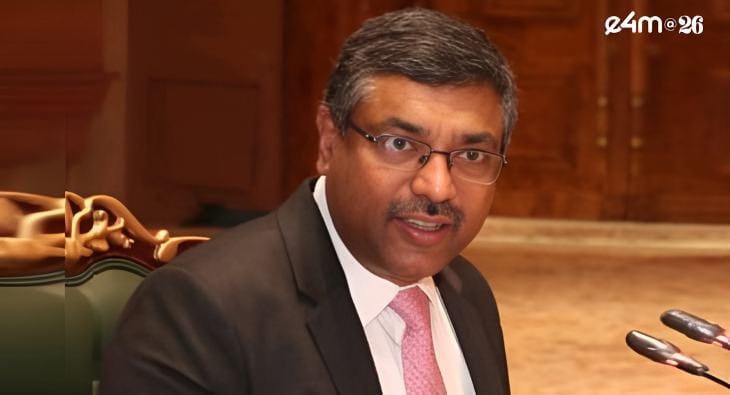

Framing the proposed changes to the Information Technology (IT) Rules as a refinement rather than a regulatory clampdown, the Ministry of Electronics and Information Technology (MeitY) has sought to quell concerns around overreach.
MeitY Secretary S Krishnan sought to reframe the narrative around the proposed changes, pushing back against concerns of regulatory overreach. “These amendments, in our view, do not in any way actually give us wider powers or expand it. They are merely clarification of nature,” he said.
Krishnan emphasised that the trigger for the amendments came from within the digital ecosystem itself, with intermediaries seeking clearer guidance on compliance. “The request from intermediaries for clarification on what constitutes takedowns and suggestions on preservation of records led to this,” he noted, adding that multiple stakeholders had flagged interpretational gaps in the current framework.
His remarks come at a time when the rapid expansion of digital platforms has sharply increased the volume and complexity of content disputes. Acknowledging this shift, Krishnan pointed to the scale challenge. “To some extent there has been a sudden explosion,” he said, linking the surge to emerging risks such as deepfakes and misleading content with potential implications for public order and national security.
‘Bound by the Constitution’
A central theme of the government’s position is that the draft amendments remain firmly anchored within existing legal boundaries. “We are bound by the Constitution and statutory provisions. We are not going to exceed any of those,” Krishnan said, underscoring that any action will continue to fall within the ambit of reasonable restrictions on free speech.
He described the exercise as an attempt to codify existing practices into clearer rules to minimise disputes. “When the law says guidelines may be prescribed, they have to find a place in the rules. That is what we are doing,” he explained.
At the same time, Krishnan acknowledged legal complexities in structuring such guidelines. “There is a little bit of a grey area between provisions of the Act. We have to examine that in a legal framework,” he said, indicating that further refinement of the draft is underway.
Fault lines across stakeholders
The consultation process has revealed deep divisions across the digital ecosystem, particularly on classification and compliance obligations. “Intermediaries didn’t want to be clubbed with publishers, and publishers didn’t want to be clubbed with users,” Krishnan said, highlighting the challenges of regulating a layered and diverse digital landscape.
For businesses, especially large platforms, the concerns centre on execution. Even if framed as clarifications, tighter compliance norms could translate into higher operational costs and more stringent moderation systems. Smaller businesses, too, have flagged risks of disproportionate compliance burdens.
Acknowledging these concerns, Krishnan said the ministry is mindful of the impact on smaller players. The government, he indicated, is working to ensure that “small businesses… are not affected by an increased compliance burden.”
Due process and platform economics
On the contentious issue of content takedowns, Krishnan reiterated that existing safeguards remain unchanged. “Takedown is done under established provisions. There is a complete process. Reasons have to be cited,” he said, stressing adherence to due process and review mechanisms.
He also pointed to the role of judicial oversight in shaping the framework. “We will examine the order and, if required, we will appeal. We go as per due process,” he said, referring to recent court interventions.
In a notable remark that signals the government’s evolving stance, Krishnan framed social media platforms primarily as commercial entities. “I don’t see why we are using social media as the vehicle of freedom of speech. These are commercial undertakings,” he said, suggesting a shift toward evaluating platforms through a business-regulatory lens rather than purely as conduits of expression.
Open-ended consultation
The government has left the timeline for finalising the amendments deliberately open, signalling a consultative approach amid industry pushback. “I cannot give you a timeline… that would mean I have already made up my mind,” Krishnan said.
He added that stakeholder inputs will continue to shape the final framework. “We are open-minded. The ministry is open-minded. We will listen and take note,” he said, pointing to a history of revising drafts based on industry representations.
As MeitY navigates competing demands of regulatory clarity, free speech safeguards and business feasibility, the next iteration of the IT Rules is likely to reflect an incremental, stakeholder-driven approach. For the digital ecosystem, the shift is clear: the debate is no longer about whether regulation will tighten, but how it will evolve alongside platform economics and governance priorities.
Read more news about Digital Media, Internet Advertising, Marketing News, Television Media, Radio Media
For more updates, be socially connected with us onInstagram, LinkedIn, Twitter, Facebook, YouTube & Google News