#e4mXplains: Is India’s growing one-screen economy changing the face of advertising?
With consumers not just watching content but buying from inside it, platforms are now designing surfaces so that the impulse has no room to escape
 by
by
Published: Dec 5, 2025 9:30 AM | 7 min read
 Follow Us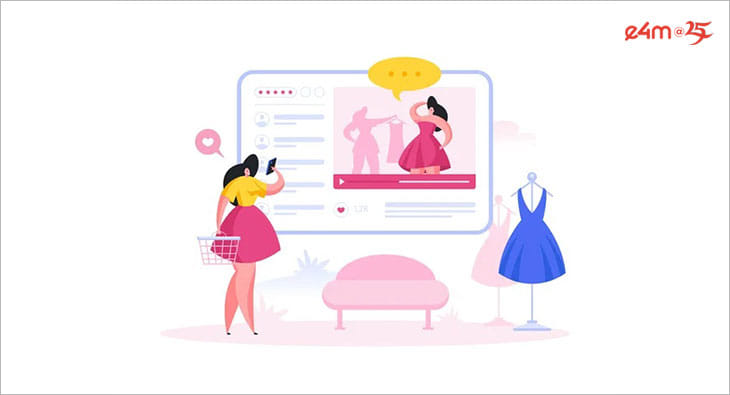

As someone who is often on YouTube on their phone (and today who isn’t, given Google’s YouTube and Meta’s Instagram monopolisation of our time and attention?), one can’t but help notice changes. Like how, despite paying for YouTube Premium to avoid advertising, you can’t move your finger or cursor around without accidentally hovering over ‘Featured Products’ and ‘Purchase now’ and other totally not ads. The same is true for Reels, as we’ve heard.
This isn’t fun new experimentation or A/B testing. This is now a feature, by design, and with intent. And it’s changing the face of media, advertising, and commerce in India (and beyond). Having already come to THE screen near you.
What used to be a polite sequence of discovery, consideration, and purchase has begun to overlap, merge, and finally disappear into a single uninterrupted journey that refuses to respect those old borders. And the place where this shift is most visible is the single screen that has come to dominate Indian consumer behaviour: the phone, and increasingly, but still distantly, the Connected TV.
Read e4m analysis on how the BigTech guys are holding ground
Role of platforms
Platforms have stopped pretending that they belong to only one part of the consumer journey. YouTube is no longer just entertainment, Flipkart is no longer just commerce, and WhatsApp is no longer just messaging. Each wants to be the surface where the entire journey begins and ends, without ever letting the consumer wander off.
The most dramatic evidence comes from video. In April 2025, YouTube reached over 75 million Indians aged 18 and above on connected TVs. That number on its own signals how firmly YouTube has taken over the front room. But the real shift is what people do on these screens. Shorts has crossed 650 million monthly logged-in viewers globally, and India drives a staggering proportion of that behaviour.
The moment the viewing habit shifted from long-form to snackable scroll video, the gap between “I saw this” and “I want this” shrank to seconds. YouTube’s shopping affiliate programme in India, which saw a 250% surge in shopping-related watch time year-on-year, tells a straightforward story: consumers are not just watching content; they’re primed to buy from inside it.
Did you know true creator ROI takes a year to show up? Find out more
While Instagram and Facebook are clearly part of the same shift, the public data coming out of Meta in India is narrower than YouTube’s. Reels is undeniably massive; Meta’s own IPSOS study this year claims that 92% of surveyed Indian users prefer Reels over other short-video formats, with creators seeing roughly 33% higher engagement on Reels.
Instagram itself sits at around 484 million users in India, and Gen Z surveys show that 83% have bought something through Reels or Stories while 71% still use YouTube Shorts for discovery. But unlike YouTube, Meta hasn’t published India-specific numbers that directly tie Reels viewing to purchase behaviour at scale, which is why the clearest quantifiable evidence of video-commerce compression still sits with YouTube.
The Consumer Journey
This is where the idea of discovery being separate from purchase starts looking dated. Earlier, creators were a top-funnel asset: great for awareness, weak for conversion. But when Myntra reports that creator-led content now contributes around 10% of its overall revenue, and when users who engage with social content convert 25–28% better than normal platform traffic, it becomes clear that the creator is no longer just setting the mood.
The creator has become the funnel. Video is no longer the thing you watch before you shop; it is the shop.
This logic extends cleanly into the retail media ecosystem, where platforms like Amazon and Flipkart have engineered something more radical: checkout itself becoming a media surface. Retail media ad spend in India is projected to grow 21.9% in 2025, dwarfing the growth of traditional paid search and paid social.
Much of that is because these platforms have done what Google and Meta always wanted to do but never fully achieved: containing the entire consumer journey inside their own walls from the first impression to the final purchase. When 40% of agency executives say retail media is now a full-funnel solution, they are quietly acknowledging that the separation between brand-building and performance has ceased to matter inside commerce ecosystems.
The Retail Advertising Market
This isn’t trivial scale, either. India’s retail platform advertising market is estimated at around US$2.1 billion in 2025, which means your shopping app is now one of the country’s largest media networks. For marketers, this creates a clean, if unforgiving, logic: why rent attention on platforms where users have to be nudged toward action when you can buy attention in a space where action is default behaviour?
The third engine of compression (the quietest, but perhaps the most potent) is conversational commerce. WhatsApp has achieved something astonishing in India: reported conversion rates of 45–60% from commerce campaigns, compared to the typical 2–3% on e-commerce websites. This difference is not because consumers suddenly trust brands more in WhatsApp; it’s because the friction is gone. Asking a question, receiving a catalog, getting a recommendation, and making a payment now happen in one chat thread, in one emotional moment.
Businesses have reported ROI jumps of 200–300% after shifting parts of their sales journey to WhatsApp, a number that would have sounded absurd even three years ago. And by 2026, conversational commerce is projected to account for 20% of all e-commerce transactions in India, effectively becoming a mainstream purchasing habit.
What ties these engines together is the behaviour of the Indian consumer. India’s digital ad spend touched roughly US$1.56 billion in the first half of 2025, and shopping was the single largest online spending category at a 30% share. Programmatic accounts for 42% of digital spend, which means infrastructure has caught up with intent.
Add in the fact that 93% of Indian consumers shopped online during Diwali 2025, with e-commerce penetration projected to cross 11% of total retail, and a pattern emerges: India is not just mobile-first. India is compression-native.
The crucial detail is that none of this is happening because platforms suddenly became visionary. It’s happening because users have rewired their behaviour so thoroughly that the old funnel is too slow for them.
Discovery and consideration are no longer two steps; they are one feeling. A spark of interest is now indistinguishable from the moment of decision. And the platforms that understand this are designing their surfaces so that the impulse has no room to escape. A video scroll becomes a storefront. A search page becomes an ad carousel. A chat window becomes an invoice. A CTV remote becomes a shopping trigger.
The result isn’t the death of the funnel. What’s happening is more structural: the funnel is flattening into a surface. Platforms are trying to become the place where the uninterrupted scroll happens, where the user doesn’t have to move to another app to complete the journey, and where attention and transaction don’t live in different universes.
Every major platform in India today (YouTube, Gmail, Flipkart, Jio, Amazon, Instagram, and even OTT apps) has begun to look eerily similar because they’re chasing the same outcome: to be the final surface.
And as this surface unifies the journey, the distinctions that marketers relied on become softer, blurrier, and less reliable. Brand vs performance, top-funnel vs bottom-funnel, content vs commerce; all these categories assume a consumer who moves in a straight line. But the Indian consumer of 2025 isn’t walking a line; they’re circling a screen. That screen is where they watch, compare, and buy, often within the same gesture.
This is India’s year of the great compression. Not a collapse. Not a revolution. Just a quiet but irreversible shift to a one-screen economy, where the journey is compressed, the consumer is in control, and the platforms are racing to stay on that one screen for as long as the thumb keeps scrolling.
Read more news about Digital Media, Internet Advertising, Marketing News, Television Media, Radio Media
For more updates, be socially connected with us onInstagram, LinkedIn, Twitter, Facebook, YouTube & Google News