High Costs, Long Timelines: AI becomes studios’ new production engine
A growing number of film projects — particularly mythological and historical ones that are expensive and time-taking to mount — are now being produced with GenAI
 by
by
Published: Nov 24, 2025 8:47 AM | 7 min read
 Follow Us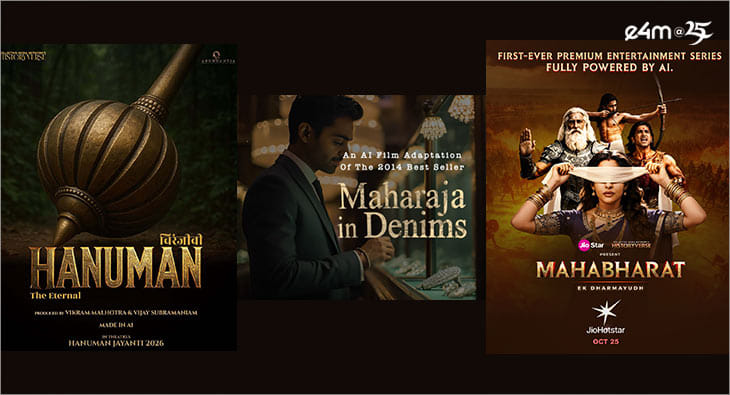

With filmmaking costs rising and audiences gravitating toward short-form, scrollable content, India’s film, ad and OTT creators are adopting generative AI to compress timelines, expand visual scale, and optimize budgets. Over the past couple of months alone, half a dozen AI-driven projects have been announced.
One of the most visible signals of this shift is Vikram Malhotra’s Abundantia Entertainment, which recently unveiled Jai Santoshi Mata: Sukh Sampatti Daata under its new AI-focused vertical, Abundantia aiON. The full-length feature, slated for release next year, will be an equal blend of live-action and AI-generated content, Malhotra told e4m.
Abundantia has already partnered with Collective Artists Network on Chiranjeevi Hanuman – The Eternal, a fully AI-made feature. The studio has also set up its own AI facility and forged partnerships with international AI firms that specialise in filmmaking to ensure high-quality human-centric storytelling.
View this post on Instagram
Read On: From studios to startups: How filmmakers are building AI businesses
Another example of this transition is Twenty21 Studios’ collaboration with Intelliflicks on Maharaja in Denims, based on Khushwant Singh’s novel. The project is being executed without physical sets, actors, or cameras — a route the team chose after the traditional live-action version was dropped due to the prohibitive cost of recreating historical backdrops. Streaming platform JioHotstar has also come up with Mahabharat: Ek Dharmayudh, which is being positioned as India’s first fully AI-produced web series.
Most of the AI-driven content announced so far leans toward mythology and history — genres that typically demand heavy investment and long production cycles.
Typically, a full-length feature film on mythology takes 2-3 years to produce. However, Malhotra aims to release Chiranjeevi Hanuman by mid-2026 and Jai Santoshi Mata by the end of 2026, planning to complete each film within 10-12 months.
The producers are not disclosing the costs of their AI-driven projects due to contractual obligations with their technology partners. However, industry insiders estimate that a high-quality mythology film featuring a major star can cost between ₹150 crore and ₹400 crore.
“By integrating AI, we could be saving anywhere between 50–90% of the budget compared to traditional VFX or live-action workflows,” Malhotra says.
Across scripting, pre-visualisation, editing and post-production, AI has moved from a peripheral tool to a creative co-pilot. Producers admit that AI-led projects are “easier to plan, faster to execute, and far less drama-prone than star-driven shoots.”
Moreover, the technology is reshaping cost structures across formats, from microdramas to mass-market spectacles. “As studios balance shrinking budgets with the need for constant output, AI is emerging as a practical ally,” says Pep Figueiredo, COO - PTPL India, ex-SonyLIV. “By reducing dependence on actors, their tantrums and entourage costs and by accelerating workflows, and enabling creative experimentation, AI is redefining how Indian filmmakers tell stories in an age of economic caution and fleeting viewer attention.”
Read On: Producers now need scripts and sponsorships: Are OTT platforms flipping the funding model?
Even the Government of India is now embracing the AI-content wave. Doordarshan and Waves OTT have partnered with Vijay Subramaniam’s Collective Media Network to reimagine India’s most celebrated epic, the Mahabharat, through an AI-led production. The series was released on WAVES on October 25 and on DD on November 2.
While India’s top production houses are still to take the plunge into AI content making, many of them have started roping in AI tools to produce complicated sequences, industry leaders say.
The audience is also loving the format. Mahabharat: Ek Dharmayudh, for instance, made a phenomenal debut with 6.5mn + video views and 2.1x higher reach than platform average, according to JioHotstar.
A Deloitte–MPA report estimates that India’s film, TV and online curated content (OCC) market generated ₹1.10 lakh crore in FY24 — and industry watchers say the sector is now entering an AI-first era.
Strategic Commitment
Several production houses have set up AI divisions or partnered with specialised tech studios. From Ajay Devgn’s Prismix and Lens Vault Studios to Telugu producer Dil Raju and Tamil composer Tenma, creators across regions are building AI-enabled pipelines.
“AI is not a tactical or part-time experiment for us — it’s a strategic commitment,” Malhotra says. His studio’s AI-first arm, Aeon, aims to empower storytellers to create narratives they were previously constrained from making. “We’re bringing together our creative strengths and human networks with some of the best tech creators globally. It’s a complementary relationship between art and science — not a replacement of one by the other.”
Read On: Brands slash ad production budgets by half, leaving creative agencies high and dry
Since AI is evolving at breakneck speed, with tools advancing almost by the week, content creators must be equally committed to upgrading their craft on the go, say producers.
Filmmaker Vivek Anchalia, founder of Amazing India Stories, was the first in India to produce a full-length, AI-generated feature film Naisha in May. Even as he completed Naisha, he postponed its theatre release. “We are now reworking and enhancing it using more sophisticated tools, with a revised release planned for December,” Anchalia told e4m.
Institutional Recognition: India’s First AI Film Festival
Institutional support is further accelerating adoption. The International Film Festival of India (IFFI), in partnership with LTIMindtree and NFDC, has announced the country’s first Artificial Intelligence Film Festival and Hackathon to be held during IFFI’s 56th edition in Goa from November 20–28, 2025.
“Cinema has always reflected the power of human imagination. Today, AI gives us a new lens that expands our ability to dream, design and express,” said Shekhar Kapur, IFFI Festival Director and Jury Chair of the AI Film Festival in a statement.
Read On: Smarter, cheaper, faster: Has AI cut ad production costs by up to 60%?
From Efficiency to Creativity
India’s AI sector is projected to triple to ₹1.4 lakh crore ($17 billion) by 2027, according to BCG’s India’s AI Leap. With 600,000 AI professionals, 700 million internet users, and more than 2,000 AI startups created in the past three years, the ecosystem is primed for rapid adoption.
For the ₹2.5 lakh crore entertainment industry and the ₹1 lakh crore advertising sector, AI marks a decisive inflection point. Even as major studios have yet to formally announce collaborations, many are experimenting quietly — from The Eternaut on Netflix, which used AI-driven effects, to Disney’s exploration of deepfake technology for de-aging actors in upcoming live-action remakes such as Moana.
This steady shift signals a major transition: AI is moving from backend efficiency to frontline creativity. Production houses, OTT platforms, brands, and tech partners are using it to design next-generation storytelling workflows. With content costs rising and subscriber growth flattening, AI is no longer just a cost-saving lever — it is redefining how stories are imagined, produced, and scaled in an era shaped by speed, precision, and boundless creative possibility.
Looking ahead, industry experts say hybrid productions — combining live action and AI — will become mainstream by mid-to-late 2026. In Mumbai, only a handful of producers have taken the leap so far, but adoption is accelerating quickly.
Read more news about Digital Media, Internet Advertising, Marketing News, Television Media, Radio Media
For more updates, be socially connected with us onInstagram, LinkedIn, Twitter, Facebook, YouTube & Google News