#e4mXplains: Claude for Chrome could transform how we shop online
The debut of Claude for Chrome by Anthropic is expected to make browsers the new arena for e-commerce and marketing competition
 by
by
Published: Aug 29, 2025 2:08 PM | 3 min read
 Follow Us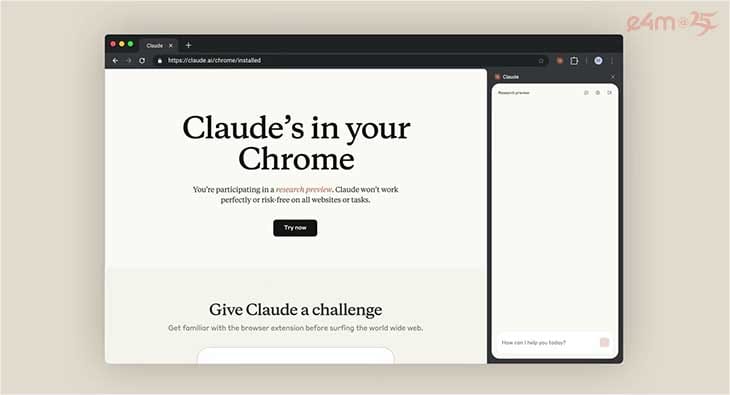

Claude for Chrome is a new product from Anthropic that functions as an AI assistant within your web browser. Imagine it as a sidekick that resides in a little panel next to your Chrome window, ready to respond to inquiries, provide a summary of what you're viewing, or even assist you with tasks like completing online forms, writing emails, or comparing products. In contrast to standard chatbots, Claude is able to "see" the context of your surfing and intervene to speed up and simplify routine internet tasks.
Convenience is the immediate draw, but marketing and advertising may be more affected in the long run. AI agents that are embedded into browsers have the potential to revolutionize how consumers find products, engage with content, and make purchases online.
Browsers as the new AI Battleground
At a time when browsers are emerging as the next battleground for AI rivalry, Claude for Chrome is making its debut. Google has brought out Gemini features into Chrome, Perplexity has unveiled its own AI-powered Comet browser, and OpenAI is reportedly working on a comparable product.
Since browsers have historically served as the main interface via which advertising, targeting pixels, and recommendation engines function, this convergence is significant for both adtech and martech. AI-curated shopping and decision-making processes may replace traditional ad placements if agents like Claude filter, summarize, and even take action on behalf of consumers.
A Shake Up for E-commerce
The change could have a significant impact on e-commerce platforms. Users may depend more and more on AI agents to locate, evaluate, and buy products right in the browser rather than perusing product lists or clicking on retargeted advertisements. As a result, marketing methods will need to change. Brands may soon optimize their products for AI mediation in addition to human attention, making sure that they are structured and defined in a way that makes them easy for AI agents to find and suggest.
Affiliate models, sponsored product listings, and recommendation-based advertising may replace traditional banner ads if Claude or comparable agents establish themselves as reliable middlemen. Additionally, this might open up new avenues for martech companies that focus on feed optimization, content structuring, and developing AI-readable product taxonomies.
Safety, Trust, and Data Question
Anthropic recognizes the risks associated with browser AI. Prompt injection attacks, in which hidden code on websites deceives the AI into doing dangerous things, can affect browser-based agents. Site-level permissions, restricted access to adult and financial websites, and confirmation prompts for high-risk activities are some of the measures Anthropic has put in place to lessen this.
This focus on safety also means that user trust will be a crucial consideration for advertisers. Customers may prefer buying through AI-guided flows over traditional browsing if they believe AI agents preserve their privacy and filter out harmful content, which would limit their exposure to modern advertisements.
The Future of AdTech and MarTech
Anthropic's decision is about taking charge of the consumer journey, not just about convenience. The entire advertising funnel may be redesigned if AI agents take over as the entry point for internet activity. While martech platforms might concentrate on guaranteeing brand presence in AI-curated environments, adtech companies will need to investigate integrations where ads are offered to AI agents as well as people.
To put it briefly, Claude for Chrome suggests a potential shift from targeting people with ads to tailoring for the AI agents that increasingly influence their choices. This could result in more seamless transactions for e-commerce. It might require advertisers to reconsider the fundamentals of digital marketing.
Read more news about Digital Media, Internet Advertising, Marketing News, Television Media, Radio Media
For more updates, be socially connected with us onInstagram, LinkedIn, Twitter, Facebook, YouTube & Google News