Telecom tussle: Airtel-Vi spar over priority access advertising
Industry experts say the Airtel-Vodafone debate highlights a shift in India's telecom sector, focusing on brand philosophies and consumer values over technical claims
 by
by
Published: Jun 12, 2026 9:23 AM | 6 min read
 Follow Us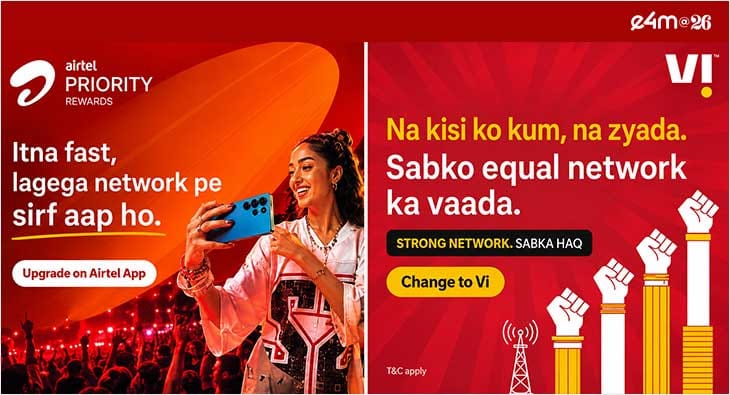

- Bharti Airtel has rebranded its "Priority Postpaid" service to "Fast Lane," igniting a broader debate in India's telecom sector about 5G network slicing and net neutrality.
- Airtel positions itself as a premium service provider, while Vodafone Idea (Vi) advocates for fairness and equal treatment for all users, leading to a notable advertising rivalry.
- The discussion highlights a shift in telecom marketing from technical features to emotional branding, with Airtel focusing on premium experiences and Vi emphasizing equitable access.
- Regulatory scrutiny has emerged regarding net neutrality, as the debate raises questions about user-tier discrimination and consumer rights in the evolving telecom landscape.
Bharti Airtel's decision to rebrand its "Priority Postpaid" offering as "Fast Lane" may appear to be a simple marketing tweak, but the move has opened up a much larger battle brewing within India's telecom sector.
What began as a debate around 5G network slicing and net neutrality has rapidly evolved into a clash of competing brand philosophies. While on one side stands Airtel, positioning itself as a premium service provider promising superior experiences for customers willing to pay more. On the other is Vodafone Idea (Vi), which has seized the opportunity to champion fairness and equal treatment for all subscribers.
The resulting exchange has become one of the most interesting telecom advertising battles in recent years, reflecting how operators are increasingly looking beyond traditional network claims to differentiate themselves in a mature market.
In May Airtel launched Priority Postpaid plans powered by 5G network slicing technology. The technology allows operators to create dedicated virtual lanes within their networks, enabling differentiated service experiences for specific users.
Soon after, critics questioned whether creating priority access for one category of users could undermine the principle of net neutrality. The discussion gained momentum online and eventually attracted regulatory scrutiny.
Amid the debate, Airtel quietly removed references to "Priority Postpaid" from its website and app, replacing them with the "Fast Lane" branding. The underlying technology, however, remains unchanged.
Industry experts argue that the discussion has often overlooked the actual functionality of the service.
"Airtel Priority creates a dedicated virtual slice of Airtel's 5G network for postpaid users. It separates them from the bulk of prepaid traffic. It is like a HOV lane on a highway during rush hour," said Sandeep Goyal, Managing Director of Rediffusion.
According to Goyal, the proposition is designed primarily for congested environments where connectivity becomes critical. "Priority works for traffic-jam, packed concerts and crowded-market situations where video calls drop or UPI fails. Airtel says it provides a stable and dependable experience, not necessarily faster speed," he said.
The technology itself is hardly experimental. Similar network-slicing deployments are already operational across markets such as the US, Singapore, the UK and Malaysia. Airtel's move is notable because it represents one of the first attempts to extend the capability to mass-market consumers in India.
Yet the bigger story may not be technological at all.
For decades, telecom advertising in India revolved around functional benefits. Operators battled over call rates, roaming charges, SMS packs, network coverage and data pricing. During the 4G era, campaigns shifted towards download speeds, streaming quality and network superiority.
Today, however, the sector faces a different challenge.
With networks becoming increasingly comparable and mobile internet evolving into an essential utility, operators are finding it harder to stand apart through technical claims alone. That reality is pushing telecom brands towards emotional positioning and lifestyle-oriented storytelling.
"What we're seeing now is less of a network-speed war and more of a perception war," said Yasin Hamidani, director at Media Care Brand Solutions. "Brands are trying to own emotional territories rather than technical features."
According to Hamidani, the current exchange reflects a broader shift across the industry, where companies are attempting to build distinct identities beyond tariff plans and coverage maps.
That evolution is evident in the contrasting approaches adopted by Airtel and Vi.
Airtel's messaging is rooted in premiumisation. The company is effectively telling consumers that connectivity has become so critical to everyday life that paying extra for a more dependable experience is a rational choice. The proposition mirrors trends across sectors ranging from banking and aviation to e-commerce, where customers routinely pay premiums for faster service, priority access and greater convenience.
Vi, meanwhile, has chosen to challenge the idea at a philosophical level.
Rather than debating the technology itself, the operator has framed the conversation around fairness. Its communication implicitly asks whether some users should receive preferential treatment on a network simply because they pay more.
For Syed Amjad Ali, brand consultant and former president of Mullen Lintas, both strategies are aimed at distinct consumer mindsets.
"Airtel's messaging is built around premiumisation—offering customers the feeling of being valued and prioritised," Ali said. "Vodafone Idea, on the other hand, is leaning into accessibility and fairness."
The effectiveness of either strategy, he added, will ultimately depend on whether the customer experience matches the promise being made.
The confrontation also highlights a broader reality about modern India: consumers are increasingly divided between those who actively seek premium experiences and those who continue to value equitable access.
"One India is increasingly aspirational. It pays extra for airport lounges, express delivery, premium banking and concierge services," said Himanshu Arora, co-founder of Social Panga. "The other India still believes essential services should remain democratic and equitable."
According to Arora, this is what makes the Airtel-Vi exchange particularly compelling. "The conversation has moved beyond network capabilities and technical features to focus on what consumers value most in a connected world."
The debate has also raised questions about regulation and consumer rights. While Airtel faced reviews from the Department of Telecommunications and the Telecom Regulatory Authority of India (TRAI), industry observers note that current net-neutrality regulations are largely focused on preventing content discrimination rather than differentiated service tiers.
"My personal view is that user-based discrimination—where postpaid customers get better quality than prepaid users—is perfectly okay," Goyal said. "Current rules ban content discrimination, not user-tier discrimination."
Whether regulators eventually take a different view remains to be seen. But from a marketing perspective, the battle has already achieved something significant: it has transformed a complex technical issue into a mainstream consumer conversation.
Industry executives believe the episode offers a glimpse into the future of telecom advertising in India.
As network capabilities converge and connectivity becomes further embedded in daily life, operators are likely to invest more heavily in building emotional connections and distinctive brand identities. The next phase of competition may be less about spectrum and speeds, and more about the values brands choose to represent.
For consumers, however, one reality remains unchanged.
No matter how sophisticated the storytelling becomes, telecom remains a category where performance is experienced every day. A dropped call, failed payment or interrupted video stream can quickly undermine even the most compelling brand proposition.
The Airtel-Vi battle may have shifted the conversation from technology to ideology, but the eventual winners will still be determined by the quality of the experience they deliver once the advertisements end.
Read more news about Internet Advertising India, Marketing News, PR and Corporate Communication News, Digital Media News, Television Media News
For more updates, be socially connected with us onInstagram, LinkedIn, Twitter, Facebook YouTube & Google News