Rakhi Sawant Birthday: Revisiting actress’ snowy metro moment with CRED Foundation
As Rakhi Sawant celebrates her birthday today, revisit the CRED Foundation film that brings her trademark humour to an unusual winter setting to explain loan stacking
 by
Published: Nov 25, 2026 9:07 AM | 9 min read
 Follow Us

- Rakhi Sawant stars in a new CRED Foundation campaign titled "avoid loan stacking," aimed at promoting financial literacy and addressing the issue of borrowers holding multiple loans.
- The campaign features four short films, with Sawant's performance characterized by a calm delivery of complex financial concepts, contrasting her typically theatrical public persona.
- CRED Foundation, a non-profit arm of the fintech platform, seeks to make financial literacy accessible to all, moving away from traditional finance advertising that audiences often overlook.
- While the campaign successfully captures attention and conveys important lessons, its effectiveness in reaching a broader audience and prompting actionable behavior remains to be evaluated.
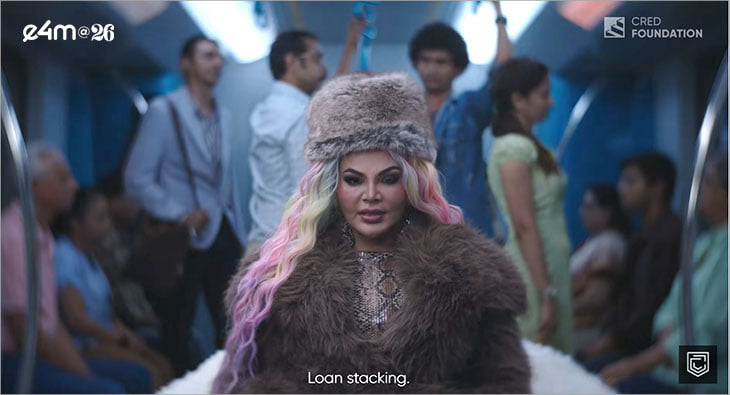
Picture a metro coach, a patch of fake snow, a snowman for company and Rakhi Sawant in a full winter ensemble, lamenting that the Alps are beyond her budget. Nobody on the train bats an eyelid and neither does she. It is a premise that would sit comfortably in any CRED film from the last six years, except this time the brief isn't a rewards programme or a UPI feature. It is loan stacking. And what better way to wish Rakhi Sawant a very happy birthday than to take a closer look at the film where she teaches the nation about debt.
Nearly three decades of cut-through
Before the film, a detour, because Rakhi's own story explains why this casting works. Rakhi Sawant, the actor, dancer and media personality born Neeru Bheda on 25 November 1978, made her screen debut in 1997 with Agnichakra under the name Ruhi Sawant. Her early years consisted of dance numbers in films such as 'Joru Ka Ghulam' and 'Yeh Raaste Hain Pyaar Ke'. By the time the film 'Krazzy 4' came along in 2008 with the item song 'Dekhta Hai Tu Kya', she had turned the item number into a calling card.
Television is where she built the real IP. She was part of the very first season of 'Bigg Boss' in 2006, finished as runner-up on 'Nach Baliye 3' and in 2009 turned the search for a husband into a primetime event with 'Rakhi Ka Swayamvar'. She has kept returning to reality television since, reaching the finale of 'Bigg Boss 14' as a challenger and choosing to walk out with ₹14 lakh, finishing as fourth runner-up on 'Bigg Boss Marathi 4' with a ₹10 lakh walk-out, and re-entering the Marathi house this year as a wild card. Few contestants have played the economics of the format as well as she has.
In marketing terms, that longevity makes her a rare asset: a celebrity whose cut-through does not depend on a release calendar. She is native to Instagram, turns every paparazzi frame into content and carries a recognition that cuts across language, class and geography.
Even in recent weeks she has been busy, with a cameo in Pakistani actor Hania Aamir's debut single Pablo earlier this year and a very public campaign asking Salman Khan to cast Hania opposite him in his next film, backed by calls and emails from her own account. She has also spoken candidly in a recent interview about the dreams she carried into Bollywood and the personal hardships that bent her path. That is a lot of meme equity and a lot of heart, and a financial literacy brief that needs people to stop scrolling has few better starting points.
avoid loan stacking ft. Rakhi Sawant
The film, titled ‘avoid loan stacking’, is the first work from CRED Foundation, the Section 8 not-for-profit arm of the fintech platform, funded through equity voluntarily put in by CRED's leadership, team and investors. The Foundation is built on the belief that creditworthiness should not be a luxury reserved for affluent consumers, and its debut campaign comprises four films of under 60 seconds each, rolled out across Instagram, YouTube and JioHotstar.
Rakhi, an actor and media personality, opens the series. Actor Disha Patani closes it. Miten Sampat, interim CEO of CRED, has pitched the campaign as a first step towards making financial literacy a right for every Indian, starting with the jargon that has long wrapped the subject.
For a brand that built its reputation on celebrity flips where the star is the joke and the product is the payload, the Foundation films keep the joke and swap the payload for a lesson. That is a harder trade than it sounds. A rewards pitch only has to survive one watch, while a lesson has to survive the laugh. So the real question is whether the Rakhi film pulls it off, and whether the films around it keep pace.
A topic that needs a snowman
Loan stacking is not an academic worry. Credit bureau data shows the share of borrowers holding two or more active loans climbing from 37.2% in June 2023 to 43.5% in June 2025, a rise that may reflect product diversification but also points to over-leverage. TransUnion CIBIL, one of India's four credit information companies, reported in July 2026 that delinquency touched 8.7% in one cohort of experienced card users juggling multiple personal loans, well above the portfolio average. Moneylife Foundation, a Mumbai-based consumer advocacy non-profit that runs credit counselling, examined 110 lending apps for a July 2026 study and has pushed for caps on how many digital loans one borrower can hold.
Which is exactly why the subject deserves better than a chart and a worried voiceover, the default grammar of finance advertising that audiences have learnt to scroll past. CRED's answer is to win attention first and teach second, and in this category that is not a gimmick.
It is the only sensible order of operations.
Why the casting clicks
Sawant's public persona runs on volume, so the lazy route would have been to let her be loud. The film does the opposite. She walks through the debt spiral in fluent, composed, almost corporate-trainer deadpan, taking it one rung at a time: a second loan to clear the first, a third to clear the second, a fourth to clear the third, until a voice off camera politely tells her the audience has got it. She then moves to compound interest; the metro brakes without warning, she hits the floor face first and the Great Depression gag lands. The humour lives in the gap between the calm of the delivery and the chaos of the setting.
The craft call worth applauding is sequencing. The explanation gets real screen time before the gag arrives, so the lesson is not a sticker slapped on a joke. She signs off by pointing out that money is not the root of all evil; its absence often is, which is the one genuinely useful reframe in the film because it nudges viewers to fix the shortfall instead of borrowing over it. In a 60-second format, that is a lot of ideas per frame.
The Dravid test
The obvious yardstick is CRED's 2021 film that turned Rahul Dravid, the former India captain and a byword for composure, into the Indiranagar ka gunda, smashing a car mirror in Bengaluru traffic. That film worked because it spent years of banked public image in one stroke; the further the man was from the act, the louder the laugh. It also kept the product in frame, with actor Jim Sarbh walking viewers through the bill-payment rewards before the chaos began. Recall followed, with a study by the Indian Institute of Human Brands reportedly pegging spontaneous recall of the Dravid film at 17%.
Rakhi, however, brings a different kind of appeal. Her image is already built on theatrics, so the flip is not the chaos but the restraint, and the surprise is a diva reading out the arithmetic of debt with a straight face. It is a cleverer inversion than it first appears, but also a softer one. Brands have been casting her with increasing frequency, including a recent beauty film for Nykaa, so the novelty premium is thinner than what Dravid's casting ever carried. There is also a difference in what the film asks the viewer to hold on to. Dravid's ad sold a reason to open the app. Rakhi's sells a concept, and with no reward on screen to anchor recall, that is the tougher brief.
Sameness creeps in by film four
Sonam Bajwa's film plays the bounce in her hair against a bounced EMI, a piece of wordplay that lands the consequence in a single image. Disha Patani then closes the series on 22 October with a film titled ‘look beyond the obvious’. Stranded on an island with one companion, she builds up a reveal that turns out to be her own face emerging from behind a book, and uses the moment to flag the fine print most borrowers skip: convenience, processing, platform and service fees. A rising tide sweeps the companion away and the film signs off with a check before you pay message. The tide is a neat visual payoff and the hidden charges brief is a genuinely useful one.
But watch the films back-to-back and the template shows: celebrity, absurd setting, pivot to a lesson, pithy sign-off. In Rakhi's film, that sequence feels fresh because the lesson is woven into the gag. In Disha's, the reveal is a hook and the lesson is bolted on after it, and the link between a face behind a book and fee transparency is looser than the link between a snowy metro and a debt spiral. The series starts with an idea and ends with a format. That is not fatal, since CRED's best work has always been serial, but a four-film arc usually earns sharper escalation than its opener.
The reach question
The bigger test is audience. The people most exposed to stacked app loans are not necessarily CRED's core base, a platform that has historically been gated by strong credit scores. The Foundation exists to widen that circle, which makes the media plan as important as the creative. Instagram, YouTube and JioHotstar offer scale and tend to skew urban, so vernacular and tier-two cut-through will decide whether the lesson travels beyond people who already know what an EMI bounce costs.
There is also a missing last mile. The film closes on its punchline, and a closing pointer to where a stacked borrower can seek help or check existing exposure would have turned recall into action. A not-for-profit film can afford that kind of earnest sign-off in a way a brand film cannot.
The verdict
As a first outing, the Rakhi film does what the Foundation needed. It earns attention in a category that usually loses it in three seconds, and it teaches a real concept in under a minute without talking down to anyone. Dravid sold the app, Rakhi sells a concept and Disha sells a habit, and the arc from one to the next shows a brand slowly trading surprise for utility. The attention test is passed. The comprehension and behaviour tests are still open. CRED has proved it can make a snowman memorable; the next job is making sure the debt lesson outlives it.
On a day that belongs to Rakhi, the best thing about this film is how fully she commits to it. Happy birthday, and here's to many more briefs that let her be this entertaining and this useful.
Read more news about Internet Advertising India, Marketing News, PR and Corporate Communication News, Digital Media News, Television Media News
For more updates, be socially connected with us onInstagram, LinkedIn, Twitter, Facebook YouTube & Google News