Bisleri says all 143 plants comply with FSSAI norms, welcomes regulator's clarification
Company says sale prohibition is limited to one Goa-manufactured batch from September 2025, with no stocks currently in the market
 by
Published: Nov 24, 2026 6:38 PM | 3 min read
 Follow Us

- Bisleri confirmed that its packaged drinking water is safe and that all 143 operational plants comply with FSSAI regulations, addressing a recent prohibition on a specific batch (GO 270) produced on September 27, 2025.
- The FSSAI clarified that the prohibition applies only to Batch GO 270, which was found to have bromate levels exceeding permissible limits, while other samples from the same source met safety standards.
- Bisleri stated that no stock from the affected batch is in the market and emphasized that it has not received any directive to suspend operations at its Goa plant.
- The company plans to cooperate with the FSSAI, defend its position in any legal proceedings, and seek legal action against misinformation regarding the safety of its products.
The article was originally published in BW Businessworld
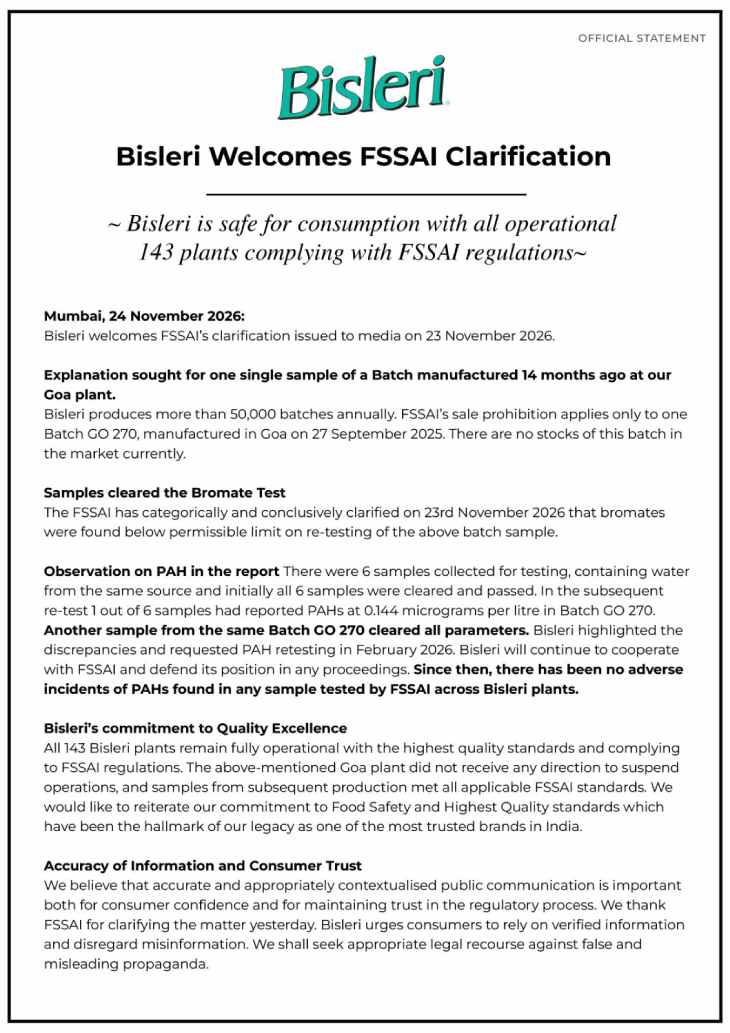
Bisleri said on Tuesday that its packaged drinking water is safe for consumption and that all 143 of its operational plants comply with FSSAI regulations. It welcomed the food regulator’s clarification of a day earlier on a sale prohibition that applies to just one batch.
In an official statement, the company said the prohibition covers only Batch GO 270, made at its Goa plant on September 27, 2025. It said the company makes more than 50,000 batches a year and that no stock of this batch is in the market. The Goa plant received no direction to suspend operations, and samples from later production met all FSSAI standards, it added.
Bisleri pointed to the FSSAI’s 23 November clarification that bromates were below the permissible limit when the batch sample was retested. On PAHs (polycyclic aromatic hydrocarbons), it said six samples from the same water source were collected and all initially passed. In a later retest, one of the six showed PAHs at 0.144 micrograms per litre. Another sample from the same batch cleared all parameters, it said. The company said it flagged the discrepancies and asked for PAH retesting in February 2026, and that no adverse PAH findings have been reported in FSSAI-tested samples from its plants since.
The company said it will keep cooperating with the FSSAI and defend its position in any proceedings. It urged consumers to rely on verified information and said it will seek legal recourse against “false and misleading propaganda”.
What Happened?
The row began over the weekend. On 22 November, the FSSAI sanctioned prosecution against Bisleri under the Food Safety and Standards Act and prohibited the sale of that one batch. Reports on Monday morning said the regulator had declared a Bisleri water sample unsafe, and that caused alarm among consumers.
Bisleri responded on Monday that its products were safe. It said the matter went back about 14 months to a single batch from its Goa facility, one of 143 plants, and that it had received no official notice. It said it sent independent test results to the FSSAI’s Western Regional Office in a letter dated February 2, 2026, and heard nothing further, so it understood the matter to be closed.
Later on Monday, the FSSAI issued its own clarification. The regulator said only one sample from one batch (GO 270) at the Goa plant was non-compliant, and that it had issued a prohibition order under Section 36(3) of the FSS Act. The referral laboratory, NFL in Navi Mumbai, detected PAH at 0.000144 mg/l in that sample, though bromate was below the limit of quantification and within prescribed limits. The FSSAI said under FSS Rule 2.4.6, a referral laboratory’s findings are final when a food business operator appeals a primary lab result. The company was directed to carry out a root cause analysis.
Background
According to Bisleri, the FSSAI collected six samples from the Goa facility on 30 September 2025. One sample, from Batch GO 270, reportedly showed bromate at 12 micrograms per litre against a limit of 10. Bisleri’s statement describes the initial results, saying all six samples passed at first, so the sequence of early test results is still disputed.
The FSSAI has stressed that only one batch is affected. Reports also note that the order is a sanction for prosecution and not a conviction.
Read more news about Marketing News, Advertising News, PR and Corporate Communication News, Digital News, People Movement News
For more updates, be socially connected with us onInstagram, LinkedIn, Twitter, Facebook, YouTube & Google News