Leaders decode the challenge of building ‘One Brand Story, Every Screen, Every Platform’
At the 5th edition of e4m Pitch BrandTalk 2026, marketing leaders discussed how brands can maintain a consistent identity across an increasingly fragmented media landscape
 by
Published: Nov 25, 2026 8:21 AM | 10 min read
 Follow Us
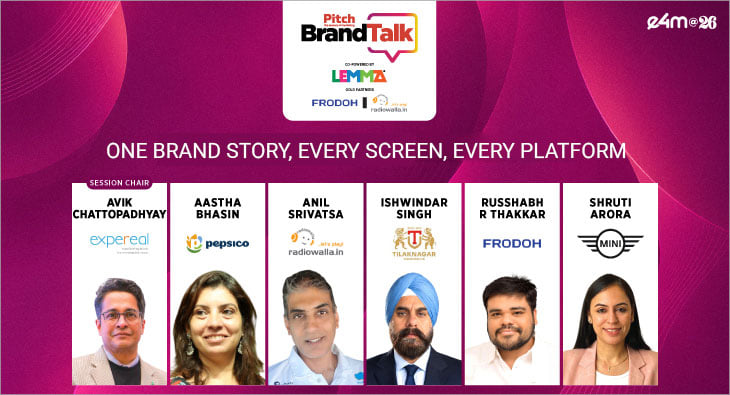

- The panel discussion at e4m Pitch BrandTalk 2026 focused on the complexities of maintaining a consistent brand narrative across multiple consumer touchpoints, featuring industry leaders from PepsiCo, Tilaknagar Industries, and BMW India, among others.
- Key insights included the importance of adapting brand messaging to different platforms while preserving core identity, as illustrated by PepsiCo's 5S framework and Tilaknagar's enduring 'Men Will Be Men' campaign.
- The conversation also highlighted the significance of physical retail environments and in-store communication, with emphasis on how audio and sensory experiences can enhance brand recall and consumer engagement.
- Panelists discussed the need for brands to evolve with consumer behavior and the media landscape, advocating for responsible marketing practices that balance visibility with consumer experience, while ensuring that brand stories remain recognizable across all platforms.
As consumers move seamlessly between television, social media, digital platforms, retail spaces and physical experiences, maintaining a consistent brand narrative has become an increasingly complex task for marketers. While the number of consumer touchpoints continues to multiply, the challenge for brands is to ensure that their identity and promise remain recognisable across every interaction.
This formed the central discussion at the panel titled 'One Brand Story, Every Screen, Every Platform' at the 5th edition of e4m Pitch BrandTalk 2026. The session brought together Aastha Bhasin, Marketing Director – Potato Chips Category, PepsiCo India; Anil Srivatsa, Co-Founder & Director, Radiowalla Network; Ishwindar Singh, Senior Vice President – Marketing, Tilaknagar Industries; Russhab R Thakkar, Founder & CEO, Frodoh; and Shruti Arora, Head of Marketing – MINI, BMW India Pvt. Ltd.. The discussion was chaired by Avik Chattopadhyay, Co-founder & Partner, Expereal.
Setting the context, Chattopadhyay recalled a definition of a brand shared by brand consultant Wally Olins: "The brand is the promise of an experience, but delivered consistently over time." He added that in today's media environment, this promise needs to be delivered consistently across every screen and platform.
The conversation began with Ishwindar Singh, who unpacked the longevity of Tilaknagar Industries' iconic 'Men Will Be Men' campaign for Mansion House. Nearly 29 years after its inception, the campaign continues to build on humour and the everyday quirks of men, without losing its core identity.
"It's clearly a brand which has been built on a story of consistency," Singh said, explaining how the campaign has maintained its central thought even as its executions have evolved over the years.
He pointed out that the campaign brought a different perspective to a category where advertising traditionally focused on preparing consumers for another demanding day. Instead, it created a space for men to switch off, enjoy humour and spend time with friends.
"What you had to do was switch off and get into a moment of time where you were there with your own humour, with your close friends and having a good time. I think that's what we brought to the category," he said.
Singh also emphasised that the campaign's appeal is not restricted to India, noting that the brand is present in 44 countries. While consumer behaviour and cultural contexts differ across regions, the underlying idea has remained consistent.
Addressing how the portrayal of men has changed over the years, he said, "Men have evolved. It's not that they haven't changed." He added that the brand has continued to reflect positive aspects of masculinity, with its recent film bringing back the idea of chivalry.
For Singh, consistency has also been strengthened by the campaign's distinctive sonic identity. He described its signature ghazal as an important part of the brand's recall, adding that consumers often want to hear the complete song whenever a new campaign is released.
Moving to the challenge of maintaining a unified narrative across multiple touchpoints, Aastha Bhasin of PepsiCo India explained how brands need to preserve their central identity while adapting communication to the context of individual platforms.
"The core brand has to remain consistent. The message has to remain consistent. The screens would change," Bhasin said, highlighting that every platform comes with its own audience, context and consumption behaviour.
Sharing PepsiCo's approach to building Lay's brand presence, she explained the company's internal 5S framework: Stream, Scroll, Shop, Search and Sense. The framework helps the brand translate its central proposition across broadcast media, social platforms, retail and consumption occasions.
Using the 'Lay's Ke Liye Kuch Bhi' campaign as an example, Bhasin explained how the brand adapted its storytelling across different platforms. While television was used to establish an entertaining brand story, social media opened up the campaign to audience participation and creator-led expressions.
She cited the campaign's outdoor executions, including billboards showing people going to extraordinary lengths to get a packet of Lay's, as examples of translating the same idea into different media contexts.
"The whole is only to retain that core of the brand, but not really the way it is expressed in the larger audience," she said, explaining how brands can maintain their identity without restricting the creative freedom of individual platforms and creators.
On the growing role of influencer-led communication, Bhasin stressed that authenticity should not be compromised by excessive brand control.
"When we use a creator, I think we realise the power of their local expressions. They have a style, that's why they have a community. They have a way to bond with their audiences. So we don't want to compromise on that," she said.
She added that the responsibility of the brand is to protect its core values while allowing creators the freedom to communicate in their own voice.
Bhasin also discussed how PepsiCo's wider snacking portfolio addresses different consumer needs and occasions through brands such as Lay's, Uncle Chipps, Kurkure and Doritos. Addressing growing health consciousness, she explained the company's consumer-centric approach through what she described as a debit-credit mindset.
"It's not like every single consumer is like, 'I will only debit or I will only credit'. Through his day and through his week, he finds moments of debit and he finds moments of balancing that with a credit," she said, explaining how the portfolio caters to different consumption preferences and occasions.
Bringing another dimension to the discussion, Anil Srivatsa of Radiowalla Network highlighted how brands often overlook the physical retail environment while planning their omnichannel communication strategies.
Clarifying Radiowalla's business model, he said, "We're not an FM station. But we run almost 10,000-plus live radio stations every day in businesses."
From shopping centres and restaurants to retail stores and elevators, the company operates in-store audio networks and screens that allow brands to communicate with consumers at the point of purchase.
Using Lay's as an example, Srivatsa explained how brands need to carry their communication right up to the moment of purchase. He pointed out that while consumers may encounter advertisements across television and digital platforms, the final retail interaction is equally important, particularly when competing products are placed alongside each other.
"You keep saying screen, screen, screen, but there's also speakers, because at the time where there are speakers, there are no screens. It's a media dark space, and they spend 35 to 40 minutes in that space. How do you reach them?" he asked.
He argued that in-store audio can help brands close the gap between awareness and purchase by communicating with consumers when they are making decisions.
"The medium doesn't fail or succeed. It's the messaging on that medium that fails or succeeds," Srivatsa said.
He also shared the example of Amazon Pay, which conducted pilots across retail stores to encourage shoppers to use the payment platform. Following the results, the campaign expanded across the network, which covers an estimated 700 million footfalls.
Srivatsa further highlighted the possibilities of combining audio, visual and even olfactory experiences to strengthen brand recall. He explained how fragrances in retail and hospitality spaces can become distinctive brand identifiers, while also improving the overall customer experience.
The conversation then moved to the luxury automobile segment, with Shruti Arora of MINI India explaining why brand consistency should not be mistaken for repetitive communication.
"Consistency is not repetition at all," Arora said, pointing out that while the central brand promise must remain intact, the way it is expressed needs to evolve with consumers and markets.
She observed that even high-involvement categories such as automobiles need to engage consumers across multiple touchpoints, particularly as audiences become more exposed to choices and information.
For MINI, the brand's distinct personality is built around individuality, self-expression, British humour and its go-kart driving experience. Arora explained that these characteristics need to be visible across everything the brand does, from advertising and visual identity to dealership experiences.
She highlighted initiatives such as MINI's Go-Kart Days, which encourage customers to experience their cars on a go-kart track, and night test drives that offer a different way of experiencing the vehicle.
"The moment of truth is when you drive it, when you experience it," she said, stressing that digital communication cannot replace the physical experience of an automobile.
Arora also spoke about the importance of maintaining MINI's distinct identity within the BMW Group. While both brands operate in the premium automobile space, MINI's British humour, distinctive design elements and individualistic personality help differentiate it from BMW.
Sharing another insight into the brand's consumer base in India, she said that a significant proportion of MINI's sales comes through loyalty and referrals, underlining the importance of its customer community.
Adding the perspective of the digital advertising ecosystem, Russhab R Thakkar of Frodoh discussed how brands need to communicate across connected TV, social media and emerging digital formats.
Drawing parallels with iconic Indian brand storytelling, he cited Amul's topical advertising, alongside 'Men Will Be Men', as examples of how consistency can sustain a brand's identity over several decades.
Thakkar explained that connected TV offers a more relaxed, shared viewing environment, while social media and other digital platforms provide opportunities for deeper interaction.
He emphasised that the promise communicated through a television advertisement needs to remain relevant when consumers encounter the brand again on digital platforms or at the point of purchase.
"Medium will only be utilised if the messaging is right," he said, highlighting that the effectiveness of a platform ultimately depends on the relevance of the communication it carries.
The panel also examined a growing concern around advertising intrusion, particularly on streaming platforms. Chattopadhyay questioned whether excessive or irrelevant advertising could eventually lead to consumer backlash, especially when advertisements interrupt the viewing experience.
Responding to the concern, Thakkar acknowledged that relevance and context are important considerations. He explained that advertising-supported content remains an important part of the streaming ecosystem, allowing audiences who may not be able to afford subscriptions to access content.
He argued that brands and platforms need to ensure that advertisements are relevant to the content and viewing context rather than simply using available inventory.
The discussion brought the panellists back to the larger question of how brands should approach experimentation in a rapidly changing media environment.
Singh said that while brands need to evolve with consumer behaviour, they do not necessarily need to follow every emerging trend. Sharing the example of Mansion House's collaboration with comedians through its 'Men Will Be Men' content, he explained that the brand continues to explore new formats while staying rooted in its established association with humour.
Bhasin highlighted the speed of India's digital transformation and the need for the industry to evolve responsibly.
"The only word which we live by is responsible marketing," she said, adding that experimentation and evolution would continue as the industry collectively establishes new benchmarks.
Arora, meanwhile, acknowledged that while advertising across multiple screens and platforms is becoming increasingly common, consumers may also develop a certain acceptance of these interactions as part of their everyday media consumption. However, she noted that brands would need to continue navigating the balance between visibility and intrusion.
Wrapping up the discussion, Chattopadhyay brought the conversation back to the central idea of the session: building one recognisable brand story without treating every platform as an identical communication channel.
The panel underscored that consistency comes from protecting a brand's core identity, while allowing its expression to change according to the medium, audience and moment and highlighted how the future of brand storytelling will depend on connecting these experiences without losing sight of what the brand stands for.
Read more news about Marketing News, Advertising News, PR and Corporate Communication News, Digital News, People Movement News
For more updates, be socially connected with us onInstagram, LinkedIn, Twitter, Facebook, YouTube & Google News