Narayana Murthy reignites debate, calls for 72-hour work week again
In a recent interview, the Infosys co-founder has cited China’s 9-9-6 model and urges young Indians to “work harder before seeking balance”
.png) by
by
Published: Nov 19, 2025 12:03 PM | 3 min read
 Follow Us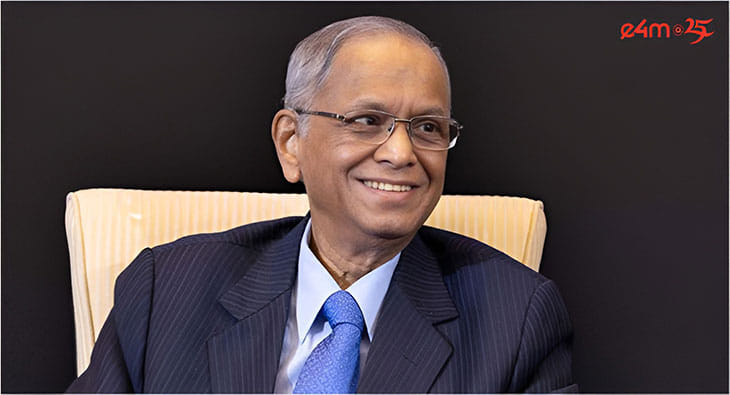

Infosys co-founder N. R. Narayana Murthy has once again sparked nationwide debate after advocating a 72-hour work week during a recent interview on Republic TV. Speaking about India’s economic ambitions, Murthy said that extraordinary national progress requires extraordinary effort — and that young Indians must be prepared to put in significantly longer hours.
“9-9-6 means 72 hours — that’s how China got ahead”
In the interview, Murthy reiterated his now-familiar stance, stating:
“There is a saying in China — 9, 9, 6. You know what it means? 9 a.m. to 9 p.m., six days a week. And that is a 72-hour week.”
He added that young Indians should focus first on building their careers and discipline before seeking work-life balance. According to him, every citizen — from bureaucrats to politicians, entrepreneurs to employees — must set higher benchmarks if India wants to compete globally.
What is the 9-9-6 model?
The 9-9-6 model refers to a work schedule once common in China’s fast-growing tech and manufacturing sectors: 9 a.m. to 9 p.m., six days a week, totalling 72 hours. It became emblematic of China’s breakneck economic rise and an unofficial standard in many tech companies.
However, the model later faced intense backlash for promoting exploitative work culture, leading to public criticism, worker protests. Despite this, it remains a symbol of extreme productivity — and a benchmark Murthy continues to reference.
Not the first time Murthy has pushed for longer work hours
Murthy has spoken about this issue several times in recent years. In 2023, he asked Indian youth to commit to 70 hours a week to accelerate national growth. His latest comments slightly extend that figure and reintroduce the debate, insisting that India must match or exceed global competitors in sheer effort if it wants to catch up.
Social media reacts: frustration, disbelief and some support
His remarks have triggered a wave of reactions across social media platforms:
- Many users criticised the concept, arguing that long hours without systemic improvements—such as better infrastructure, fair pay, and employee protections—only increase burnout, not productivity.
“So will you pay on an hourly basis? No. You want employees to work 24×7 so that you can transfer shares worth ₹250 crore to your 9-month-old grandson and you pay that employee 3.6 lakhs per annum,” posted another user.”
- Several pointed out that China itself has moved away from 9-9-6, with its courts deeming it illegal, questioning why India should adopt a model another country is abandoning.
- Young professionals highlighted that Indian corporate workdays are already long, with commutes, weekend calls and “always-on” expectations pushing many close to burnout
“Great idea sir, but first give China-level salaries, infrastructure, and cost of living. Then we’ll talk.”
A debate that goes beyond hours
Murthy’s statement has once again opened larger questions:
What role does worker well-being play in long-term economic success?
And in an era of automation and AI, is the path to global competitiveness really through increasing work hours — or redesigning work itself?
As the divide between hustle culture and modern work-life expectations widens, Murthy’s comments have ensured that this national conversation is far from over.
Read more news about (internet advertising India, internet advertising, advertising India, digital advertising India, media advertising India)
For more updates, be socially connected with us onInstagram, LinkedIn, Twitter, Facebook YouTube & Whatsapp
