Not just an internet pipe, we’re digital experience platform: ACT FIBERNET’s Ravi Karthik
In this edition of e4m TechTalk, Ravi Karthik, Chief Marketing Officer of ACT FIBERNET, talks about the firm’s journey from being a regional internet provider to a non-telco broadband company
 by
by
Published: May 19, 2025 8:49 AM | 6 min read
 Follow Us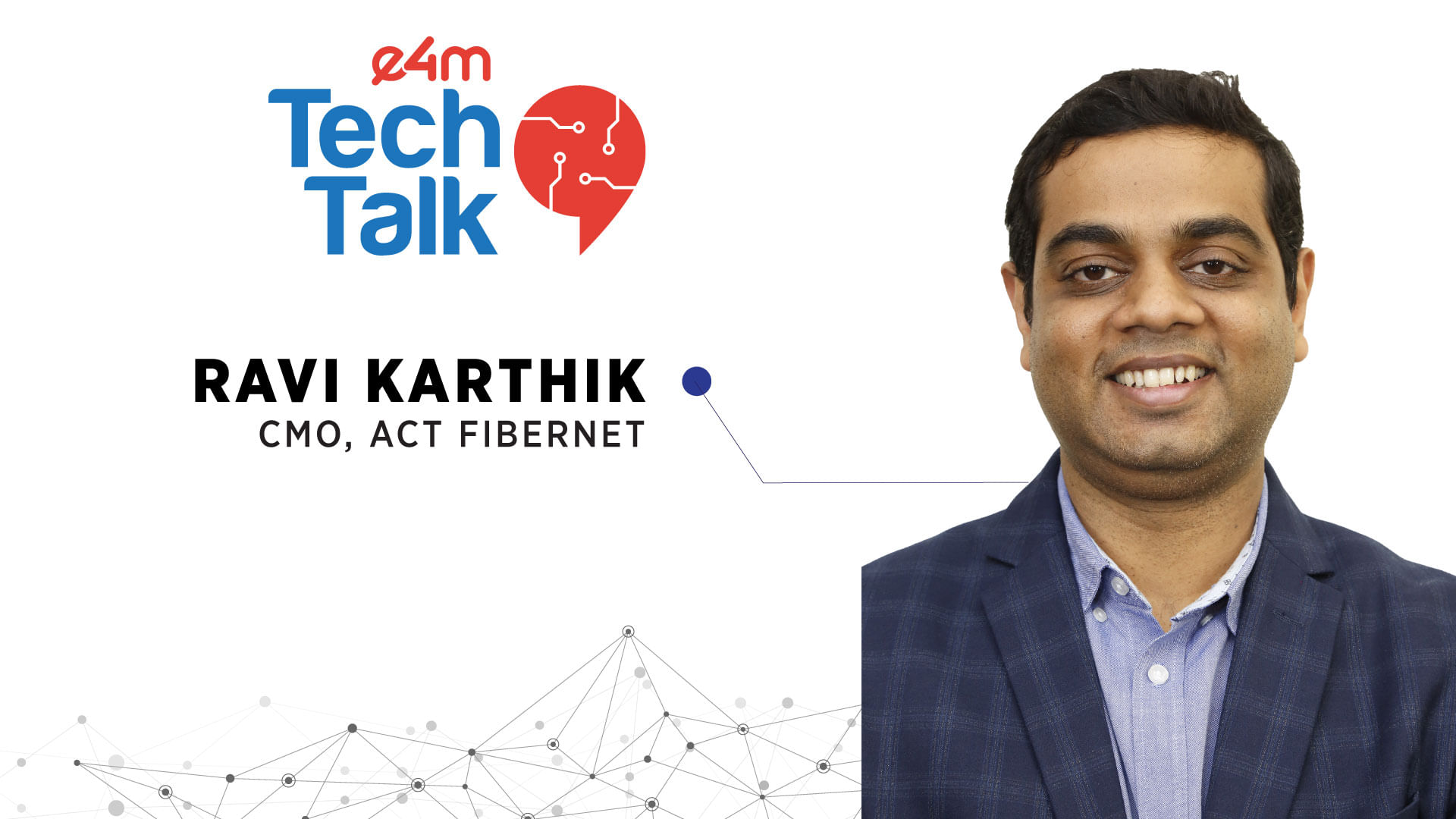

When Ravi Karthik, Chief Marketing Officer of ACT FIBERNET, talks about broadband, he doesn’t talk in dry numbers or network jargon. Instead, he paints a picture of a digital universe powered not by fiber alone, but by the seamless experiences those fibers enable.
“Consumers don’t care about Mbps,” he says matter-of-factly. “They care about whether their Zoom call stutters, their kid’s online class buffers, or their 4K stream drops to 720p.”
It’s this nuanced understanding of customer behavior—equal parts data and empathy—that’s helped ACT FIBERNET transform from a regional internet provider into India’s largest non-telco broadband company.
Headquartered in Bangalore but launched originally in Hyderabad, ACT (short for Atria Convergence Technologies) has, since 2010, focused on building a service-led, innovation-first internet company. While telcos like Jio and Airtel boast customer bases of 13-14 million, ACT operates with a laser focus on high-speed fixed-line broadband, currently serving 2.3 to 2.5 million customers in broadband and around 1.8 million in cable.
Karthik describes ACT as “market leaders in Bangalore, Hyderabad, and several Tier-1 and Tier-2 towns across the south.” But growth, he says, is no longer just a southern story. “We’ve been rapidly expanding into the north—Delhi, Ghaziabad, Jaipur, Lucknow, Ahmedabad—and we’ve just piloted Pune.”
However, this is no scattershot expansion. Karthik outlines a strategic approach: start with a major metro, then scale to satellite towns. “We set up in the big city first, then extend to surrounding Tier-2 and Tier-3 towns. That way, demand and support scale naturally.”
This measured approach comes from a company with a pioneering past. In 2016, ACT launched India’s first 1 Gbps home broadband plan—well before most players had crossed 50 Mbps. “When others were doing 1 or 2 Mbps, we were at 10, 20, 25. Speed has always been our calling card,” Karthik says.
But speed, he insists, is not enough. “At one point, our brand positioning was ‘Incredibly Fast’. But by 2018, we shifted to ‘Feel the Advantage’. Because customers today want more than just bandwidth—they want reliability, experience, and innovation.”
Innovation, in ACT’s case, comes bundled with foresight. As far back as 2018, they partnered with Netflix to bundle content with connectivity. A year later, they were collaborating with World of Warships to enhance the gaming experience. “We’ve always seen ourselves as an enabler,” he explains. “Whatever a customer wants to do with Wi-Fi—stream, game, learn, work—we want to make it better.”
Today, with smart homes, connected TVs, IoT devices, and work-from-home routines becoming commonplace, the demands on home Wi-Fi have never been greater. And ACT has responded with what might be one of the most under-hyped but over-performing innovations in the broadband space: Smart Wi-Fi.
Developed through a strategic investment in a tech company, ACT’s Smart Wi-Fi leverages real-time AI to monitor and optimize home network environments. The product, named Zippy, is baked into the router’s firmware and scans the home continuously, adapting channel frequencies, bandwidth allocations, and interference management based on actual usage.
“Wi-Fi is a broadcast medium,” Karthik explains. “You’ve got five routers in a 100-foot radius, walls, microwaves, phones, smart TVs—all creating noise. Zippy learns what each device is doing, understands whether it’s a 4K stream or a WhatsApp call, and optimizes accordingly.”
The result? Up to a 2x improvement in perceived Wi-Fi speeds, dramatically fewer buffering incidents, and what Karthik calls “an uninterrupted digital lifestyle.”
For instance, if Zippy detects a user watches 4K Netflix daily at 8 PM, it reserves bandwidth and a clean channel ahead of time. “It’s not a gimmick,” he insists. “It’s real-time AI making sure your internet just works, every single time.”
Of course, not all innovation lives in silicon and signal chains. ACT’s marketing strategy is equally evolved. Traditional mass media still plays a role, but it’s shrinking. “We were on linear TV and print until the pandemic,” says Karthik, “but now we’re big on YouTube, Instagram, connected TV, and especially influencer campaigns.”
The company deploys a “barbell strategy,” mixing broad-reach digital campaigns with hyperlocal initiatives. “This is a research-heavy category. People don’t just Google and buy broadband. They ask on WhatsApp apartment groups—‘Which provider works best here?’”
Accordingly, ACT activates local campaigns in societies and gated communities—events, activations, even newspaper inserts. They’ve also tapped into the rising trend of digital out-of-home (OOH) screens inside apartment elevators and common areas. “India is verticalizing,” says Karthik. “Digital OOH in apartments is a great way to maintain an always-on presence.”
When entering new markets like Delhi-NCR or Ahmedabad, ACT begins with a mix of digital buzz and brand awareness through OOH and television. But the real muscle lies in grassroots activations and word-of-mouth. “We tell our existing customers in other cities that we’re entering Delhi. They refer friends and family. That works better than any ad.”
Interestingly, for a brand so plugged into innovation, commerce and retail media haven’t yet featured in ACT’s roadmap. “We’re watching it, but right now, our focus is on content, gaming, education—where the need for reliable broadband is most acute.”
What is acute, however, is the evolving role of the CMO. “It’s not enough anymore to just launch a campaign and measure ROI,” says Karthik. “Today’s CMO must understand SEO, performance marketing, AI, martech stacks—everything under the hood.”
That said, he sees the fundamentals as unchanged. “It still boils down to three things: driving growth, building the brand, and staying ahead—whether through innovation, insight, or experience.”
It’s a tall order, especially in a sector dominated by giants. But Karthik remains unfazed. “You don’t change broadband providers on a whim. You change when your experience breaks down. Our job is to make sure that never happens.”
As Indian homes become smarter, denser, and more digitally dependent, ACT’s approach feels less like a pipe and more like a platform. One that not only delivers internet, but elevates every byte that flows through it.
Read more news about Tech Talk, Marketing, PR and Corporate Communication, Internet Advertising, People Movement
For more updates, be socially connected with us onInstagram, LinkedIn, Twitter, Facebook, YouTube & Google News