Making purpose mainstream: How Girish Balachandran is reimagining PR impact in India
In today’s feature, we step into Girish Balachandran’s personal and professional journey, from discovering his passion for communication to the moment he chose to work “on purpose”
 by
by
Published: Nov 7, 2025 1:58 PM | 13 min read
 Follow Us

For Girish Balachandran, Founder at ON PURPOSE, purpose isn’t a branding buzzword, it’s a way of life. After 19 years in corporate communications, he set out to use his skills where they mattered most: in helping India’s social and development sectors tell stories that inspire action. Today, as a widely recognised storyteller and one of the top change-makers in communications, Girish leads ON PURPOSE, a consultancy that has become synonymous with integrity, creativity, and social impact. He is a great exemplar of reinvention as he reinvented purpose by starting a movement to help brands see the people behind their profits, to bring empathy into strategy, and to make social impact part of business ambition.
In today’s feature, we explore Girish Balachandran’s journey, from his early transition into communications to the defining “on-purpose” moment that reshaped his career. We delve into how he interprets purpose through the lens of communication, the strategies he relied on to navigate the challenges of being a first-time entrepreneur, the toughest leadership lessons he learned while building a purpose-driven agency in a profit-led industry, and the next big idea guiding his work today.
Excerpts:
You began your career as a chef and later transitioned into communications. What first drew you towards communications? How has been your growth as a PR & comms leader in the industry?
Pursuing a career in hospitality meant taking the road less travelled. It was an option beyond the regular and I have my elder sister, whom I role-modelled, who dropped out of St. Stephen’s to pursue hotel management, only to have me follow suit two years later; and my parents who allowed us both to do whatever we wanted, to blame or thank, depending on how we end up.
Having enjoyed and struggled, in equal part, in the first five years of my career in hospitality in both India and West Asia, the opportunity to pursue a career that was more focussed on knowledge than skills, appealed to me. I joined Perfect Relations in 2005 and have since lived and worked in London, post an MBA, for almost a decade working with Omnicom companies Ketchum and Pleon and the world’s largest technology focussed PR firm, Waggener Edstrom, now known as We. I returned to India in 2014 and after a brief stint with Avian Media, now AvianWe., I started ON PURPOSE to use the power of communications to drive social change in India. It was my way of using the privilege and exposure I’ve had to make the world a better place and with the hope that I will sleep better at night.
What were the defining moments in your early professional journey that helped you understand the power of communication?
My early days at Perfect Relations gave me exposure to how PR could build narratives around election campaigns and build brands by engaging with key opinion leaders. In London, at Pleon, I witnessed how client teams would build relationships with journalists and keep them informed about how their clients were growing and innovating over sustained periods of time that would lead to powerful stories in print. We lived and work through the financial crisis of 2008-09, where we saw brands pivot from spending on brand and reputational building to just being close to customers and supporting them through crises. At Ketchum, I saw how agency team members would collaborate across the globe to protect our client’s reputation. By then, I was also fortunate to be listed as the first Indian Board Director of Ketchum’s London office. In 2012, I was headhunted by Waggener Edstrom Worldwide (now We) to lead Client Development across Europe, Middle East and Africa, giving me new experience across markets like France, Germany and South Africa. This exposure helped me understand the challenges of managing brands in multi-cultural markets and environments, where regional sensitivities are as pronounced as they are in the different states of India.
After 12 years working abroad, I returned to India in 2014 and joined Avian Media’s leadership team to accelerate its growth. At Avian, I learnt how we could manifest growth by bringing teams together and believing that anything is possible. We did some fun work together, won a ton of business and put Avian on its global trajectory in alignment with We.
This experience made me confident to believe I was ready to set out on my own in the PR world.

What was the “on purpose” moment? When did you decide to build ON PURPOSE as a consultancy? How did you differentiate it from the other established agencies?
In 2017, I went through a divorce. I had also come to the end of my journey with Avian Media and was left with a blank slate in which I had to chart the rest of my life. A friend of mine from school, Ajit Sivaram, allowed me to teach kids English in an NGO called U&I that he was running. It lasted a day. In that day I had newfound respect for all my teachers who had the misfortune of teaching kids like me and my batches for months and years on end. I realised this wasn’t my calling and decided to pivot back to familiar grounds – PR, but with a laser sharp focus on social change. It was my way of putting my time and life to use after all my perceived misdeeds, prior to it.
ON PURPOSE would be the vehicle of change, for me personally, and for those who chose to join. While we were conscious that we may not be able to effect change directly on the ground, we were choosing to work with individuals and organisations who were. PR for social change and the change-makers.
Its differentiation lay in our ability to choose. Today, eight years on, we’ve had the privilege to work with some of the world’s largest foundations, UN bodies and private sector companies committed to driving change. Of course, it’s never perfect. As a boot-strapped company, we’ve often had to find the balance between purpose and profit, even if that meant, grudgingly, having to take on mandates that are less inherently purposeful, but has allowed us to pay bills and salaries on time.
What does purpose mean to you personally? How do you define it in a brand’s context and how has that definition evolved over time?
Purpose is the fulfilment of an individual or an organisation’s reason to exist, beyond making money. For a brand, living up to its purpose is something it must do at the cost of profit, not to enable more of it. Unfortunately, today, vocabulary like purpose-driven campaigns, purpose-driven leadership and purpose-driven everything has diluted what purpose really stands for. Today, most brands use purpose to market their halos, while continuing to ignore or brush under the carpet, excesses in how they manage their supply chain and the negative impact of their business on communities around them. Purpose-washing has become ubiquitous and takes away attention from those doing purposeful work. The backlash against climate action and diversity and inclusion in the wake of the new US administration around Trump has worsened it.
What were some of the biggest challenges you faced as a first-time entrepreneur, and how did you overcome them?
Naivety was both my strength and my weakness. As a first-time entrepreneur, I was inspired by our vision and drive of pursuing a noble ideal – to use communications to drive social change. It allowed us to attract talent that was passionate about the cause, and we did some fun, yet impactful work in our early years. As we grew, the pressures of maintaining cash flow, rising payroll costs and an unpredictability in the business environment made financial stability a more pressing concern. In the last 8 years, we’ve survived and lived through two election cycles, a pandemic, the unprecedented overnight shutting down of the world’s largest development aid funder, USAID and are currently discovering the full impact of AI on our business. It’s fair to see that change and volatility have been consistent companions and our greatest teachers, forcing us to lose our naivety and instead build a smarter, sharper business that can navigate the choppy waters of unprecedented geo-politics and an industry still trying to find its place in the AI-led disruption that is slowly but surely taking effect.
ON PURPOSE has consistently been recognized as one of the best places to work. What’s your secret to building a strong culture and effective teams?
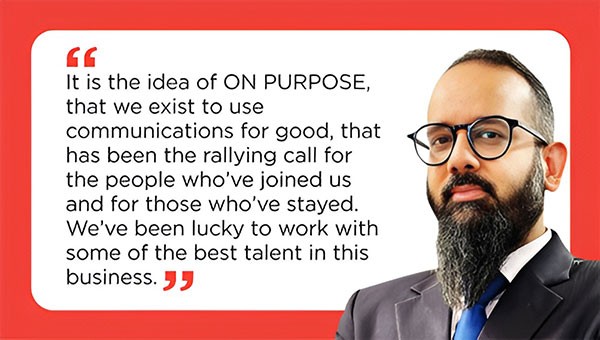
As the central theme from Kung Fu Panda suggests – there is no secret ingredient. It comes down to self-belief, together. In our case, it is the idea of ON PURPOSE, that we exist to use communications for good, that has been the rallying call for the people who’ve joined us and for those who’ve stayed. We’ve been lucky to work with some of the best talent in this business. Where we’ve lacked experience, we’ve made up in passion and ambition. Where we’ve felt under-skilled, we’ve made up in agility and collaboration with partners who bring complementary skills. Sometimes, we’ve also hired people with skills and expertise to improve our craft and the delivery of it, even if they don’t necessarily believe in the company’s vision, and that’s alright. We need their experience and capabilities to be more effective in delivering for clients and for our teams to learn and upskill.
The PR and communications industry has evolved dramatically in the last decade. What do you think are the most profound shifts shaping it today?
The PR industry has moved from being a megaphone for brands and organisations to being its central nervous system. We’ve never been more interconnected through geo-politics, or vulnerable to an attack on a brand’s reputation, due to the pace and economic agenda of those behind content creation on social media, where mis-information and dis-information can snowball faster than those on the side of facts and truth. This has made the role of the Chief Communications Officer more critical than ever before and the need for agencies to be on top of the news cycle, critical.
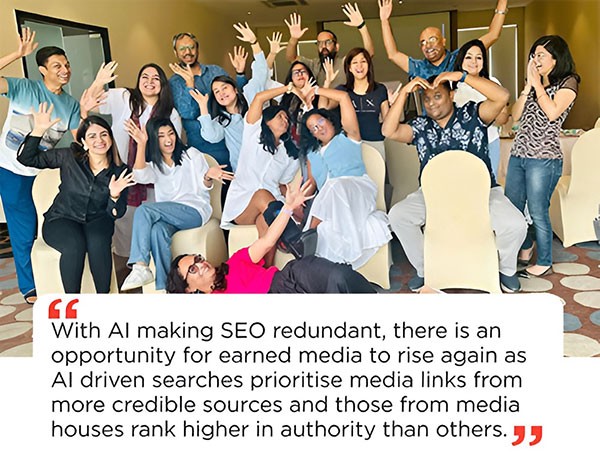
With AI making SEO redundant, there is an opportunity for earned media to rise again as AI driven searches prioritise media links from more credible sources and those from media houses rank higher in authority than others.
The rise of data as a storytelling tool – to uncover insights, predict trends, measure real business impact and tell the story of our success to the C-suite in a language they understand, has been another driver of change in the PR industry.
Finally, the corporate ‘why’ is non-negotiable. Stakeholders from employees to customers demand to know a company’s purpose beyond profit. Communications must authentically, articulate and embed this purpose into every narrative without falling prey to greenwashing or purpose-washing.
What role do you think Indian consultancies can play on the global communications stage in the coming decade?
Indian consultancies have a unique advantage that the world can benefit from in the coming decade – it’s our lived experience of tech-led, scale driven societal transformation because of innovation in world-leading digital public infrastructure (UPI, Aadhar and ONDC). Secondly, it’s our mastery of driving narratives in a poly cultural world. India is a constellation of micro-markets and our experience of crafting narratives that resonates across diverse languages, cultures and socio-economic backgrounds will be of immense interest to those looking at communication at a global scale. Finally, our ‘Jugaad’ mindset of strategic frugality combined with a deep understanding of global business standard, makes us incredibly potent partners for multinationals looking for efficient, high-growth strategies.
What were the toughest leadership lessons you learned while building a purpose-driven agency in a profit-driven industry?
The toughest lesson we’ve learnt is that balance is important. Idealism, in most cases is a privilege for the well-funded. Being purpose-driven is harder. It’s meant saying ‘no’ to profitable clients whose values don’t align. Its meant having difficult conversations with team members about not being able to pay them comparable market rates because of the choices we’ve made. At times, and I have no qualms in admitting this, we’ve had to make choices to take more profitable clients, even if their purpose is questionable, because we needed to keep the lights on. The tightrope walk between purpose and profit is a daily battle.
You describe yourself as a storyteller, what’s a story from your own life that you often find yourself retelling?
Of a childhood, where a friend’s mum casually asked me, “Tuh Hero Hain Ki Zero Hain’ and burst into laughter. In my insecurity of being the ‘Madrasi’ or the outsider in a Delhi neighbourhood, that interaction today has defined my inner drive, to somehow prove to this neighbourhood aunty, that I’m a hero, even if just unto myself. Someday, when I grow up, I might get over this and realise I have no one to prove myself to anymore, but until then, I’ll take this taunt to drive us further than I ever thought was possible.
What do you believe are the defining traits of an impactful leader in communications today?
It’s very difficult to say. We’re all easily impressed by someone with charm, charisma and someone who can speak the language of woke-ness. I remember once sitting in a conference, at a table where we were sitting with people we didn’t know from before and were asked to work together to come up with possible solutions to a climate problem. In this group, there was one person, who calmly listened to everyone’s views, summarised, added her own opinion and sought consensus. She then noted the points being made by the group and by the end of the discussion, we unanimously asked her to present our findings. A leader on all counts, without a title that said so.

What’s next for ON PURPOSE and what’s the next big idea you’re most excited to take on?
ON PURPOSE has been working at the intersection of climate, health, education, and gender for the last 8 years. As a result, we often find ourselves with communication mandates that require empathy for marginalised and under-represented communities. We’ve now also extended our reach and engagement for clients in other countries including Singapore, Vietnam and Indonesia. This gives us a unique opportunity to be a Global South agency, representing voices from these regions that require more mainstreaming to balance world narratives where decisions are being made for us by people, usually in the Global North.
As we deepen our engagement with clients in India, South East Asia, South Asia and look for new horizons in Africa, we hope to be the world’s most sought after agency to represent Voices from The Global South.
Read more news about PR and Corporate Communication News, Internet Advertising, Marketing News, Digital Media News, People Movement News
For more updates, be socially connected with us onInstagram, LinkedIn, Twitter, Facebook YouTube & Google News