Crisis Communications in the AI era: Insights from industry leaders
At the e4m PR & Corp Comm 30 Under 30 Summit 2025, senior industry leaders explored how AI is transforming crisis communication strategies
 by
by
Published: Dec 17, 2025 12:31 PM | 4 min read
 Follow Us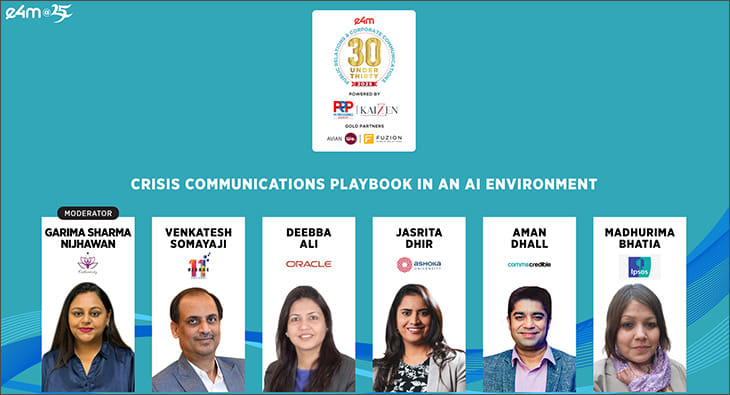

The very definition of a crisis has evolved. What was once largely tangible and event-led has now become increasingly intangible, driven by non-physical triggers such as data breaches, privacy violations, algorithmic failures, social media backlash, and even synthetic content like deepfakes. In an always-on, 24×7 social media ecosystem, crises no longer unfold over days; they escalate.
The evolving ‘Crisis Communications Playbook In An AI Environment’ took centre stage during a panel discussion at the recent e4m PR & Corp Comm 30 Under 30 Summit 2025. The session featured senior industry leaders and was moderated by Garima Sharma Nijhawan, Founder, Oathenticity.
Deebba Ali, Director Corporate Communications - India & PR Lead for Saas, Oracle, pointed out that today’s digital environment has fundamentally altered how crises emerge and spread. With information circulating relentlessly across platforms, even a small spark can quickly spiral into a full-blown reputational challenge, often before brands have time to assess the situation.
Ali added that a crucial, and often underestimated, stakeholder in this new crisis landscape is employees. “During moments of reputational stress, employees become inadvertent brand ambassadors. What they say, share, or choose not to say can significantly influence public perception, making internal communication and alignment just as critical as external messaging,” she mentions.
Jasrita Dhir, Vice President Brand & Communications, Ashoka University highlighted a particularly unsettling shift in crisis management today. “Your brand can be at risk even if the underlying event never happened,” she mentions.
Dhir further states that AI-generated misinformation, manipulated narratives and fabricated content now have the power to cause large-scale reputational damage without any factual basis. “In such cases, brands are forced to respond not to reality, but to perception often shaped by algorithms rather than truth,” she adds.
Venkatesh Somayaji, Director & Founder, Visage11 Advisors, underlined how digital, social media, and AI have compressed what was traditionally known as the ‘golden hour’.
“Agencies are usually brought in after a crisis has already broken out, but today narratives, true or false, are set even before a response is ready, often using AI. Ironically, AI is currently being used more to create crises than to solve them,” Somayaji says.
He added that the industry is still grappling with how to effectively deploy AI in crises. As a result, agencies must relearn crisis management, restructuring teams and capabilities to deal with speed, scale, and synthetic narratives. While messaging remains important, managing velocity and volume has become the real challenge.
Aman Dhall, Founder, CommsCredible, echoed this sentiment, noting that while crisis playbooks have always existed, they rarely work as intended in real-time scenarios.
“No two crises are the same. Agencies often act as execution partners, dousing fires unless there’s a deep, long-term relationship with the brand. But today, a crisis can’t be solved with just a PR or media statement,” Dhall adds.
According to him, modern crisis management demands integrated thinking combining PR, content, context, and technology. The key questions now are whether brands and agencies can shape AI-led narratives and move beyond traditional crisis responses. In the AI era, adaptability and deep understanding are non-negotiable.
From a global brand perspective, Madhurima Bhatia, PR Head and Media Engagement & Partnerships - India and APEC, Ipsos in India emphasised that while structured crisis playbooks do exist, the reality is far more demanding.
“We have crisis playbooks across markets, with clear escalation processes and roles. But in practice, crisis management is constant, invisible firefighting,” Bhatia mentions.
She shared that misinformation can emerge from anywhere, misquoted headlines, misrepresented data or obscure publications and yet pose serious reputational risks. Real-time social listening has become essential, sometimes requiring incorrect stories to be taken down almost immediately. This, she stressed, is why guardrails matter—from IT security frameworks to clear social media guidelines.
“In today’s environment, preparedness isn’t just a document—it’s a 24/7 discipline,” she added.
As crises become more fragmented, faster and increasingly synthetic, one reality is clear: stakeholders are no longer limited to customers and the media. Employees, platforms, algorithms, AI systems and online communities now all play a role in shaping reputational outcomes. Crisis management, once reactive and episodic, has become continuous and far more complex than ever before.
Read more news about PR and Corporate Communication News, Internet Advertising, Marketing News, Digital Media News, People Movement News
For more updates, be socially connected with us onInstagram, LinkedIn, Twitter, Facebook YouTube & Google News
