Communicators have moved from sidelines to influencing leadership and business outcomes
In this feature, Nidhi Gulati, Country Comms Director, Springer Nature opens up about her communications journey, the secret behind crafting impactful strategies, key lessons, and much more
 by
by
Published: Nov 14, 2025 1:12 PM | 13 min read
 Follow Us

Every once in a while, we meet someone who doesn’t just tell stories, they live them. Nidhi Gulati, Country Communications Director at Springer Nature, is one such person. She is not just a communications leader, but a storyteller who listens deeply, leads authentically, and reminds us that the best stories aren’t told, they’re lived.
From national newsrooms to influential global boardrooms, she has mastered the art of connecting strategy with soul, proving that the essence of communications is and will always be people. For over two decades, she has spread her communication magic to industries including financial services, IT, and scientific publishing where she has built reputations, steered through crises, and helped organizations find their authentic voice. Whether defining employer brands, leading integrated campaigns, or guiding C-suite leaders through change, Gulati’s hallmark has always been empathy, curiosity, and courage.
In this conversation, we trace Nidhi Gulati’s journey from journalism to corporate communications, exploring how she adapts her communication strategies across industries, the major transformations she’s witnessed, her strategies to make the story truly powerful, her leadership lesson, what lies ahead in her journey, and more.
Excerpts:
You began your career in journalism before moving into corporate communications. How did this transition happen, and how did you find your start in communications?
My transition from journalism to corporate communications was driven by purpose. As a journalist, I learned the power of authentic storytelling—how it can shape perception, influence behavior, and inspire trust. Over time, I wanted to use this power more strategically, and that’s what motivated me to move to the other side, helping organizations articulate who they are, what they stand for, and how they make an impact.
When the opportunity came to move into corporate communications, it felt like a natural evolution. I began by building narratives for brands that were grounded in truth—very much like journalism—but with a clear connection to business outcomes. That balance between storytelling and strategy has defined my career ever since.
I started my journey as a journalist with The Times of India, and later moved to television newsrooms like CNN-IBN, News18, and NewsX. Journalism taught me to ask the right questions, listen deeply, and tell stories that matter. But over time, I realized I wanted to go beyond reporting stories, to actually shape them, to build narratives that drive purpose and impact within organizations.
The transition happened quite organically when I joined Tech Mahindra. It was the first time I saw how storytelling, strategy, and culture could come together to build a brand from the inside out. My role at Bajaj Finserv then deepened my understanding of reputation management and corporate narrative building at scale.
Now, at Springer Nature—an entirely different industry—I’ve been able to bring it all together. Over nearly a decade here, my journey has come full circle: combining storytelling roots with strategic communications, branding, DEI, and CSR, all anchored in authenticity and purpose. Looking back, journalism gave me the foundation of curiosity and credibility, and communications allowed me to build on it—not just to tell stories, but to make meaning out of them.
You have over two decades of experience across industries—from financial services to technology, and now scientific publishing. How do you adapt your communication strategies to different sectors and industries?
What I’ve learned over the years is that while industries differ, people and purpose don’t. Whether it’s financial services, technology, or scientific publishing, every sector has its own language, culture, and priorities.
The key is to first understand these nuances deeply, what drives the business, what matters to its people, and what values anchor its reputation.
In financial services, communication needs to inspire trust and transparency because you’re dealing with people’s money and aspirations. In technology, it’s more about simplifying the complex and telling stories of innovation and impact. In scientific publishing, where I work today, it’s about building credibility and purpose, enabling access to knowledge and supporting the research community.
Across all these, my approach has remained consistent: listen first, learn the ecosystem, and then craft narratives that connect strategy with empathy. The context may change, but the fundamentals of good communication which is clarity, authenticity, and relevance remains the same.
I also place a strong emphasis on empathy, because communication is not just about what we say, but about how people feel when they hear it. Storytelling is about perception—what people hear and how it makes them feel. Whether it’s a brand story or an internal change message, authenticity builds trust, and when it comes from a place of empathy, it always helps. When teams lead with that mindset, communication stops being just a function—it becomes a force that unites people with purpose.
Since the time you started until now, there have been so many transformations in the industry. What are some of the major transformations you have observed?
When I started out, communication was all about telling the right story at the right time. Today, it’s more about shaping meaning and building trust. In a world of fake news and social media overload, building trust is not an easy task. The communicator’s role has evolved from being reactive to being strategic.
Moreover, in today’s time, communication is not just a support or corporate function; it’s a strategic function, one that sits at the table where culture, purpose, and performance intersect. A modern communication leader, to me, is someone who is curious, authentic, and courageous and someone who listens deeply, acts with empathy, and holds themselves accountable to both words and outcomes.
It’s not just about what we say, but what we do and how it matters to the organization. We’re no longer just managing perception; we’re helping organizations stay human. In a world where AI is creeping in, being human is more important than ever.
It’s no longer about simply drafting messages or handling media. It’s about creating meaning, helping organizations articulate who they are, what they stand for, and how they make an impact. Communicators have moved from the sidelines to influencing culture, leadership, and business outcomes at large.
How do you define a strategic communication leader in 2025 and beyond?
A strategic communications leader in 2025 and beyond is someone who leads with clarity, courage, and connection. It’s a complex environment—narratives shift overnight, and trust is more fragile than ever. Communication today is not just about messaging; it’s about meaning.
A true communications leader is no longer just managing reputation, as communicators were once perceived to do. The role now is about shaping culture, influencing strategy, and empowering people—who are an organization’s biggest ambassadors—to navigate change with confidence.
My approach is guided by a few core values. Curiosity keeps me learning and evolving, and that’s essential for staying relevant as new technologies, audiences, and ideas emerge. Authenticity and accountability ensure that our communication is grounded in truth and purpose—what we say is what we stand by.
Courage is equally important. It enables us to take tough calls, ask hard questions, and lead conversations that matter. We are not the “yes, sir” or “yes, ma’am” department, we must sometimes say no when it benefits the organization’s reputation.
Finally, perseverance keeps us focused amid uncertainty. Ultimately, a strategic communications leader today must be both empathetic and ambitious—someone who listens deeply, acts decisively, and uses the power of storytelling to unite people around progress and purpose.
.jpg)
From your vantage point, what do you think are the key elements that create a good story?
I have always believed that storytelling comes from a place of passion. You need to be passionate about what you do and how you do it. Stories have the power to shape not just perception, but also progress. It is so important to shape meaning and build trust — and I think all of this comes from storytelling.
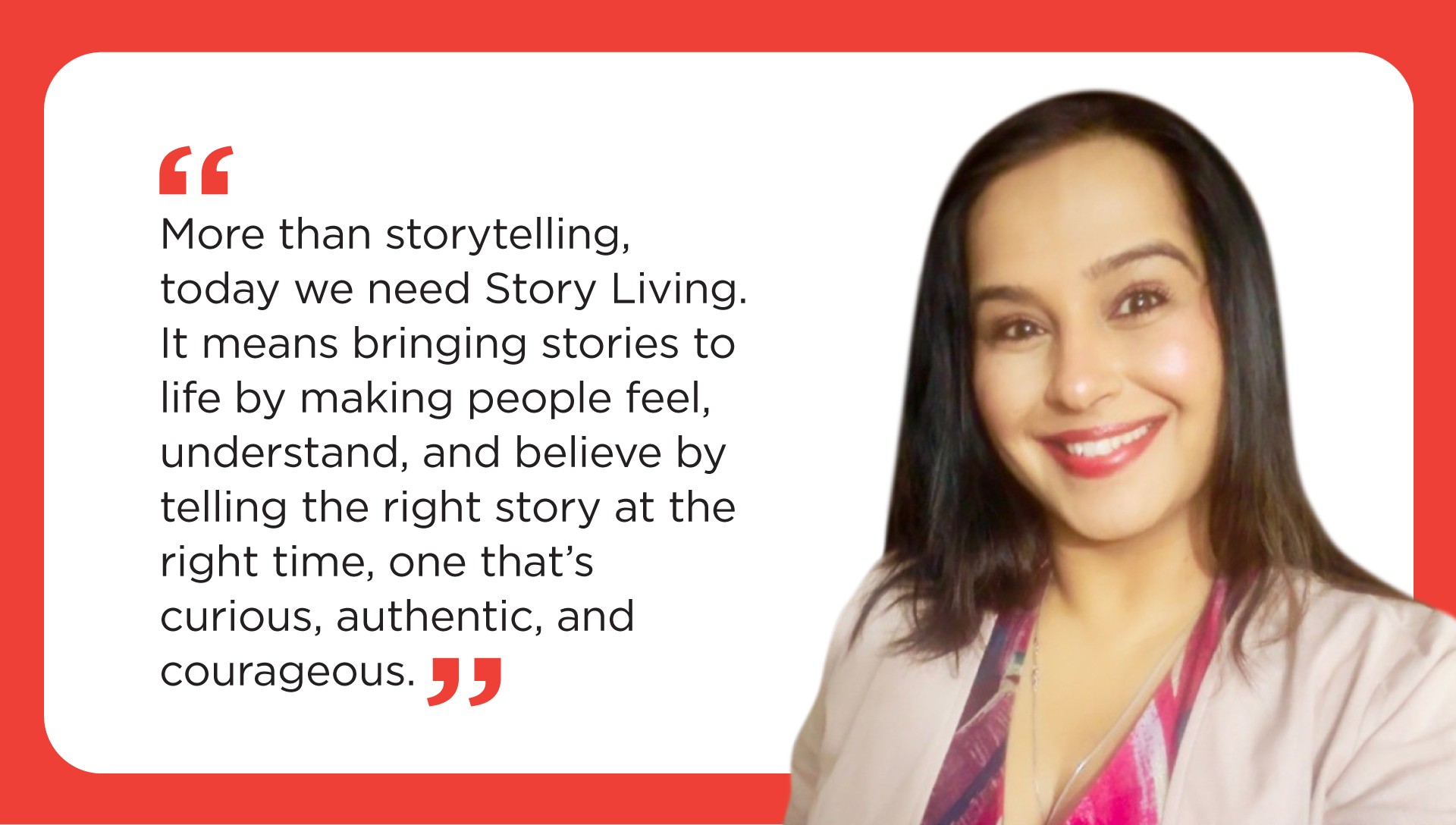
Storytelling comes from curiosity, from being open to change, and from being deeply passionate about what you want to convey and how you want to bring that entire narrative together. What motivates me most is the impact storytelling can have. But more than storytelling, I think today we need story living.
Story living is about making people feel, understand, and truly believe in the story. It’s about bringing meaning to life. For me, shaping meaning and building trust comes from telling the right story at the right time — one that is curious, authentic, and courageous. When a story is built on facts and authenticity, it builds credibility and evolves into story living, helping organizations stay more human in a fast-changing world.
Since you have over two decades of experience, you must have worked on so many campaigns. Could you share some of your favorite ones with us?
One of my proudest campaigns would be the employee value proposition creation for Springer Nature.
When I joined the company about eight years ago, my main tasks were to build a communications function—since we didn’t have one in India—and to address a challenge: people didn’t really connect with who we were as a company. Everyone connected to their own work and departments, but there wasn’t a sense of unity across the organization. That was something I really wanted to tackle.
So, my first campaign was to create an employee value proposition. Along with a few partners, I spent about 85–90 hours interviewing colleagues at different levels and departments to understand what truly connects everyone—what the binding factor was. It wasn’t an easy journey; it involved a lot of listening, understanding, and collaboration to see how we could come together as one Springer Nature.
At the time, many said, “We’re two very different areas—technology and publishing—working independently.” And I said, “If that’s what emerges from our conversations, we’ll build two EVPs instead of one. Let’s see how it shapes.”
Surprisingly, when we analyzed the results, everyone agreed with the insights. We came up with this beautiful EVP: “We keep science moving.” Since we’re a scientific publisher, it perfectly captured our shared purpose. Everyone, whether from tech, publishing, or corporate functions related to it.
That unity was powerful, and when we rolled out the campaign, it became one of the most beautiful outreach initiatives I’ve ever worked on.
.jpg)
How is the definition of “good communication” evolving in 2025?
Communication is a mix of both art and science. You need to have an understanding of neuroscience to become a good communicator, but at the same time, how you speak, shape narratives, and tell stories is something that doesn’t come easy. If it were, everyone would be a storyteller. I wish that day would come, because if everyone were a good storyteller, we’d live in a world full of great communicators.
That’s why I say the shift is from storytelling to story living. Today, most employees are seen as brand ambassadors—across organizations and industries—because whether it’s on social media, within the company, or beyond, everyone is speaking and shaping the larger narrative.
For that narrative to come from a place of purpose and become a strong, authentic voice, it’s essential to tell the right story. And for employees to do that, they must be equipped with the right messages.
What motivates your passion for purpose-led communication?
For me, purpose-led communication and my passion for it come from a simple belief that stories have the power to shape not just people’s perceptions, but also progress. It’s all about balance—leading with authenticity and acting with accountability.
Accountability ensures that you work in the right direction and measure success not just by campaign outcomes but by the impact they create on people. When you communicate with courage, clarity, and purpose, performance naturally follows.
.jpg)
What's your leadership mantra for balancing purpose, people, and performance?
My leadership mantra is staying endlessly curious and being authentic, which is so important in a world full of competing narratives.
I believe curiosity has shaped me into a better communications professional. Along with that, being open to change is very important to me. I don’t believe that having 20-plus years of experience means I know it all — I don’t. Everything is constantly evolving. There are so many times you can learn from someone who has just graduated or even from someone still in school.
If we’re not open to embracing change and learning from it, we stop growing. For me, curiosity, openness to change, and the continuous cycle of learning, unlearning, and relearning are what have helped me grow.
What’s next for you, personally and professionally? What are the areas you are planning to explore or reinvent yourself in?
I have always believed that growth comes from curiosity and being open to change. Both personally and professionally, I am at a stage where I want to deepen my impact and move from shaping communication strategies to shaping conversations that influence culture, inclusion, and purpose at large.
In the next phase of my journey, I want to explore how communications can drive systemic change, whether through diversity, equity, accessibility, and inclusion, or by building sustainable brands. Certain things become buzzwords, but I want to understand how we can create meaningful impact through authentic stories that truly connect people.
Secondly, for me, authenticity matters and it’s important to back stories with data and real action. Moreover, I’m particularly interested in how technology, especially AI, can be used more responsibly to enhance human connection rather than replace it. We are at a fascinating intersection of communication, technology, and empathy, and I want to learn more about that.
On a personal front, I want to keep learning and continue mentoring young professionals. I’ve received so much love and acceptance from my community and professional network, and I want to give that back. There was a time when I was a young professional full of enthusiasm but without clear direction. Now, I hope to guide others whether in their communications careers or personal growth journeys.
I also want to document some of the lessons I’ve learned along the way. For me, reinvention isn’t about changing direction, but evolving with intention, staying true to my values, continuing to find meaning in what I do, staying ambitious with purpose, curious with courage, and rooted in authenticity.
Read more news about PR and Corporate Communication News, Internet Advertising, Marketing News, Digital Media News, People Movement News
For more updates, be socially connected with us onInstagram, LinkedIn, Twitter, Facebook YouTube & Google News