Stay with print, it's a pretty trustworthy medium: Sameer Singh, HT Media
At the e4m Revenue Leaders Conference, HT Media Group CEO Sameer Singh, engaged in a fireside chat with e4m Co-founder Nawal Ahuja on the advent of AI, the evolving consumer ecosystem and more
 by
by
Published: Jul 31, 2025 8:57 AM | 9 min read
 Follow Us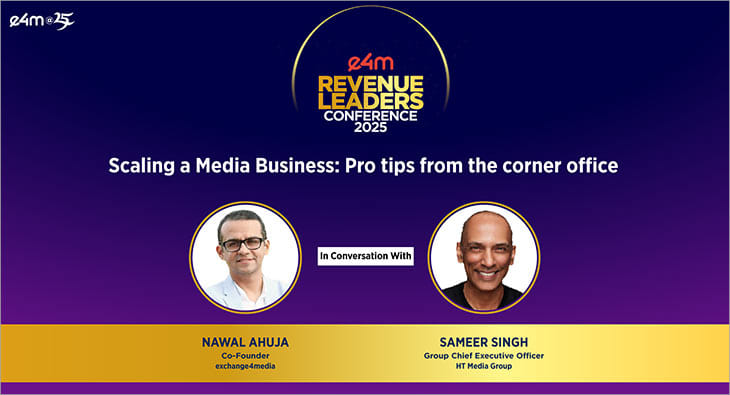

“Formats that can surprise and engage will always have a role. And print has really innovated,” said HT Media Group CEO Sameer Singh in a candid and wide-ranging fireside chat with Nawal Ahuja, Co-founder of exchange4media at the e4m Revenue Leaders Conference held in New Delhi, on Wednesday.
The session, titled “Scaling a Media Business: Pro Tips from the Corner Office,” offered rare insights into the transformation of legacy media, the rise of AI, and how brands and publishers can navigate the challenges of a fast-evolving consumer ecosystem.
Singh, who took over the reins of HT Media four months ago, comes with a storied background across tech giants like Google, platforms like TikTok, global agencies, and now a traditional media powerhouse. The conversation with Ahuja spanned the past, present, and future of media; and the kind of leadership mindset needed to ride the waves of change.
Kicking off the session, Singh described his journey as a "very interesting” one that reflects the shifting nature of the industry itself.
“I started off in agencies, moved to tech platforms like Google where I saw the performance ecosystem maturing, then back to agency, and then to TikTok. Now, at HT Media, I’m looking at how to reinvent a trusted legacy brand in the digital age,” he said.
He recalled his time at Google as particularly pivotal. “It was a time when Google was transitioning from being a pure performance business to exploring more brand-led narratives. YouTube had just started making its presence felt. And today, the same platform is being reshaped by AI and creator content in ways we couldn’t imagine back then,” he said.
Consumers are changing—so must media
As consumer attention continues to fragment, Singh said brands are under pressure to find relevant, trustworthy, and immersive ways to engage. “You’d be surprised at the contribution of digital to the overall agency business today,” he said. “But what hasn’t changed is the value of trust. That’s why print, especially in India, still has legs.”
In response to a question on consumer shifts, Singh stressed that India is uniquely placed.
“I think India is one of those two markets where the print journey, the print conversation, the whole print function, that this is the act of developing India, right, as an agency, the sexist definition, that is still penetrating down the way, but disposable incomes are still rising. And as we're going through sometimes, outside of the metros into smaller towns in the hinterland, you actually see print doing rather well,” he said
He added that this rise of trust-based content also explains the popularity of long-form podcasts in markets like the U.S. “People are looking for fewer, deeper, more reliable engagements. That’s a positive for content ecosystems like ours that prioritize credibility and verification.”
AI: Both a threat and an opportunity
A major theme of the conversation was AI and the disruption it’s bringing to media, content creation, and monetization. Singh broke it down into phases: AI-researched, AI-assisted, AI-amplified, and eventually AI-generated content.
“Newsrooms around the world are already using AI for things like fact-checking and referencing archives. That’s assistive AI. But we’re also seeing AI start to generate video summaries and stylized storytelling,” he said.
Citing an example, he explained: “If a news outlet has no video footage of an event, they could recreate it in Japanese manga comic style. I am going to make the narrative because I know the story, I don't have the visuals, and that is what I use to convey the story, convey the news, convey the information, where it is very clear to everybody that the style of storytelling is now assisted and generated, not the story itself. I think it will lead to very, very interesting spaces.”
But Singh warned of a bigger disruption looming. “What happens when consumer-side bots start interacting with our content, curating it, summarizing it, maybe even choosing what videos to watch?”
The many facets of trust
As the conversation turned toward brand concerns in digital media, with Ahuja talking about how with the advent of technology and digital, one of the key aspects of brand requirement has also become safety and trust.
On being asked what it says in terms of where we are headed and if there is a way to curb this menace, Singh’s instant response was, “I'd say stay with print. It's a pretty trustworthy medium.”
“There are several distinct facets to the trust conversation,” said Singh.
“At one end, luxury brands want their message placed in premium, curated environments — glossy magazines, red carpets where brand perception matters. At the other, digital-first brands are more concerned about avoiding harmful or distasteful content, especially on platforms driven by user-generated content,” he said.
He noted that in such digital spaces, third-party tools and verification systems often step in to enforce brand safety. “Another layer of trust is about delivery—are you actually providing what you promised? Whether it's print circulation or digital impressions, the question is: am I getting what I paid for?”
Finally, Singh pointed out that performance marketers often bypass intermediate metrics entirely. “They don’t care about viewability or verification if they can directly measure outcomes. For them, it's simple: are you delivering ROI or not?”
He acknowledged that these challenges are more pronounced on UGC platforms. “That’s why you see third-party measurement systems playing such a big role.”
At the same time, Singh urged marketers to reframe the performance vs. brand debate. “I haven’t met a single marketer who doesn’t think they’re a performance marketer,” he quipped. “Even back when I was at P&G, we were doing performance—we just used mix models instead of last-click attribution.”
He noted that for many D2C brands, marketing is not even marketing—it’s sales. “They’ll tell you, the budget is infinite if the ROI is positive. It’s a sales channel. But legacy firms like Unilever know that long-term brand building is their hedge against private labels.”
HT Media’s transformation playbook
Talking about his own company, Singh described the roadmap ahead as one focused on integration and diversification. “We are asking how to grow print in underserved segments-youth in metros, or regional audiences. On digital, the focus is on more integrated newsrooms, a more unified go-to-market model, and better use of data,” he said.
He said HT Media, like other large publishers, is looking to balance ad revenue, subscriptions, and transactional models such as e-commerce and events.
“And we’re asking the same questions many tech companies are asking—what should be web vs app, how do we balance direct traffic vs search, and how do we engage with AI platforms as ecosystem players?” he said.
“How do you ensure that the bets that you are taking are smart and nimble? You're not getting locked down too fast and too hard. Yet where you see green shoots, you're able to fund. Bringing in some of those startup-kind of principles of management into large companies that have been there for a long period of time into systems where efficiency and zero defect.
“At the end of the day with the newspaper, if you make a mistake in your news and then it's printed and it is out there, it's gone. So you have to eliminate errors towards a model of quick alteration, fast-paced change, test, learn, A-B testing, all of that stuff. How do you get those two cultures working together? And there's no right or wrong,” he said.
Revenue models in the Age of AI
Before closing, Ahuja brought up the contentious issue of revenue sharing with platforms like Google.
On being asked what do companies like HT Media do to keep the growth of digital intact while companies like Google through their AI systems mine so much data?
Singh said it will play out at three or four levels.
“One, active conversations that companies like ours need to continue to have not just with Google but all the key players in the AI space. You have to keep talking,” he said, while adding that getting them to share more revenue is a “byproduct”.
“First, just have conversations. Where are they headed? What's the model that they are looking at? Because guess what? While we are seeing it from one side of the coin, the other side of the coin that they are looking at is what will be our sources of information? They are now looking at moving beyond just using data to train LLMs into how do I actively curate, become a gateway, land up creating and participating in an ecosystem that is a sustained win-win.
“Otherwise, very quickly you will find that the creators of content start dwindling away. And then the only data that a model is training on is data that's been created by other models. And that just results in noise in the system. So that's a conversation that's going on.
“The second challenge that a lot of players are and almost everybody is dealing with is how do you start owning more of the relationship with your readers? Whether it's in print or in digital, certainly it's in print and digital. And lower the dependence on a gatekeeper. Linked to that is how do you drive repeats? So frequency, recency, more number of times when people come back. I think the pendulum is moving very quickly in terms of traffic, but what's the engagement,” he explained.
Read more news about Print Media, TV Media, Advertising India, Digital Media, Marketing
For more updates, be socially connected with us onInstagram, LinkedIn, Twitter, Facebook, YouTube & Google News