'What India needs is a platform with global reach'
A panel discussion at the e4m Confluence 2024 focused on leveraging both digital and traditional methods to create meaningful connections with audiences
 by
by
Published: Nov 12, 2024 1:29 PM | 7 min read
 Follow Us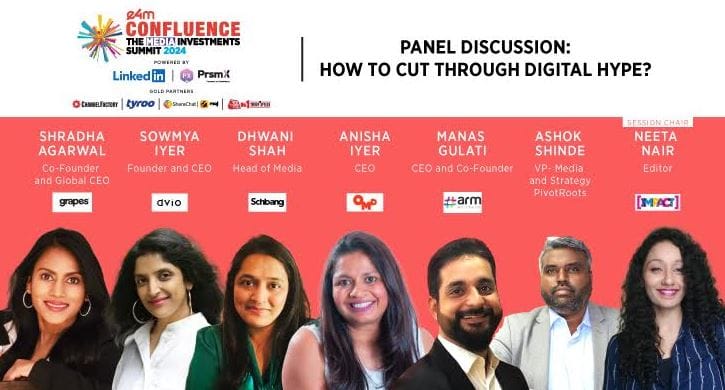

At the e4m Confluence 2024, a panel discussion focused on how media agencies and brands can sustain authenticity amidst rapid industry shifts, highlighting the importance of real, human connections in media strategy.
The panel featured Shradha Agarwal, Co-founder and Global CEO of Grapes Worldwide; Sowmya Iyer, Founder and CEO of DVIO Digital; Dhwani Shah, Head of Media at Schbang; Anisha Iyer, CEO of OMD India; Manas Gulati, CEO and Co-Founder of #ARM Worldwide; and Ashok Shinde, VP of Media and Strategy at PivotRoots. The session was chaired by Neeta Nair, Editor of Impact.
Nair began the discussion by asking panellists to share their perspectives on what brands should avoid in digital marketing.
Agarwal emphasised the need for brands to avoid vague requests, such as simply asking for social media services. Instead, she suggested, “Brands should tell us their business problems and let us, as experts, propose solutions.” Reflecting on a humorous exchange with a client, she recalled, “There was a client who came to me looking for SEO, social media, a website, and PR. I asked, ‘How many bottles do you want to sell?’ He said, ‘20,000 caskets.’ I told him I could sell that door to door without needing all those services.” Agarwal underscored that not every brand requires a full suite of services simultaneously.
Sowmya outlined three key points for effective digital planning. “First, avoid planning in silos. Any brand with an omnichannel strategy should integrate experiences across digital channels. Second, don’t be myopic; map the consumer journey to design a more connected approach. And third, don’t just stop at a media plan—prioritise first-party data to enhance campaign value over time.”
When asked about clients pushing for media trends that might not suit their brand, Anisha shared a memorable example. She recounted an experience when a new decision-maker at a client company wanted to switch from a broad-based digital approach to a more narrow, targeted one, despite the product being priced at only ten rupees. “There was no point in going narrow,” she explained, “as cohorts led to overly specific targeting and personalisation, which didn’t make sense for such a low-value product. So we said no.”
To address the client’s insistence, Iyer proposed a compromise by running two test campaigns: one broad-based and one micro-targeted. As she described, “Of course, the cost of the targeted approach went up fourfold, yet the number of products sold didn’t increase.” By the second week of a planned four-week test, the client acknowledged the results and reverted to the broad-based approach.
Reflecting on the experience, Iyer remarked, “One lesson I learned is it’s okay to defend what you believe in, but sometimes, a small test can prove a point more effectively than words alone.”
Nair next asked Shah if clients often demand a “viral” campaign. She confirmed that such requests are indeed common, explaining that while many brands desire virality, there is no guaranteed formula for making content go viral. “Something that works today might not work tomorrow,” Shah said, highlighting the unpredictable nature of virality. However, agencies do have certain strategies and frameworks that can improve a campaign’s chances of resonating with audiences.
She cited the example of a campaign for Cipla, ‘Inhaler Sahi Hai’, which centred on an asthmatic girl passionate about dancing. “The campaign struck an emotional chord, especially among parents, by conveying the message that using an inhaler could enable children to put their best foot forward.” Shah explained, “The crux of this is touching an emotional appeal, aligning with pop culture or Gen Z culture.”
Shah also mentioned other tactics, such as hyper-personalisation and influencer marketing, which have proven effective in viral campaigns. “The BoAt campaign, with its ‘sharing the BoAt moment’ approach, is a good example,” she said, where users were encouraged to share their experiences using BoAt products in various settings, adding a personal touch. Shah concluded by noting that, at the end of the day, “the first ‘P’ of marketing, which is product, has to be the core in order for it to go viral.”
The conversation then moved to how brands often jump into digital advertising without a compelling customer proposition or a focused strategy. Shinde pointed out the rapid growth and penetration of digital media. "If you look at digital, the way it's growing, it’s penetrating deep into every household," he said, noting that reports estimate digital penetration to be between 50% and 70%, even excluding under-18 users, many of whom are active through their parents' devices.
Shinde explained that while the reach is significant, it’s crucial for brands to understand their target audience before diving into digital channels. He elaborated, “If a brand caters to premium, affluent audiences, perhaps there’s no better channel than digital, particularly connected TV, where you can avoid much of the waste.” However, he advised that for brands with broader audiences or smaller budgets, other channels like TV or print might be more effective for creating awareness. "If the focus is to drive sales, digital could definitely come to the rescue," he added.
Shinde emphasised the importance of introspection and prioritisation in digital strategy: “A brand must understand who their key target group is, where they are, and the most effective channels to reach them at the lowest cost.”
He concluded by stressing the necessity of a solid foundation. “Before investing in digital, you need a working website and an infrastructure that allows consumers to interact and make purchases.”
Next Gulati was asked about the shift to India-based social networks or emerging platforms beyond Facebook. He responded by acknowledging that his team hasn’t been focused on smaller platforms due to the nature of their clientele, which doesn’t target rural markets. “We haven’t been doing much on the smaller platforms, but for a couple of financial clients we worked with, we did experiment with smaller platforms,” he said. “It worked decently but didn’t give us tangible results.”
He explained that Instagram and Facebook continue to dominate because of the strong data management these platforms have established, especially in smaller towns. "These platforms managed the data game very well, and that’s why even in tier-two or tier-three markets, they still remain reliable for targeting and delivering concrete results," he noted. While he acknowledged that smaller platforms might work for engagement and interaction, he observed that they aren’t as effective for conversion campaigns or reach.
Sowmya added her perspective, noting that while India has seen attempts by platforms like Chingari, Moj and ShareChat to carve out their niche, a key factor for success would be global appeal. "What India needs is a platform with global reach. It’s not about India serving India, but India serving a global audience," she said. This, she explained, would help bring in the aspiration factor for these platforms to truly take off. "Otherwise, we’re still working with the same set of channels that we have right now."
Read more news about Marketing News, Advertising News, PR and Corporate Communication News, Digital News, People Movement News
For more updates, be socially connected with us onInstagram, LinkedIn, Twitter, Facebook, YouTube & Google News