Unpacked at Impact digital influencer conference: The new rules of influencer marketing
Industry heads converged at the conference to decode influencer campaigns, pop culture, the creator economy and more
 by
by
Published: Dec 18, 2025 2:36 PM | 5 min read
 Follow Us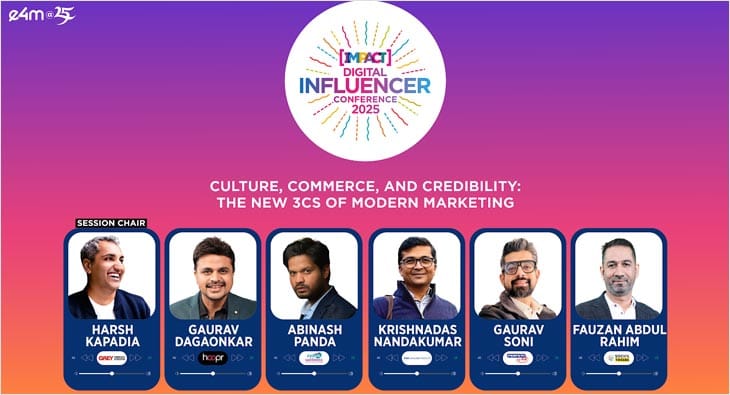

Today’s marketers are operating in a fractured attention economy, where audiences are scattered across platforms, creators move faster than brand cycles, and cultural trends can peak and vanish within days. For brands embedded in pop culture, the challenge is no longer about finding creators with scale, but creators with cultural alignment.
At the Impact Digital Influencer Conference, Gaurav Soni, Head of Media at Perfetti, put it bluntly when he said that most influencer campaigns don’t fail because of bad content, but because “the wrong person is saying the right things.”
According to Soni, advertisers still fall into the trap of treating creators as media inventory rather than cultural voices. “Culture decides who gets to speak, commerce decides how loud a brand should speak. Commerce should never dictate what culture should say,” he said, adding that forcing brand messaging onto creators who don’t naturally fit the conversation almost always backfires.
For low-involvement, impulse-driven categories like confectionery, the emphasis shifts towards shareability, nostalgia and repeat viewing rather than hard-selling. “If you remove the brand from the content and the creator would still post something similar, that’s when you know it’s a cultural fit,” Soni explained.
Credibility is built before the campaign begins
While cultural relevance fuels engagement, credibility determines whether audiences believe what they see. For wellness and FMCG brands, this starts right at the influencer selection stage. Abinash Pandya, Digital Lead at Zydus Wellness, stressed that credibility is filtered as much qualitatively as it is quantitatively.
“It’s not just about engagement rates or views,” Pandya said. “We deeply evaluate whether the influencer’s persona matches the brand’s consumer archetype. For one of our skincare brands, we even define what the ‘brand girl’ stands for and eliminate influencers who don’t naturally align with that worldview.”
This alignment becomes even more critical in categories where trust and authenticity directly influence purchase decisions.
Krishnadas Nandkumar, Senior Vice President at Tata Consumer Products, highlighted how credibility is reinforced differently across markets, even for the same brand. Speaking about Organic India, Nandkumar pointed out that its credibility was built over decades, starting from convincing a single farmer to grow organic tulsi in the 1990s. “Today, when clean-label claims are everywhere and skepticism is high, brands must dial up their vectors of credibility,” he said. In India, this includes trusted public figures like Sachin Tendulkar, while in mature markets like the US, long-term influencer partnerships and farm-level storytelling take precedence.
The data trap and the fake influence problem
As influencer spends rise, so does scrutiny around ROI. Fawzan Abdul Rahim, Founder of Social Tweets, revealed a sobering insight from the agency side. “Nearly 30–40% of creators brands have worked with show credibility levels below 50%. That means half the money is effectively wasted,” he said.
Rahim noted that views alone are no longer a reliable indicator of impact. Brands must now ask harder questions about where those views are coming from, whether the audience is genuine, and if the creator is actually influencing their own followers. “If expectations aren’t set right and the audience isn’t real, the money just goes down the rabbit hole,” he warned.
This is where technology-backed creator audits are increasingly shaping influencer shortlists, helping brands move beyond surface-level metrics to deeper audience intelligence.
Moving past vanity metrics
Perhaps the strongest consensus on the panel was around the death of likes as a standalone success metric. While hygiene metrics like views and engagement still matter, they are no longer sufficient.
“If likes paid the bills, marketing would be easy,” Soni remarked. For high-involvement categories, even a single meaningful comment can outweigh thousands of likes. For low-involvement categories, signals such as shares, repeat views and peer-to-peer forwarding are becoming more valuable indicators of cultural impact.
The discussion also touched on the growing importance of community-led ecosystems, where success is measured in brand equity, participation and long-term affinity rather than immediate conversions. As Nandkumar explained, some campaigns are designed not to sell but to strengthen brand health over time, especially for legacy brands built over decades.
Letting go without losing control
One of the most debated questions was how open brands should be to creative risk. While experimentation is essential to stay culturally relevant, panelists agreed that not every category can afford to gamble with brand values.
“There is no common playbook,” Nandkumar said. “Some brands are built on decades of trust. You can experiment with narrative styles, but the core values cannot be compromised.”
At the same time, panelists acknowledged that personal bias from marketers often restricts creativity. Allowing creators flexibility in tone, dialect and storytelling, while staying within brand guardrails, is increasingly seen as the only way to stay relevant in a fast-moving cultural landscape.
As the session concluded, one message rang clear: modern marketing is no longer about choosing between culture, commerce or credibility. It is about understanding how deeply interconnected they are, and knowing that when culture is authentic and credibility is intact, commerce has a far better chance of following.
Read more news about Marketing News, Advertising News, PR and Corporate Communication News, Digital News, People Movement News
For more updates, be socially connected with us onInstagram, LinkedIn, Twitter, Facebook, YouTube & Google News