‘UGC is primarily driven by consumer demand for authenticity and trust’
At the e4m ScreenAge Mobile Marketing Summit 2024, industry leaders participated in The Great Debate on User-Generated Content vs. Brand-Created Content: What's The Ideal Mix?
 by
by
Published: Dec 2, 2024 12:59 PM | 5 min read
 Follow Us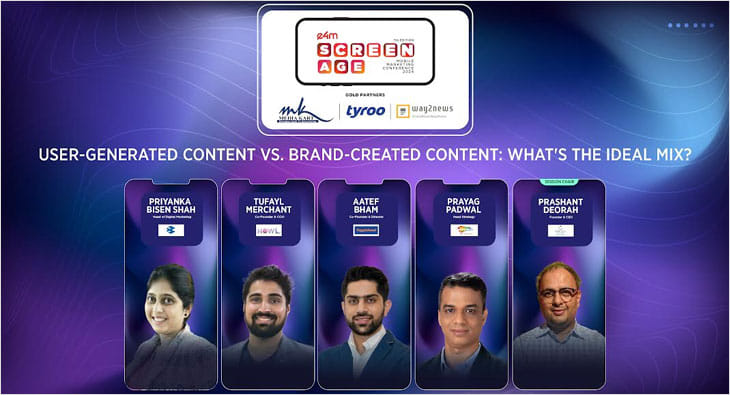

User-generated content and brand-created content are two key components of a brand’s digital strategy. To ensure high visibility and engagement, teams must strategically balance the two. But what does the ideal mix look like?
At the e4m ScreenAge Mobile Marketing Summit 2024, industry experts explored this, providing key insights into achieving the perfect synergy between user-generated and brand-created content.
Prashant Deorah, Founder and CEO of Puretech Digital, chaired The Great Debate on ‘User-Generated Content vs. Brand-Created Content: What's The Ideal Mix?’. Priyanka Bisen Shah, Head of Digital Marketing at Bajaj Auto Ltd; Tufayl Merchant, Co-Founder and COO of Howl Digital; Aatef Bham, Co-Founder and Director of Togglehead; and Prayag Padwal, Head of Strategy at Shemaroo Entertainment Limited participated in the session.
Prashant kickstarted the debate by asking the brand representatives to share their views on the dominance of user-generated content. Is it a temporary phenomenon or would its dominance increase over time, he asked.
“UGC is primarily driven by consumer demand for authenticity and trust. I don’t think this is a temporary shift as it’s primarily driven by more involvement of consumers. It’s more of a participatory form of marketing,” said Padwal. He underscored the role of rising digital adoption in increasing the consumption of UGC content.
Further, he highlighted that only a few brands have been able to use UGC effectively. Going forward, it will be critical to approach UGC smartly and strategically complement it with brand-created content for the best results. Shah shared the example of KTM and Dominar bikes, which are used for long-distance leisure rides. “We arrange such rides without branding them as our rides. We tactfully ingest guidelines and people generate content. Once they generate content, we then utilise it. That’s when people feel recognised and continue generating content,” she added.
She further added, “There is only so much we can talk about the specs, which are available on multiple platforms at one click. People don’t buy the bikes for the specs, they buy it for the feeling. We want people to generate this content, we want people to include it. The brand love comes from there.”
Merchant added to the conversation by listing the brand categories that use UGC content the most: beauty and fitness. “Fitness enthusiasts love a challenge. So, we created a challenge-based campaign for HRX wherein we asked the brand’s community to replicate Hrithik’s moves in a video. We incentivised the challenge by saying that if we love your video, we will fly you down and you will star in the next campaign video with Hrithik. You become a brand ambassador for HRX. It generated a huge amount of entries. We got over 5 million organic views on these UGC videos,” he explained.
Bham added to the conversation: “Beauty as an industry heavily relies on people’s opinions to make that purchase. It’s technically intangible from a digital platform, yet digital is the biggest revenue driver for most of the beauty brands.”
He shared the example of Nykaa’s micro-influencer programme to illustrate the importance of UGC content for beauty brands. “You will see brands sending out products to a large number of people free of charge every month as long as they consistently create content for the brand,” Bham said. He explained that by doing so brands are essentially creating guidelines, a mechanism and a streamlined process for content to be generated.
“You get the content you like. Sometimes you don’t. But it’s creating a chain reaction for people to consume and create such content,” he added.
Deorah then asked the panel to share their views on the role of influencers in shaping brand narratives and fuelling user-generated content.
Merchant spoke about how when influencers promote multiple brands, it reduces the value of their opinion on the topic. “I think it’s important for individual influencers to stand for something. They need to pick a category and own it,” he explained.
Shah added to the conversation with her experience in the auto space: “At the launch, when influencers review a bike, they share how they feel about the ride. We give the influencers a free hand to criticise the bike. Because we are the brand owners, we know exactly what can go wrong. So, we always have a plan B in terms of how to address the challenges that influencers could bring in. We tactfully handle those pieces so that the influencers come back and share how though there was a particular issue, it has been resolved now. As a brand in the auto space, we can’t dictate the influencers to say what we want them to say.”
The session concluded with a focus on the critical role regional influencers play in helping brands connect with consumers in specific markets. A nationwide campaign can be led by brand-created content and supported by influencers. However, when it comes to campaigns for specific regions, influencers help brands create nuanced content that would resonate with the target audiences — and also help brands save on budgets and resources that would otherwise be required for creating multiple advertisements. The panel also touched upon the use of AI in scaling influencer-led campaigns and how it could define the next wave of campaigns in the space.
Read more news about Marketing News, Advertising News, PR and Corporate Communication News, Digital News, People Movement News
For more updates, be socially connected with us onInstagram, LinkedIn, Twitter, Facebook, YouTube & Google News