The power of no: Strengthening client-agency collaboration
During a panel discussion at the e4m iDAC 2024, experts explored the intricate relationship between creativity and business objectives in client-agency dynamics
 by
by
Published: Sep 30, 2024 12:24 PM | 6 min read
 Follow Us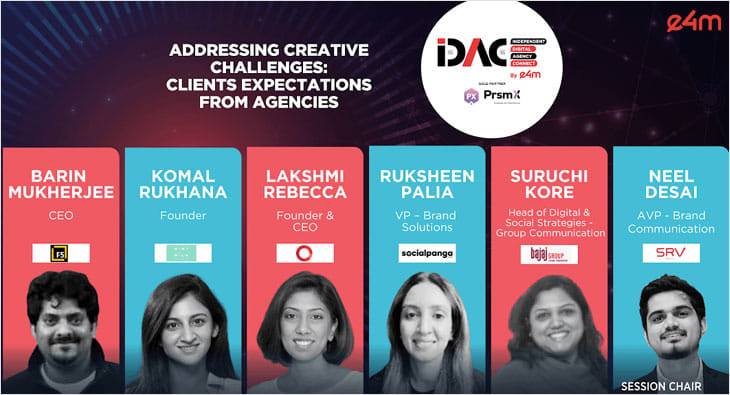

At the e4m iDAC 2024, industry leaders from both agencies and brands convened to discuss the challenges of aligning creative expectations, focusing on collaboration, flexibility, and adaptability. The panel featured Barin Mukherjee, CEO of DigitalF5; Komal Rukhana, Founder of Mint + Milk; Ruksheen Palia, VP – Brand Solutions at Social Panga; and Suruchi Kore, Head of Digital and Social Strategies - Group Communication at Bajaj Group. The session was chaired by Neel Desai, AVP - Brand Communication at SRV Media.
Setting the tone for the discussion, Desai delved straight into the topic of creative challenges and client expectations from agencies. "When we talk about creative challenges, especially between clients and agencies, there are multiple layers to it. These layers go beyond meeting deadlines and delivering creative outputs. It's more about understanding the nuances of collaboration and the constant push and pull between creativity and business needs."
He then posed his first question to the panel, asking, "How do you see the relationship between clients and agencies, specifically in the context of this ongoing tension between business needs and creativity?"
To this Mukherjee replied by reflecting on how the relationship has progressed in recent years, particularly with the rise of e-commerce. “It’s been a journey for all agencies and clients, but in the last one and a half to two years, creativity linked to business metrics has improved significantly.”
He explained that the growing focus on e-commerce has brought more clarity in measuring business outcomes from creative efforts, even though some gaps remain. “While we always don’t get access to all the data— and that’s where the frustration starts— we’re now able to better map what business output is generated from a creative input. It’s getting better, though there’s still a long way to go in terms of exact measurements and metrics,” he said, highlighting the positive shift in aligning creativity with business goals.
Rukhana agreed, attributing the shift to the increasing competitiveness across industries. “Every industry has become extremely competitive, and the lines are blurred when it comes to messaging. Everyone wants to build their niche and loyal consumer base,” she pointed out, emphasising the need to be creative and proactive with strategies.
“If you’re not ahead of the curve and consistently pushing out the brand messaging, it becomes difficult to stand out amidst the clutter,” she added.
Palia echoed these sentiments, stressing the importance of effective collaboration in today’s fast-paced digital landscape. “Collaboration is a word we keep mentioning, but it truly is the key. A perfect client brief can work wonders, and when collaboration is seamless, there’s no stopping,” she said.
She discussed that great campaigns emerge when business goals and creativity are perfectly aligned, underscoring that “everything good you see in digital today starts from that perfect collaboration.”
Kore stressed the importance of agencies fully understanding the brand before pitching creative ideas. "The first thing I expect from agencies is to understand what the brand is all about," she said. "Grasping the brand’s ethos is crucial. Can we really go that far with a creative pitch? That’s the starting point."
She shared her experiences with agencies that have successfully captured the essence of Bajaj Group. "Whether it’s a conglomerate like Bajaj, Tata, or Adani, the creative approach must align with the brand's core values," she explained.
Once agencies understand the brand, Kore prefers to give them creative freedom. "It’s valuable to get an outsider’s perspective since, within the company, we often face limitations and pressures from management," she said, highlighting the importance of an external viewpoint.
When asked how agencies can balance creative ambition with business outcomes, Mukherjee acknowledged the challenge. "It’s not an easy answer. All of us face this problem day in, day out," he said. He pointed out that creative teams, while passionate, can sometimes feel disheartened, and it’s the agency’s role to mediate between them and the client.
"The key is being sensitive to both sides and setting clear expectations from the start," Mukherjee added. He stressed the importance of a well-defined briefing stage to minimise iterations and ensure concepts are understood. "There’s no one-size-fits-all solution. It’s an ongoing journey because, at the end of the day, we’re dealing with people on both sides. It’s a professional hazard we’ve signed up for, so we can’t complain."
Palia emphasised the subjectivity of creativity during meetings, noting that sometimes outcomes don’t align with briefs. "Creative is very subjective; today I might love something and you might not," she stated.
She highlighted the importance of giving constructive feedback to creative teams, explaining that they can become too attached to their work. "It’s essential to provide creative criticism with empathy, helping them understand why something may not work while also offering ways to improve," she said, acknowledging that this remains a challenge due to the hard work creatives put into their ideas.
Rukhana built on this by reiterating the importance of knowing the client. "When dealing with corporate clients, especially those with a pan-India presence, creativity needs to be toned down," she said.
She pointed out that in India, cultural nuances and emotional sensibilities play a significant role in shaping campaigns. "In contrast, working with a young startup or a unique product allows for more creative freedom," she added, underscoring the necessity of understanding the client's scale and audience when planning a campaign.
Desai moved to asking the panellist about the unseen value of saying no. Agencies and clients often encounter situations where agencies feel they must decline a request or where clients might resist accepting a no. “Have there been instances where you wanted to say no to a campaign but had to proceed regardless?”
To this, Rukhana replied, “It's very natural. You're dealing with different kinds of people within one brand itself—there'll be three people with three different opinions wanting you to execute things in various ways. They may want innovation and creativity, but if the brand can't support us in executing those ideas, it becomes a moot effort.”
She shared that there have been multiple occasions where they had to align with the client. “It’s not about saying no specifically but about changing the narrative slightly or meeting halfway through, especially when facing challenges.”
Mukherjee, having experience with both the client and agency side, asked to zoom out a bit and look at the picture as a whole. “My view on saying no is that, at an insight level, it comes from a strong understanding of each other. Sometimes that understanding is missing. Saying no doesn’t mean that the client is holding the agency responsible for a failed campaign; it reflects a belief in the client's perspective.”
“When clients give in to a no from the agency, they often stand by us, understanding that the decision was made with the best intentions. Fortunately, most clients have supported us when we've had to decline certain ideas, allowing us to explore other avenues,” he added.
Read more news about Marketing News, Advertising News, PR and Corporate Communication News, Digital News, People Movement News
For more updates, be socially connected with us onInstagram, LinkedIn, Twitter, Facebook, YouTube & Google News