‘The future of marketing isn’t about replacing people but amplifying abilities through AI’
Parul Bajaj, India Lead for Marketing, Sales and Pricing Practice at Boston Consulting Group, spoke on AI’s transformative potential at the e4m Martech India 2024 conference
 by
by
Published: Dec 12, 2024 12:07 PM | 4 min read
 Follow Us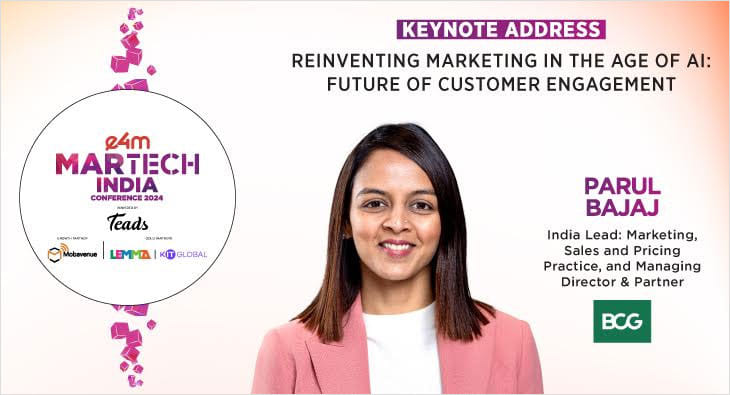

At the e4m Martech India 2024 conference, Parul Bajaj, India Lead for the Marketing, Sales, and Pricing Practice at Boston Consulting Group (BCG), delivered a thought-provoking keynote on how artificial intelligence (AI) is reshaping the marketing landscape.
Bajaj’s address was a compelling narrative of AI’s transformative potential, illustrating its role in enhancing customer engagement and improving business outcomes.
Bajaj began by highlighting marketers’ enthusiasm for AI, backed by extensive research conducted by BCG. “When we surveyed 200 CMOs across markets, including India, 70% expressed optimism about generative AI,” she said.
Furthermore, 84% had a robust investment pipeline, signalling a significant shift toward integrating AI into marketing functions. Personalization emerged as the leading use case, with 67% of CMOs identifying it as the most valuable application.
Bajaj underscored the growing consumer demand for tailored experiences, noting that 96% of Indian consumers are comfortable with companies using their data to deliver personalized offerings. “It’s no longer an option—it’s an expectation,” she emphasized.
The conversation moved to the tangible benefits of AI adoption. Bajaj differentiated between personalization leaders—companies excelling in AI adoption—and laggards, who remain at an early stage.
Her findings were clear: personalization leaders achieve 10% higher growth than laggards, a number she termed “substantial” in the current economic environment. She cited Netflix as an example of how AI is used effectively. “Netflix doesn’t just recommend shows; it customizes trailers based on your preferences,” Bajaj explained. Action enthusiasts see fast-paced sequences, while rom-com lovers encounter heartwarming moments—all curated to maximize engagement.
To illustrate AI’s operational impact, Bajaj shared a real-world example from the airline industry. A leading airline partnered with BCG to integrate generative AI into its content management system, enabling them to accelerate content production by 40 times without additional resources. She credited the result to the harmonious integration of AI and human oversight. Similarly, Bajaj painted a picture of the future with a virtual travel advisor powered by AI, capable of creating personalized itineraries, packing lists, and even product recommendations based on individual preferences. “This isn’t just about convenience; it’s about creating seamless, end-to-end experiences,” she said.
However, Bajaj cautioned against an over-reliance on technology. She introduced BCG’s “10-20-70 rule,” explaining that only 10% of AI’s impact comes from the quality of the algorithm, 20% from technology, and 70% from people, processes, and culture. “While the tech may be sound, if the people and processes aren’t ready, the value won’t be delivered,” she warned. Bajaj shared a retail experiment involving three scenarios: one where human judgment guided merchandising decisions, another where algorithms led the process, and a third where AI insights were combined with human expertise. Predictably, the hybrid model outperformed the others, reinforcing her point.
Bajaj emphasized that AI allows marketers to move beyond conventional segment-based strategies. Instead of finding the right customer for a product, AI empowers businesses to identify the next best action for each individual customer. This shift, she explained, enables businesses to deliver highly personalized and effective messages. She also showcased BCG’s proprietary AI tools that automate campaign execution, offering marketers real-time insights and simplified workflows.
Bajaj’s concluding remarks provided a roadmap for marketers navigating the AI era. She urged businesses to prioritize customer-centricity, operate with agility, and embrace experimentation. “Fail faster and learn faster,” she advised, cautioning against chasing magic bullet solutions. “The future of marketing isn’t about replacing people but amplifying their abilities through AI,” she said, encapsulating her vision.
Her keynote, a blend of data, real-world examples, and practical advice, underscored the necessity of a balanced approach to AI adoption. Bajaj left the audience with a clear message: AI is not a substitute for human ingenuity but a powerful tool to enhance it. Her words set the tone for an era of transformative marketing, inspiring businesses to harness AI’s potential thoughtfully and strategically.
Read more news about Marketing News, Advertising News, PR and Corporate Communication News, Digital News, People Movement News
For more updates, be socially connected with us onInstagram, LinkedIn, Twitter, Facebook, YouTube & Google News