Storytelling, language and community in India’s new brand era
At the e4m Pitch CMO Summit Bengaluru 2025, marketers and creators decoded how cultural nuance, and personal storytelling are reshaping the brand playbook in India’s fast-evolving culture economy
 by
by
Published: Aug 8, 2025 2:37 PM | 7 min read
 Follow Us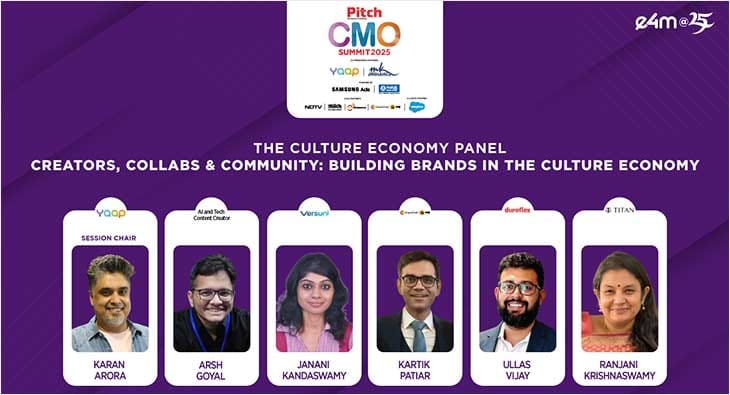

The panel on ‘Creators, Collabs & Community’ at the e4m Pitch CMO Summit Bengaluru 2025 featured voices from both legacy brands and new-age platforms, exploring how marketing is shifting from pure product narratives to deeply personal and cultural connections.
Panellists included Arsh Goyal, AI & Tech Content Creator; Janani Kandaswamy, Head of Marketing, Preethi Kitchen Appliances (Versuni – Philips Appliances); Kartik Patiar, Senior Director – Business, ShareChat and Moj; Ullas Vijay, Chief Marketing Officer, Duroflex; and Ranjani Krishnaswamy, Chief Marketing Officer – Watches and Wearables, Titan. The session was chaired by Karan Arora, Revenue Head – North, YAAP.
Kicking off the discussion, Ullas Vijay reflected on the centrality of culture in brand longevity. “Purely from the category I’m a part of, the tension creeps into the culture directly,” he said. “That’s the reason any brand can exist for decades or centuries; it becomes an integral part of the culture.”
He emphasised the challenge for brands to identify the right addressable market and cultural context. “A product solves a tension. But till the time it doesn’t touch the three vertices of the language, values, regional nuance triangle, it won’t succeed.” Culture is the code for a brand to exist, more than the product itself.
Krishnaswamy, drawing on Titan’s journey, noted that consumers have never bought just products. They’ve always been drawn to stories and magic. “What’s happening today that makes life interesting, and equally challenging for marketers, is that people are spoiled for choice,” she said.
She explained that the brand had evolved from being perceived merely as a timekeeping device to becoming a marker of lifestyle. It now emphasised craftsmanship, labour of love, and expertise, because, as she put it, wearers increasingly seek to express their own stories through the brand, which in turn must reflect the maker’s story.
Consumers today, she said, demand personal intimacy from brands. “People are asking, what’s your ideology? What do you stand for? The ideology and what you create must align. You can’t appropriate a cultural conversation if what you do doesn’t belong in it.”
She added that the shift from functionality to lifestyle has been symbiotic. “When phones came in, watches lost their utility in timekeeping. But the analog business became part of the accessories category. And that signalled something about the wearer. We nudged the change, but consumers led it.”
Speaking on Preethi’s approach to cultural relevance, Janani Kandaswamy argued that geography matters less than cultural behaviour when it comes to product development. “Culture affects habits, especially in how consumers interact with products,” she said.
She gave the example of changing expectations from homemakers across generations. “A decade ago, for the housewife, small quantity grinding was a mark of her culinary skills. She wanted to serve fresh chutney to her husband. Today, the same woman is a working professional who wants chutney to stay fresh longer without having to spend time in the kitchen.”
To meet this shift, the brand introduced a patented technology designed to keep chutney fresh for 24 hours. She noted that this move reflected a broader cultural change, but emphasised that, from a communication perspective, the approach had to be hyperlocal.
She elaborated that while the product remained the same, the message changed by region. “In Andhra Pradesh, it was gongura chutney. In Tamil Nadu’s interiors, like Madurai, it was takali chutney. In Kerala, it was coconut chutney. And in certain castes and communities in Chennai, we needed to reference their specific chutney preferences. That’s how a common product gets translated into hyperlocal communication.”
On the role of platforms, Kartik Patiar spoke about how ShareChat and Moj are built ground up for India, rather than following a Western playbook. “India isn’t a monolith; it’s a continent of cultures. We’ve built our platform in that context,” he said.
He pointed out that the platform has over 325 million monthly active users and lakhs of creators, with 1.5 lakh being monetisable by brands. “There are three stakeholders in our ecosystem: consumers, creators, and brands. Everything we build must serve all three.”
He explained their approach through three concentric circles, of which the core was language. “We are a language-first platform, with 15 Indian languages. About 81% of people consuming digital video do so in their preferred language. And as you move from tier 1 to tier 2 and tier 3, language builds authenticity, trust, and bridges between creator and consumer.”
He supported this with data, noting that regional creatives on their platform show a 2x increase in CTRs (Click-Through Rate) compared to generic national content. “Language-first not only builds trust, but it performs better.”
Patiar shared a case study from the last festive season. “An auto OEM (Original equipment manufacturer) came to us with high awareness scores but low purchase consideration. The creator economy helped solve that. Creators spoke about the product’s KSPs (Key Selling Points), how it solved a personal need. That moved the needle.”
He stressed the difference between translation and transcreation. “Don’t just translate. Transcreate with the creator.” A Bhojpuri-speaking audience in rural Bihar needs something different from a Coimbatore consumer. Creators provide that cultural nuance.
Responding to a question on the impact of short-term topicality versus sustained cultural relevance, Krishnaswamy shared an example from her time at Tanishq. “South India is the largest jewellery market, and our market share was minimal. It wasn’t about capturing a catchment; it was the whole state that we had a job to do in,” she said.
She noted that while Tanishq had previously focused on festival-led marketing, a more meaningful approach was necessary. The team revisited the brand’s core identity, ‘being the boldest expression of femininity’, and explored what that concept meant within the cultural context of Tamil Nadu.
This campaign featured actor Nayanthara and celebrated local women like salon artists and store staff across Tamil Nadu. “At a national level, you’d never imagine a salon artist as a brand spokesperson. But we celebrated them as the Pudhumai Penn of Tamil Nadu,” she said.
Building on her point, Vijay drew a parallel between two brands in their portfolio, Duroflex and Sleepyhead. “They speak to very different consumer cohorts. Duroflex speaks to a mature customer. Sleepyhead speaks to a first-jobber, someone in a 1BHK, setting up their first home,” he said.
Vijay shared two examples from the recliner category, illustrating how topicality can be effective when aligned with brand identity. “Take Sleepyhead. When the last season of Squid Game was out, we launched seven stores in Bangalore. Budget was tight, and we needed footfalls.”
They identified their core consumer: someone in their 20s who loves to relax, play video games, and binge-watch OTT. “What sits better than sitting? Replace the chair with a recliner,” he said.
The result was an IP called SitGames, a topical play on Squid Game. “We invited consumers to sit on a recliner for eight hours without getting up. If they did it, they got to take it home,” he shared.
Read more news about Marketing News, Advertising News, PR and Corporate Communication News, Digital News, People Movement News
For more updates, be socially connected with us onInstagram, LinkedIn, Twitter, Facebook, YouTube & Google News