Inside the playbook to reach India’s next billion
e4m Pitch CMO Summit Bengaluru 2025 saw marketers explore how legacy and digital-first brands are preparing to tap into India’s next billion consumers
 by
by
Published: Aug 8, 2025 2:27 PM | 11 min read
 Follow Us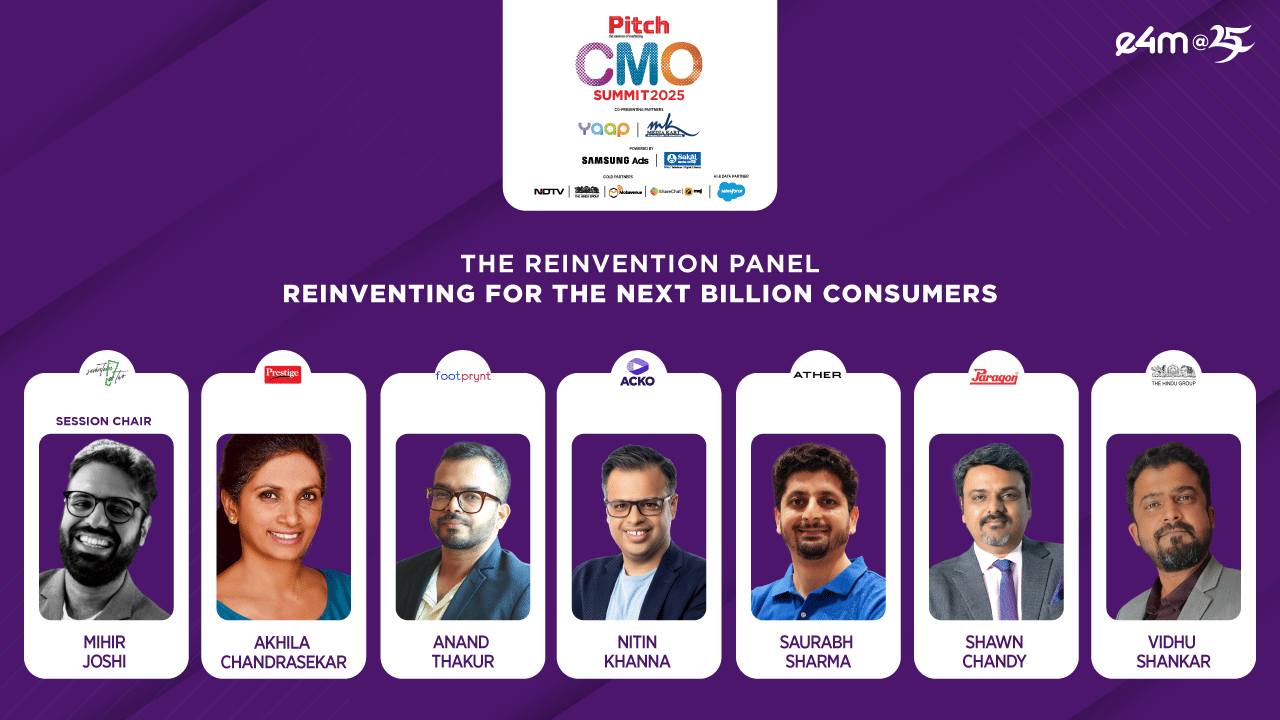

At the e4m Pitch CMO Summit Bengaluru 2025, marketers gathered to explore how legacy and digital-first brands are preparing to tap into India’s next billion consumers, many of whom are yet to shop online or even access the internet.
Moderated by Mihir Joshi, Co-founder of 1702 Digital, the panel titled “Reinventing for the Next Billion Consumers” featured Akhila Chandrasekar, Senior General Manager & Head – Marketing, TTK Prestige; Anand Thakur, Co-Founder, footprynt; Nitin Khanna, Vice President Marketing, Acko; Saurabh Sharma, Head of Marketing, Ather Energy; Shawn Chandy, Chief Marketing Officer, Paragon; and Vidhu Shankar, AVP – Ad Sales, The Hindu Group.
Joshi opened the session with a striking insight: “Ninety crore people in India have internet access today.” He added that only 17 crore Indians, or 25%, have shopped online even once, according to a July McKinsey report. “That means almost 65 crore people, twice the population of the United States, have internet but have never shopped online,” he said. “So the big question is: how do we reach them, and those who are not even online yet?”
Representing a 75-year-old legacy brand, Akhila Chandrasekar of TTK Prestige spoke about how the company is adapting to a digitally driven consumer landscape. She laid out three areas where legacy brands can leverage their strengths in the digital age.
First is consumer trust. “New-age brands have to build that trust. We already had it, but we had to build the experience. That meant improving the online journey, strengthening consumer interaction, and building advocacy,” she said. “Now that we have so many touchpoints, it’s important to live up to that trust.”
The second advantage, she said, lies in data. “Even if we just pull data from the last ten years, we have a 50-lakh database ready to go. Many digital-first brands are still building theirs from scratch,” she noted. What matters now is how that data is used to drive personalisation, develop cohorts, track purchase behaviour, run campaigns, and improve products.
She added that legacy brands often hold the position of category leaders on e-commerce platforms, offering consistency in pricing and margins. “Rarely do multi-channel brands discount beyond a point. That’s something we work with platforms to maintain,” she said.
Chandrasekar also stressed that communication must be multi-pronged. “It’s not just about traditional or digital anymore. There are different generations with different media habits, and we must cater to each with the right mix,” she said.
When asked about how brands can scale communication to influencers in tier 2 and tier 3 towns, Anand Thakur of footprynt highlighted the distinction between ‘India’ and ‘Bharat’. “If you want to market to the next billion, you first need to understand your cohort. Even Gen Z in India is different from Gen Z in Bharat. One might buy an iPhone; the other will go for a OnePlus Nord that’s cooler but gives value,” he said.
He emphasised that cultural context is critical. “A tier 2 town in UP is not the same as one in Karnataka. Pop culture is not homogeneous. A meme in Kannada won’t land the same way in Punjabi,” he said. Marketers must go beyond simply translating content. “You can’t just say, ‘Let’s make five reels in Kannada’. With whom? Does that person have the trust factor? Can they translate your message and localise it in a way that actually connects?”
Citing Meesho as an example, he said the brand succeeded by onboarding people through vernacular content and using tier 2 and tier 3 women as content creators. “That’s what built trust for them,” he said.
A New Lens for a New India
Joshi turned next to Acko’s Khanna, acknowledging the brand’s reputation for excellence in digital customer acquisition. “Genuinely, all the brands we work with look at Acko as an aspiration,” he said. “So what does your playbook look like for acquiring the next billion customers? Is it the same one from a decade ago, or are you completely flipping the script?”
Khanna was direct: “It’s almost a self-fulfilling question. The same playbook won’t apply. Even two or three years ago feels too long to hold onto a strategy, given how rapidly the marketing and product landscape is evolving.”
He explained that Acko is approaching the challenge with an entirely new lens—literally. “We call it LENS: Language, Experience, Network, and Scale. That’s the framework we’re using to reimagine customer acquisition.”
On language, Khanna echoed the earlier point made by Thakur. “We’re not just building for India 1 anymore; we’re building for India 2 and India 3. That’s where the next billion consumers are going to come from,” he said, citing Bloom Ventures’ well-known India 1/2/3 classification. “Language is no longer just about translation. It’s about trust. There are dialects beyond Kannada, Malayalam, and Telugu, and these hyper-local nuances matter deeply.”
He noted that language also encompasses tone and brand personality. It’s about humanising the conversation in a way that feels native and relevant.
Moving to the second pillar ‘experience’, Khanna highlighted how product design itself must evolve. “For a consumer in Bangalore or Bombay, we optimise for conversion, i.e. speed, seamlessness. But for the next cohort, it’s not about speed. It’s about confidence,” he said. “You’re not designing a call to action; you’re designing a call to comfort.”
Network, the third lens, requires a fundamental rethink of distribution and influence. “The creative economy is one layer of influence. But in micro-markets, it’s hyperlocal influencers that matter. The kirana store owner or the neighbourhood RJ are the trusted voices,” Khanna said. “We need to reimagine that influence layer entirely.”
He concluded with the fourth pillar: cale. “The only way to do language, experience, network at scale is with AI,” he said. “That’s the lever that will enable us to execute this reinvention for a billion people.”
Picking up on the idea of experience, Joshi asked whether creating entirely new categories could also be essential for attracting the next billion. “Think of shampoo,” he said. “Urban India was comfortable with big bottles, but rural markets wanted sachets. So how do you think about SKUs or new formats when you’re selling hardware, which is already hard to sell?”
Saurabh Sharma, Head of Marketing at Ather Energy, explained that automotive hardware follows a completely different customer journey. “The research cycle is much longer. People subconsciously start thinking about what they want to buy 12 months before stepping onto a shop floor,” he said. “By the time they walk into a store, they already have a brand in mind. They’re not exploring, they’re validating.”
He emphasised that a brand like Ather needed to be present in the consumer’s mind well before the buying stage, and that it had to be perceived as future-ready.
Sharma noted that while regional differences matter, there are national patterns marketers can build on. “India is largely an upgrading market. People everywhere want better experiences. Whether you’re at the bottom of the pyramid or the top, you’re looking to move up.”
He pointed out that while categories like mobile phones, bikes, and even cars have seen heavy premiumisation, scooters haven’t. “We’re trying to change that. Scooters are becoming a lifestyle choice, not just a commuting tool. Women entering the workforce, rising incomes, and better infrastructure are all fuelling this shift.”
So how does Ather’s marketing match up to its product ambition?
“For us, it's not just about speaking in the regional language. It’s about thinking in that language,” Sharma said. He shared a specific challenge the team faced. “We had this English line: The new law of motion. It worked beautifully in English, but it completely collapsed when we tried translating it.”
That’s when the shift happened. “We realised we had to start concepting in the regional language itself,” he said. “When the idea is born in that language, it lands better.”
Sharma said Ather now develops campaigns from scratch in four or five major Indian languages. “Once you crack the insight in that language, everything aligns. You’ve got culture on your side.”
The Channel Conundrum
Joshi turned to Chandy to address one of the most debated questions in brand-building: channel strategy. “If you look at the last decade in India, there have been two dominant models. One is the Sugar Cosmetics or Mamaearth route, i.e. starting DTC, then scaling. The other is more marketplace-first, like Atomberg, and then figuring out DTC or retail. What’s the right model for reaching the next billion?”
Chandy didn’t hesitate. “A large part of the country is still buying offline. But when we go to conferences, we meet people who only want to talk about online, DTC, marketplaces, and digital,” he said. “So my friend here from print gets ignored. And our out-of-home partners, too.”
His point was simple: no single channel will suffice.
“Even globally, e-commerce hasn’t replaced retail. Nike is a case in point. They had to replace their CEO because they over-indexed on online and ignored trade partners. It cost them,” he said. “Paragon is still over 90% offline. Multi-brand outlets are the backbone. We have a few exclusive stores, yes, but the bulk of our distribution is traditional.”
Chandy credited earlier panellists for articulating the balance required. “I think you've deliberately or coincidentally placed us on either side of the panel, sandwiching the new-age folks between us,” he joked.
He went on to explain Paragon’s approach to omnichannel. “We’ve got three brands,” he said. “The newer brands take a digital-first approach, while the legacy brand leans on traditional retail. But all are available both online and offline.”
This balance, he said, is not easy to maintain. There’s always push and pull. Dealers want to know why you’re offering discounts online. At the same time, digital partners promise conversions and ROIs that are tempting. “It becomes a management challenge: how to do right by both sides, without triggering channel conflict.”
He cited pricing as a specific concern. “If we price too low online, it angers trade partners. If we price too high, consumers don’t convert. So we’re constantly calibrating.”
His overall view: “No brand can afford to focus on just one channel. Look at DTC-first players. Even they’ve moved to offline. Brands like Lenskart, Mamaearth have all realised they need physical stores. The experience matters.”
Print’s Quiet Power
To wrap up, Joshi posed a final question to Shankar: “With 45 crore people still not online or using the internet regularly, what role can print play in reaching the next billion?”
Shankar said clearly, “India is too large and too complex for one medium to dominate. Online and offline both exist. And both work.”
He acknowledged that print often gets overlooked in modern marketing conversations. “We have digital. We do branded content. We do events. But we’re also the most subscribed news site in India, with five lakh paid subscribers,” he said. “There was a time when we thought no one would pay for content. But today, people pay separately for Netflix, Amazon, and more. Quality content wins.”
For brands looking to build trust and resonance, the print legacy matters. “We offer more than just reach. We offer relevance,” he said. “Whether it’s events, custom content, or partnerships, we know how to tell your story to the right audience.”
He also pointed out how The Hindu is cultivating the next generation of readers. “We work with over 5,000 schools. Our Young World supplement reaches kids in classes 3 to 8. Then there’s Hindu in School for classes 9 to 12. These are printed and distributed every day.”
That’s where, he said, the next billion truly begins, not just in mobile-first experiences, but in early habits formed by trust, relevance, and consistency.
Read more news about Marketing News, Advertising News, PR and Corporate Communication News, Digital News, People Movement News
For more updates, be socially connected with us onInstagram, LinkedIn, Twitter, Facebook, YouTube & Google News