Cracking the new age brand funnel in a non-linear consumer world
In a world of fragmented attention and non-linear journeys, marketers at the e4m Pitch CMO Summit Bengaluru 2025 stressed that organic demand wins over discounts
 by
by
Published: Aug 7, 2025 2:04 PM | 10 min read
 Follow Us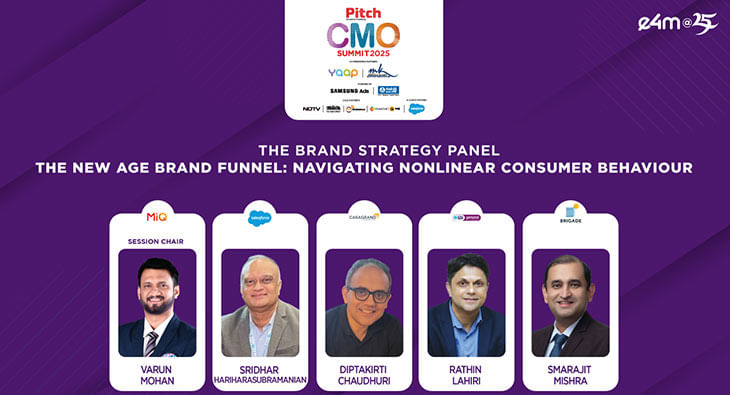

At the e4m Pitch CMO Summit Bengaluru 2025, brand leaders came together to decode the evolving consumer journey and shared how they are adapting brand strategies in an ecosystem defined by fragmented attention, multiple touchpoints, and nonlinear decision-making.
Moderated by Varun Mohan, Chief Commercial Officer – India, MiQ, the session titled “The Brand Strategy Panel: The New Age Brand Funnel” featured insights from Rathin Lahiri, Chief Marketing Officer, SBI General Insurance; Smarajit Mishra, Head – Marketing and Strategy, Brigade Group; and Sridhar Hariharasubramanian, Senior Director, Salesforce, along with Diptakirti Chaudhuri, Chief Marketing Officer, Casagrand.
Setting the tone for the discussion, Mohan spoke about the rapid shifts in consumer behaviour driven by device multiplicity and content overload. “The Indian consumer today spends around four and a half hours daily consuming video content across multiple platforms,” he said, noting that this consumption has moved from appointment-based viewing to convenience-led, on-demand habits.
Highlighting a generational shift, he added, “A major behavioural driver today is FOMO (fear of missing out). It’s no longer just about what content is consumed, but also about visibility, status, and being part of what others are experiencing.”
Opening the discussion from a financial services perspective, Lahiri said, “Our objective is to be where the customer is. We work a lot through partnerships with other brands.” He cited SBI General’s alliances with players like IDFC Bank, regional rural banks, and Policy Bazaar as examples of how the brand engages with diverse consumer segments through targeted campaigns.
He elaborated on how the brand’s marketing strategy adapts to India's life stage-driven consumption. “The median age of India is 28. People are in the asset acquisition phase, buying two-wheelers, white goods, or houses, often funded by lending. That’s when insurance becomes important,” he explained.
For SBI General, the journey doesn’t end at acquisition. Lahiri pointed out the importance of lifecycle marketing. “A customer may start with a 5 lakh health cover in his 20s. But by the time he is 35 or 40, he might need a 20 lakh cover. So, upselling and cross-selling become essential,” he said. Building trust and showcasing deliverables such as hospital networks or claim ratios are key to this approach, with Lahiri adding, “Our best marketing comes from our customer base. Better NPS scores lead to higher referrals. That’s the virality we count on.”
Mishra offered a real estate lens to the discussion, underscoring the depth and emotion behind property purchases. “We’d like to believe that a Meta ad has driven the purchase, but in India, there’s often a deeply ingrained psychology - ‘ek ghar lena hai’ (I want to own a house) - that runs deeper than any top-of-the-funnel trigger,” he said.
He pointed out that the linear sales funnel no longer holds. “Consumers today don’t move in a straight line. Their journey is influenced by everything from friends and colleagues to Meta pages and billboards,” he said.
With such a fragmented ecosystem, Mishra stressed the importance of defining clear KPIs. “You have to be able to track marketing efficacy and attribute ROI. Each effort needs a clear intent,” he said.
Taking a cue from Lahiri’s earlier point, Mishra explained how various ecosystems, channel partners, existing customers, and direct marketing must be seen as complementary, not competitive. “A great brand ad or collaboration doesn’t just increase website traffic. It gets chatter going among our channel partners and customer base, too,” he said.
He also emphasised the need for deep consumer understanding. “How well we know our customer determines how effectively we communicate. That insight defines what our next marketing exercise should look like,” he added.
As the discussion deepened, the panel explored how traditional marketing funnel models are being challenged by modern-day consumer psychology, particularly in high-involvement categories like real estate and finance.
Chaudhuri pointed out that the journey often begins long before marketers even realise it. “In real estate or other high-value purchases, people often make the decision only once, or at least they believe it’s their one big purchase,” he said.
He argued that the trigger for such purchases could be deeply aspirational, formed years before any direct brand interaction. “Someone may have seen a particular bike or a dream home as a child and decided then that one day they would own it,” he said. “That decision was made well before the marketing funnel ever began.”
Chaudhuri stressed the importance of building the brand before the consumer enters the funnel. “Great products, excellent service, and even things like claim ratios in insurance all play a role in the decision-making process. And they lie outside what is traditionally considered advertising,” he said.
He also questioned the conventional representation of the funnel. “From the top, it looks like a neat triangle, but in reality, it’s a spiral. Especially in real estate, people start with the best home in mind, a 4BHK villa near work. Then budget, area constraints, or practical concerns bring them back to reevaluate,” he explained.
“People relearn and recalibrate. From our point of view, it might seem like square one, but to them, it’s a cycle of discovery and reassessment,” he added. Chaudhuri argued that the goal of the marketer is to keep offering new and relevant information as the customer revisits the journey multiple times. “The funnel is circular and overlapping. Customers come, evaluate, drop off, come back again, often months later and sometimes in a completely different area.”
In such a nonlinear landscape, Chaudhuri highlighted the importance of value over messaging. “Younger generations, like Gen Z and Gen Alpha, are even more resistant to advertising. So it’s essential to offer them something they value, rather than just pushing brand messages,” he said. “Build trust over time, so that when they are ready to spend, they choose you.”
Mohan then shifted focus to ask if the traditional funnel still had a place in today’s strategy.
Hariharasubramanian responded with a different model altogether. “Personally, I believe in a cycle or a flywheel rather than a funnel,” he said. “The importance of nurturing that relationship long after the customer has purchased is often underestimated.”
Even in a category like real estate, where the purchase may be a once-in-a-lifetime event, Hariharasubramanian believed that customer advocacy and word-of-mouth could deliver long-term returns. “It’s about how you convert an anonymous visitor into a loyal customer and, eventually, into an advocate,” he said.
Drawing from his retail background, he spoke about the extended decision journey in digital-first environments. “From awareness to solution-seeking, product comparisons, review reading, and finally purchase, each of these steps leaves digital breadcrumbs,” he said. “Brands must track those signals, whether it’s a website visit, a brochure download, or watching a product video, to interpret intent.”
He added that technology today allows brands to follow the customer through every stage of the journey. “We now have tools that capture these signals, and over time, patterns emerge, whether the person is browsing seriously or casually. That intelligence should inform campaigns, promotions, and brand touchpoints,” he said.
Speaking of real-world applications, he also acknowledged Brigade Group as a client using Salesforce to enhance various touchpoints across the business. “Each customer’s journey is unique, but the goal remains the same: turn an intent signal into a long-term relationship,” he concluded.
The discussion then shifted to gratification and whether consumers still seek tangible rewards to influence purchase behaviour, something once central to marketing campaigns.
Smarajit Mishra weighed in: “In high-involvement segments, it’s about getting value for your money. But even more important is the entire experience of the transaction,” he said.
He explained that experience-led differentiators carry more weight than direct incentives. “If your sales team is well-trained, your booking process transparent, and every touchpoint works smoothly, that’s what tilts the decision in your favour,” he said.
While deal sweeteners and inventory preferences do have a role, Mishra emphasised that it’s the experience, not just the value, that matters most in high-ticket categories. “People are investing for 20 to 30 years. They want to feel reassured at every step,” he said.
As the panel closed, the focus turned to the fundamentals: what truly drives consumer action in today’s fragmented attention economy?
For Lahiri, the marketing landscape may be evolving, but the core purpose remains unchanged. “The job of a marketer fundamentally remains to create organic demand,” he said. “Whatever platform you use, you’re unlikely to make a profit on the first transaction. That’s how the platforms are built.”
In categories with low frequency and high trust requirements, like insurance, visibility alone isn’t enough. “You need to know what the two or three essential things your customer is looking for,” Lahiri said. For Indian consumers, he explained, value tends to outweigh price, especially in decision-making. “Value is core to every category, but it’s not why you enter it. In our space, trust is what matters most.”
To drive demand, Lahiri argued that marketers must start with consumer insights. “Once you understand the levers, then build your product mix, and use India’s massive distribution network, because there are micro-opportunities everywhere.”
Echoing Lahiri, Chaudhuri added that in high-involvement categories, deal sweeteners aren’t always tangible. “For a home buyer, the discount might not close the deal. But a recommendation that the builder has improved, or that the area has appreciated, can be the nudge,” he said. “In such cases, the macro environment becomes the deal sweetener, not the brand itself.”
In contrast, for low-involvement items like soap or chips, consumer behaviour is far more fluid. “Didn’t get a discount this month? No problem, you’ll switch next month,” Chaudhuri said. “But with homes, education, and cars, it’s about reputation, perceived quality, and future potential.”
Bringing in a technology lens, Hariharasubramanian from Salesforce took a broader view. “We offer tools that help brands right from building awareness to post-purchase engagement,” he said. These include connectors to major ad platforms, solutions for capturing campaign responses, and the Salesforce Data Cloud, which acts as a repository of every digital interaction.
“Every click, download, or brochure view tells you something about intent,” he explained. “We help brands build profiles from those anonymous interactions, enriching them with every touchpoint.”
Once patterns emerge, segmentation becomes key. “You can’t afford to blast the same message to everyone anymore. You’re interrupting someone’s day; it better be relevant,” he said.
Through micro-segmentation and data-driven targeting, Hariharasubramanian explained, brands can dramatically improve campaign ROI while reducing noise. “We work with several financial services firms in India, processing millions of customer rows to deliver hyper-targeted campaigns.”
Closing the session, he offered a simple, common-sense takeaway: “Invest in a robust data platform. Capture the full journey, segment smartly, and measure impact. That’s what will separate clutter from conversion.”
Read more news about Marketing News, Advertising News, PR and Corporate Communication News, Digital News, People Movement News
For more updates, be socially connected with us onInstagram, LinkedIn, Twitter, Facebook, YouTube & Google News