LPG crisis puts restaurant industry on edge, FMCG too may feel the heat
Shares of food delivery platforms such as Swiggy and Eternal have reportedly come under pressure after reports of LPG shortages disrupting restaurant operations across several cities
 by
by
Published: Mar 13, 2026 8:49 AM | 7 min read
 Follow Us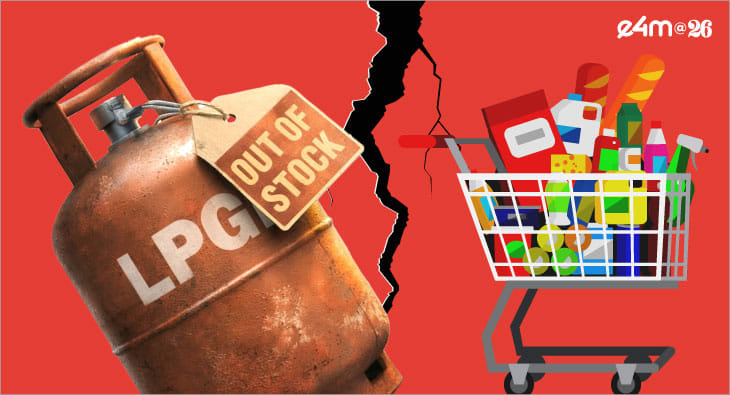

Amid escalating geopolitical tensions in West Asia, India is beginning to feel the ripple effects across parts of its food ecosystem. One of the most immediate disruptions has emerged in the form of a shortage of commercial LPG cylinders, a critical input for restaurants, food brands, QSRs, hotels, and cloud kitchens that rely heavily on cooking gas for daily operations.
Over the past few days, several cities have reported difficulties in securing commercial LPG supplies. Restaurants in Mumbai have already warned of kitchens running out of cooking gas, while industry bodies in Delhi-NCR have flagged the possibility of temporary shutdowns if supplies remain constrained. The impact has already led to temporary closures and operational disruptions across cities. A hotel in Chennai reportedly displayed a notice outside its premises declaring a holiday on March 11 due to the lack of LPG supply, while Vidyarthi Bhavan, a popular eatery in Bengaluru, temporarily suspended operations amid supply constraints. In Hyderabad, the well-known restaurant chain Shah Ghouse Café has reportedly shifted to traditional firewood stoves to cook its signature biryani as commercial LPG cylinders became scarce.
Ankur Sharma, Management Committee Member at the National Restaurant Association of India (NRAI), told e4m that the situation is becoming increasingly challenging for restaurants across the country. “Our industry is nearly 95% dependent on LPG for daily operations, and many restaurant partners are already streamlining menus and taking austerity measures just to keep their kitchens running,” he said.
While the immediate disruption is being felt by the restaurant and food service sector, the impact is beginning to extend beyond kitchens and into the broader FMCG ecosystem. Industry observers say the effects may not be limited to the short term; how companies across the food value chain adapt to potential supply disruptions in the coming weeks could shape the sector’s response in the longer run.
Food brands say the situation is already prompting companies to adapt kitchen operations and explore alternatives to ensure business continuity.
Neha Rao, Vice President – Marketing, Bikaji Foods International Limited, said the current shortage is unlikely to have a major immediate impact on the company’s production. However, she noted that rising crude-linked costs could still impact FMCG players. “Packaging material prices have gone up substantially in the last few days and the effect may be felt in the next quarter. Palm oil prices have also moved up by ₹6–₹7 per litre.”
Adding to this, L Muralikrishnan, Co-founder and CMO, Wow! Momo Foods said such disruptions often lead consumers to temporarily shift towards at-home consumption, creating short-term demand shifts across certain FMCG and convenience food categories.
Muralikrishnan, said the brand has seen minimal disruption so far as several of its kitchens already run on electrical equipment such as steamers and fryers. “Whenever restaurants face disruption, the consumer doesn’t stop eating out, they simply bring the restaurant home,” he said, adding that such situations often lead to increased demand for ready-to-eat and FMCG products that allow consumers to recreate restaurant-style meals.
Meanwhile, retail platforms are already seeing shifts in certain product categories.
Seshu Kumar Tirumala, Chief Buying and Merchandising Officer at bigbasket, said demand for kitchen appliances has spiked as households and businesses explore alternatives to LPG-based cooking. “Induction cooktops have shown a significant surge, with a five-fold jump on March 10 and a thirty-fold spike on March 11,” he said.
The concerns have also reflected in the stock market. Shares of food delivery platforms such as Swiggy and Eternal reportedly came under pressure after reports of LPG shortages disrupting restaurant operations across several cities.
Also read: Prolonged US-Iran war can push newsprint prices up 10–12%
Middle East conflict puts Indian businesses on watch; several ad campaigns put on hold
Impact across QSRs, cloud kitchens & FMCG ecosystem
Industry players say the LPG shortage is beginning to disrupt operations across restaurants, cloud kitchens and the broader FMCG supply chain.
Rashmi Daga, Co-founder & CEO of FreshMenu, said the biggest challenge currently is the lack of clarity on when commercial LPG supplies will normalise. According to her, several of her kitchens have been operating on existing inventory or sourcing cylinders wherever available just to keep operations running. “The biggest issue is the lack of predictability. If the disruption lasts a few days, businesses plan one way. If it stretches longer, the entire operating model has to change,” she said.
Platforms tracking restaurant operations say such disruptions can affect the wider food ecosystem as well.
According to Mandar Lande, Co-founder & CEO of foodtech platform Waayu, several restaurants across Tier-1 and Tier-2 cities have already taken steps such as reducing menu sizes, prioritising dishes that consume less gas, and adjusting kitchen operations to manage the shortage. While the impact on overall order volumes has remained moderate so far, experts note that prolonged instability could slow consumption growth in the food service sector, indirectly affecting FMCG sales, particularly for products that rely heavily on restaurant and bulk consumption channels.
Consumer Behaviour Shifts
While it is still early to assess long-term consumer behaviour shifts, industry players say certain demand signals are already emerging across the food ecosystem.
Platforms and suppliers say disruptions in restaurant operations often lead consumers to rely more on convenient food formats that are easy to prepare at home.
Deepanshu Manchanda, Managing Director, Zappfresh, said the company has seen a noticeable rise in enquiries from restaurants and caterers looking for frozen and ready-to-cook products that simplify kitchen operations. According to him, demand for snack-based frozen products such as samosas, momos, kebabs and spring rolls from the foodservice channel has grown by around 15–20% in recent weeks.
Similarly, Akash Agarwalla, Co-founder, ZOFF Foods, said, “We are also seeing consumers gradually gravitate towards convenient cooking formats. Categories like ready-to-cook (RTC) meals and mixes are gaining traction as they offer quicker preparation and efficient fuel usage. This aligns well with our growing RTC portfolio, which is designed to make everyday cooking easier for households.” He added, while such disruptions can lead to some cost and supply adjustments across the value chain, they also encourage innovation and efficiency within the food ecosystem.
Cost Implications & How Companies Are Coping
The LPG shortage is also creating cost pressures and forcing businesses to rethink their cooking infrastructure. Some restaurant brands are already investing in alternative energy solutions to reduce dependence on LPG.
Arjun Toor, Co-founder, RollsKing, said the company has made an unplanned investment of around ₹35 lakh to transition its outlets to electric cooking infrastructure. “While this impacts margins in the short term, it is necessary to ensure business continuity and protect revenue,” he said.
Industry players say such disruptions can also have cascading cost implications across the broader food ecosystem.
According to Lande, fuel shortages can lead to fluctuations in order volumes from restaurants, inventory planning challenges and increased logistics costs across the supply chain. If the disruption continues for a longer period, it could also affect consumption patterns in the food service sector, indirectly impacting FMCG brands that rely on the HoReCa channel for bulk demand.
Many companies are already taking several operational steps to manage the disruption, including reducing menu sizes, prioritising dishes that require less cooking time, maintaining additional backup cylinders and exploring alternative cooking equipment such as induction or electric setups.
However, experts caution that these measures may not be sustainable if the LPG supply disruption continues for a prolonged period. While the situation is still unfolding and its ripple effects are only beginning to surface across the food ecosystem, the coming days could prove critical in determining the extent of the impact on restaurants, food delivery platforms and the broader FMCG supply chain.
Read more news about Marketing News, Advertising News, PR and Corporate Communication News, Digital News, People Movement News
For more updates, be socially connected with us onInstagram, LinkedIn, Twitter, Facebook, YouTube & Google News