How wellness has got an AI upgrade
At the e4m Health & Wellness Conference 2025, top minds from across the healthcare and marketing ecosystem unpacked how artificial intelligence is reshaping wellness, blending scale with sensitivity
 by
by
Published: Jul 29, 2025 12:43 PM | 8 min read
 Follow Us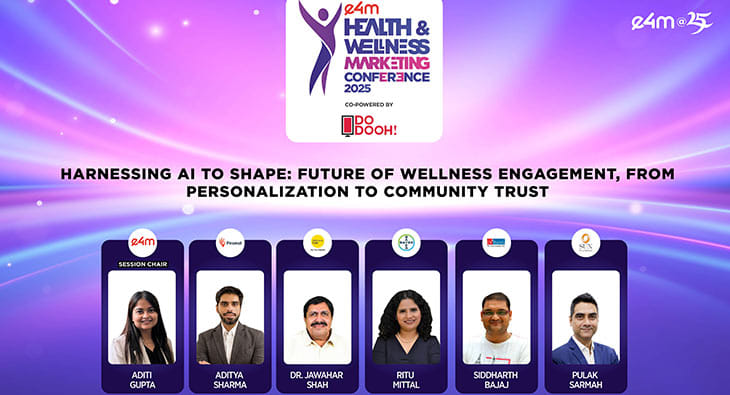

At the 2025 edition of the e4m Health & Wellness Conference, leaders from across healthcare and marketing decoded the expanding role of artificial intelligence in the wellness space. From crafting personalised health journeys to building deeper, data-backed consumer trust, the discussion spotlighted how AI is no longer a future disruptor but a present enabler of smarter, more empathetic engagement.
The panel featured voices from across the industry: Aditya Sharma, Head Media & Digital, Piramal Consumer Healthcare; Dr. Jawahar Shah, Founder, Welcome Cure; Ritu Mittal, Head of Marketing and Digital at Bayer Consumer Health, South Asia; Siddharth Bajaj, Chief Marketing Officer, Dr. Batra's; and Pulak Sarmah, Head – Corporate Brand Marketing, Sun Pharmaceutical Industries Limited. The session was chaired by Aditi Gupta, Assistant Editor at exchange4media.
The discussion was opened by Sharma by highlighting the role of AI in campaign delivery. “We don’t have enterprise-level AI solutions yet,” he said. “But we do use platform-level tools from Meta and Google, like Advantage+ and Performance Max. You define the campaign objective, reach out to your audience, and optimise accordingly. As marketers, our job is to stay anchored to a North Star metric and keep evaluating if the campaign is delivering. The AI systems themselves are increasingly refined.”
Mittal shared Bayer’s broader vision for AI across verticals, spanning operational efficiency, content adaptation, and insight generation. “We’re doing a lot of work in identifying the right partners to support us in this journey,” she noted. “For brands like Supradyn that stand for 100% nutrition, the goal is to make 100% nutrition personalised at scale. That’s the potential we see in AI.”
Bajaj emphasised how Dr. Batra’s is leveraging AI both in marketing and clinical outcomes. “There are two aspects for us: one is performance marketing, CRM, and retention; the other is diagnostics and patient management,” he explained. “We launched AI Hair and AI Skin in early 2023. These tools are built from 40 years of patient data and can identify issues that even a doctor or the human eye may miss.” He added, “Our success rate went from 75–80% to around 94%. That’s the power AI has brought in.”
A B2B2C perspective was offered by Sarmah from Sun Pharma. “We don’t directly recommend products, but we’re exploring predictive AI to drive awareness,” he said. “For instance, many people don’t understand the long-term complications of diabetes. We’re using AI to help inform them, say, what happens if your HbA1c remains high over time? It’s helping us drive engagement by guiding people from unawareness to action.”
As the conversation shifted to trust in AI-driven health recommendations, Mittal reiterated the importance of data ethics. “The first step is identifying the right partners, those who align with our views on data privacy and transparency,” she said. “Where is the data stored? Can users delete it? These are critical questions. This is not a race to churn out solutions. It has to be done responsibly, with the understanding that AI can support and augment, but never replace, human oversight.”
Shah brought in the homoeopathy lens. “A human being can remember up to 50,000 facts,” he noted. “In homoeopathy, we deal with over 10 million permutations and combinations. AI helps us navigate that complexity, improving the accuracy of our outcomes. But warmth, care, and intuition cannot be replaced. The human factor will always remain.”
Bajaj echoed that sentiment. “Homoeopathy is a body-mind medicine. Patients share physical, emotional, and even family history during case-taking. That builds a deeply intimate relationship, which forms the core of trust and credibility,” he said. “AI can act as a co-pilot supporting treatment adherence and engagement, but it cannot replace the human touch.”
Reflecting on how AI is being used across Piramal’s diverse portfolio, Sharma noted that their primary focus remains on campaign refinement through platform-based tools. “We build cohorts, track creative fatigue, monitor hook rates, and optimise performance,” he explained. “While we don’t have AI-based segmentation tools per se, we look at the data once it flows in, slicing and dicing it to identify cross-sell or upsell opportunities.”
Mittal returned with an example of Bayer’s early AI initiative: Arampur, a voice-based platform launched under the Saridon brand. “Saridon is a category leader in headache relief. We did a national survey and found that stress is the biggest trigger,” she said. “We didn’t want to just talk about pill-based solutions. So we created a voice AI platform called Arampur, which helps users identify stress-induced headaches and explore non-pill alternatives. Because Saridon has deep rural penetration, voice worked better than text. Literacy wasn't a barrier.”
She added, “We’re now expanding the platform to reach broader audiences. Stress is a major concern linked to everything from headaches to sleep issues. Used responsibly, AI can potentially serve as a personalised mental health companion. But again, only with the right human oversight.”
Welcome Cure’s Dr. Shah shared how his team has integrated AI into homoeopathy while preserving its emphasis on individualised treatment. “We’ve treated over two million patients, many at the village level, and built connected communities. One of our most interesting developments is an AI tool that helps us understand nine core emotions along with stress and engagement levels,” he said.
Illustrating the practical impact of this system through patient stories, he said, “We had a CFO who said he had no stress. But our AI analysis showed he was deeply stressed. When confronted, he admitted to being under pressure for 18 out of his 20 years as a CFO,” he recalled.
Another case involved a CEO who only showed passion and engagement, and all the other emotions were totally cut off. This insight led us to recommend lycopodium as a remedy. These kinds of insights are not visible to the naked eye.”
On being asked how Dr. Batras is repositioning itself to cater to the younger audience, Bajaj answered that the brand isn’t being repositioned but evolving. “Our chairman always says, ‘whoever comes to us should leave with a happy smile and mind. That’s our responsibility.’ AI is just one of the tools to help us do that,” he said.
He explained how AI has supported both marketing and patient care. “We were initially sceptical about how Indians would accept AI-driven diagnostics like our Hair AI and Skin AI tools, but the results exceeded expectations,” he said. “Now, we're building an end-to-end ecosystem, from onboarding and treatment adherence to satisfaction measurement. For us, AI is more authentic intelligence than artificial intelligence, given how intimate and individualised homoeopathy truly is.”
Sarmah of Sun Pharma reflected on the company’s recent “1000 Lives Every Minute” campaign. “It’s a story of scale told with a human touch,” he said. “AI has helped us on two fronts: predictive and generative. At the top of the funnel, predictive analytics help us measure awareness, consideration, and media delivery across geographies. Social listening adds a third layer, i.e. what's being said, where it’s being said. When you marry these datasets, it sharpens KPIs for future campaigns.”
He added that generative AI is accelerating their go-to-market timelines. “We use AI to test ad concepts faster and iterate in real time. It’s become a valuable tool in campaign execution.”
When asked about the future of AI across their brands, Sharma of Piramal said, “For us, it’s about creating content at scale, and at lower costs. That’s what the management expects and where AI delivers value.”
Dr. Shah underlined the importance of community. “Forming communities where users can share issues and offer peer support is essential. In a world where 90% of our time is spent on gadgets, the right way to connect is by addressing emotions alongside pain points.”
From a marketing standpoint, Bajaj outlined three key areas where AI adds value. “First, personalised and targeted content strategies. Second, improving ROI. You may generate thousands of leads, but only a handful convert. AI helps you reach them effectively,” he explained. “Third, it's about the customer experience. Once someone becomes a patient or consumer, AI helps ensure they feel engaged within the system.”
Sarmah concluded with a broader outlook. “It’s cliché to say AI is powerful, but the adoption itself proves it. Enterprise-level subscriptions like ChatGPT are now common across organisations. It’s making creative processes faster and more accurate,” he said. “For instance, before launching a recent outdoor campaign, we used AI-generated heat maps to test readability at various angles and distances. That kind of pre-testing enhances output significantly.”
Read more news about Marketing News, Advertising News, PR and Corporate Communication News, Digital News, People Movement News
For more updates, be socially connected with us onInstagram, LinkedIn, Twitter, Facebook, YouTube & Google News