How FMCG is grappling with uneven GST slabs
With GST slabs changing, FMCG companies have large inventories priced under the old rates, causing short-term disruption
 by
by
Published: Sep 10, 2025 9:10 AM | 6 min read
 Follow Us

It’s been just a few days since Finance Minister Nirmala Sitharaman, during the 56th GST Council meeting, announced the much-awaited GST 2.0 reforms. Since then, sectors across the economy, including FMCG, consumer durables, apparel, electronics, and even small businesses, have been abuzz with discussions about the potential benefits of a simpler tax structure, improved compliance, and increased consumer affordability.
Under this new framework, the government has rationalised the GST regime by consolidating multiple tax slabs into just two main rates 5% and 18%, while retaining a 40% rate for sin and luxury goods. Effective from September 22, 2025, these reforms are aimed at enhancing transparency, reducing the compliance burden on businesses, accelerating the formalisation of the economy, and lowering prices for consumers.
While most categories have stabilised following the new GST decision, the FMCG sector is finding itself at a critical juncture. Several everyday essentials such as soaps, toothpaste, and food products have benefitted from reduced tax rates, however, key segments like detergents, cosmetics, and skincare remain stuck under the full 18% GST slab, a move that has surprised the industry.
Sharing his perspective on items that remain in the higher tax bracket, Sanjiv Puri, Chairman & Managing Director of ITC Limited, explained, “Keeping detergents and skincare at 18% is unlikely to alter semi-urban or rural demand, as consumer aspirations for branded and premium products remain intact. A lower GST could have triggered a short-term volume boost, but with rates unchanged, demand trends should broadly continue as before.”
Navigating the GST shift
According to media reports, FMCG companies are currently grappling with large inventories labelled with MRP based on the old GST rates, while they await clear implementation guidelines from the government. Although the industry expects that the new tax regime, with lower duties on many FMCG products, will boost consumption over time, in the short term, it is likely to cause disruption, as companies struggle to manage large inventories priced under the old GST rates while waiting for clear government guidelines on implementation.
“With complex supply chains across different businesses, an immediate response isn’t practically possible. We are awaiting precise implementation guidelines from the government to ensure a smooth transition and uniform industry approach,” stated Jyotiroop Barua, Business Head at DS Group.
Many experts also confirmed to e4m that the uneven tax structure is expected to increase compliance challenges and may create short-term disruption in the market.
Adding to this, Ashika Institutional Equities – part of Ashika Group, notes that lower GST rates on select personal-care items may attract smaller players, increasing competition in the mass-market segments. However, major FMCG companies generally align their R&D spending with consumer preferences, which currently favour premium, value-added products. Innovation is unlikely to stop; rather, it will reorient, with faster launches of low-cost packs and formats (such as sachets and concentrates) and tactical marketing strategies aimed at protecting market share in higher-taxed categories.
Meanwhile, higher GST on certain items may delay deeper premiumisation efforts, as companies balance margin pressures with consumer affordability.
Long-term challenges for the sector
Adding a deeper perspective on the challenges, Mamatha Anand, Partner at Deloitte India, highlighted that while GST 2.0 and selective FMCG tax cuts aim to stimulate demand and simplify compliance, several potential risks remain in the long term. Lower tax rates on essentials could intensify price competition, especially if companies are expected to pass on benefits fully to consumers. This may compress margins for players with high input costs, forcing businesses to rethink their pricing and operational strategies.
Another concern is portfolio imbalance. Since only select FMCG categories benefit from the tax cuts, companies with diversified portfolios may face uneven growth. This unevenness could push firms toward strategic realignment, SKU rationalisation, or sharper focus on core categories. At the same time, sustained price sensitivity and tighter margins may restrict investments in R&D, premiumisation, and brand-building—slowing the pace of innovation across the sector.
Compliance pressures also add to the risk landscape. Strong systems will be needed to ensure transparent benefit pass-through, as lapses may invite penalties and reputational damage under anti-profiteering rules. Additionally, the uneven GST structure continues to weigh on personal care products, where higher rates on cosmetics and specialised skincare keep consumer prices elevated. This not only curbs product diversification and competitiveness but also drives down-trading behaviour, resulting in SKU rationalisation and weaker innovation momentum in the mid-tier segment.
Anand concluded that a more harmonised GST structure would create a level playing field, allowing FMCG players to invest in innovation across the value chain without being limited by tax-induced pricing disparities. “These risks can be managed through operational efficiency, supply chain optimisation, and strategic pricing models, and if handled well, the reform is more likely to unlock growth opportunities than create structural bottlenecks,” Anand added.
Positive outlook amid challenges
Beyond the immediate challenges posed by uneven GST slabs and inventory adjustments, analysts and investors see a broadly positive impact of GST 2.0 on the FMCG sector.
As data shared by Ashika Institutional Equities points out that the reforms are structurally beneficial for FMCG companies. By lowering tax incidence on a wide range of everyday items, GST 2.0 immediately restores affordability, accelerates formalisation, and is expected to deliver a front-loaded volume uplift of around 3–5% over the next two to three quarters, along with a 70–90 basis points margin tailwind from packaging and product rate cuts.
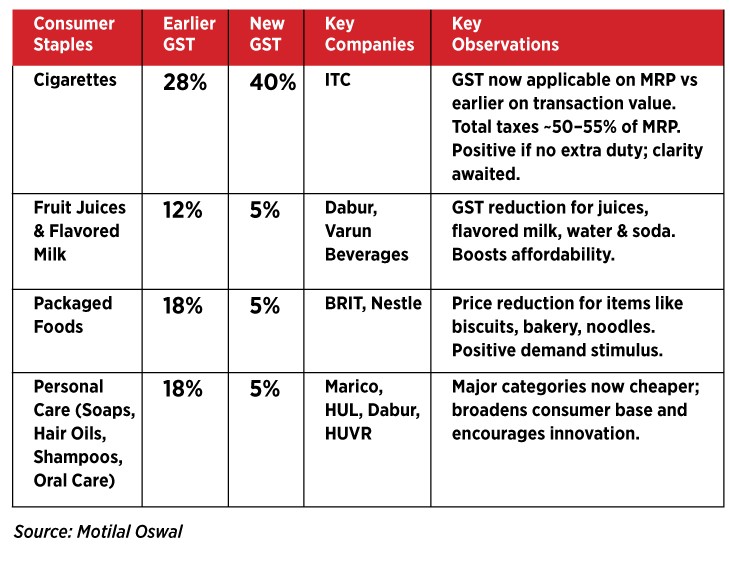
According to Motilal Oswal research, categories such as personal care (soaps, hair oils, shampoos, oral care) and packaged foods are likely to benefit the most, with GST rates falling from 18% or 12% to 5%. The reduction is expected to enhance affordability, stimulate consumption, and provide a positive boost to demand during the upcoming festive season. Leading FMCG companies poised to benefit include Marico, Hindustan Unilever, Dabur, and HULV, highlighting the sector-wide impact of the revised tax rates.
For VCs this also creates an opportunity of growth for smaller brands. Yash Dholakia, Partner at Sauce.vc, a venture capitalist focussed on mid-premium brands, said, “We expect the reduced pricing to significantly widen the consumer base that can be targeted by new age brands as they automatically become more affordable. A large number of new entrants in these categories will drive growth across food, personal care, apparel, and electronics, further driving economies of scale.”
While it is still early days and most FMCG brands are awaiting the detailed implementation guidelines ahead of September 22, the potential challenges, such as managing large inventories under the old GST rates, navigating uneven tax slabs, and aligning pricing strategies,cannot be ignored. These factors may create short-term hurdles for companies as they transition to the new regime. However, how effectively they navigate these initial challenges and position themselves for growth under GST 2.0 remains to be seen.
Read more news about Marketing News, Advertising News, PR and Corporate Communication News, Digital News, People Movement News
For more updates, be socially connected with us onInstagram, LinkedIn, Twitter, Facebook, YouTube & Google News
