'Consumers want relevance, not just their name in ads'
At the e4m Performance Marketing Conference 2025, marketing leaders discussed the challenges of achieving personalization at scale
 by
by
Published: Mar 10, 2025 12:52 PM | 6 min read
 Follow Us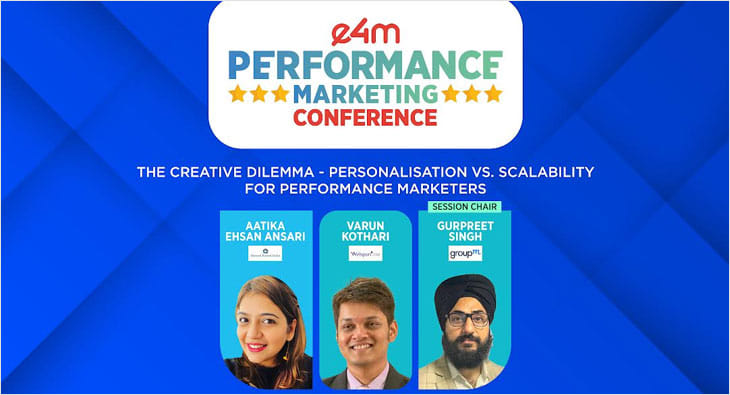

The e4m Performance Marketing Conference 2025 saw a panel of industry experts explore the creative dilemma of balancing personalisation with scalability in digital marketing campaigns. The discussion highlighted practical approaches to delivering personalised experiences without sacrificing reach or becoming intrusive.
The panel, chaired by Gurpreet Singh, Head Performance at GroupM, included Aatika Ehsan Ansari, Head of Media-Digital at Pernod Ricard India, and Varun Kothari, Head-Digital Marketing at Welspun One.
Singh opened the discussion by framing the challenge: "Can we do personalisation at scale? Because the moment you talk about scale, the personalisation goes for a toss. Think of a triangle which is inverted — personalisation stays at large, the moment you start drilling more personalisation, the scale starts tapering down."
When asked if it's possible to strike a balance between personalisation and scalability, Ansari emphasised that the two aren't mutually exclusive. "Personalisation, creative personalisation, and scale—they don’t have to be at odds with each other. There’s a way to balance them, but if you go too specific, I think one of them will inevitably be lost," she explained.
Ansari shared a practical example from her experience, "For one of our niche IPs, we had Hardy Sandhu perform. He was set to perform in Bombay, and we thought, why not leverage personalisation to sell tickets? So, we identified the 500 most common names of males aged 25 to 35 on YouTube and had him personally invite them."
The results revealed important insights about the limits of personalisation. "53% of the consumers were very delighted to hear someone like a celebrity taking their name, asking them to buy a ticket and come see him perform. But we actually got messages and emails from the remaining people saying it was really intrusive," Ansari noted.
This experience led her team to shift their approach toward contextual personalisation. "Maybe moment marketing or moments of consumption, like saying, oh, it's a rainy day, would you want to try a ginger ale tonight? Those are the things that can be at scale, because a part of India is experiencing rain," she explained.
Kothari agreed on the importance of finding the right balance, stating, "I think you have to find a point where you're not intruding." He referenced a Super Bowl campaign by Google Home that received mixed reactions. "They just had the ad saying 'Okay Google' and because a lot of homes in the US are smart homes, their Alexa devices sort of started. It got equal measure of plaudits but at the same time a lot of people found it too intrusive."
He emphasised that the choice of platform plays a crucial role in successful personalisation. "I think you have to be intentional about how you implement scale through personalisation. Choosing the right platform is key—for example, WhatsApp is great because it makes scaling personalisation easy.," Kothari said.
Drawing from his previous experience at Biramal Finance, he added, "When you compare the CTR from a generic message to a personalised message, the personalised message is almost 10x."
When asked whether personalised messaging truly delivers better results, Kothari was positive but nuanced in his response. "In what I have seen, I have almost 7 out of 10 times seen a better performance when it comes to personalisation," he stated. He referenced a McKinsey study showing that about 70% of consumers want to see ads that are specifically tailored for them.
Kothari explained why this matters in today’s cluttered advertising landscape. People are constantly exposed to ads on every platform, making it essential for content to stand out. Unless an ad truly grabs attention—a "thumb stopper," so to speak—audiences are unlikely to engage with it.
Singh then steered the discussion by highlighting the various levels of personalisation. “Now, personalisation has a lot of levels to it. One is communication personalisation, and one is experience personalisation.” He asked Ansari about what level is personalisation most important according to her.
Ansari answered by discussing the necessity of delivering relevant content to consumers. Citing a McKinsey study, she said, “McKinsey asked consumers what ads they would like to see, and they said those that are relevant to them or personalised to them.” She explained that in an increasingly cluttered advertising landscape, consumers prioritise content that speaks directly to their needs.
“Customisation can be as simple as recommending a product based on a past purchase or tailoring messages to financial behaviors, such as offering personal loans at the end of the month when salaries are credited,” she noted. “Ultimately, the goal is to reduce the time consumers spend searching for the right product. If a brand can personalise content to match a user’s lifestyle, it’s a win-win.”
She also stressed that personalisation should go beyond gimmicks like name-based targeting. “It’s more than just saying ‘Hey, Google.’ Instead, if someone attended a Coldplay concert, can we target them with another similar event? If we match consumer interests with relevant offerings, personalisation becomes less intrusive and more effective.”
Singh then shifted the focus to scalability, asking Kothari about the trade-offs between scale and personalisation, especially in different business models. “At times, there could be an imbalance between the two. From a scalability angle, would you sacrifice personalisation for effectiveness?”
Kothari responded with a nuanced perspective. “Yes and no,” he said. “A lot of times, we choose when to implement personalisation. For example, during festive periods, every brand knows it’s the best time to sell. Consumers are more willing to spend, so we may focus on broad messaging at the top of the funnel and introduce personalisation further down to aid conversion.”
Sharing an example from his past work with Taali, a makhana brand, he illustrated how personalisation can go beyond names and locations. “We noticed high engagement around comparisons between popcorn and makhana, particularly for late-night snacking. Instead of just targeting broad audiences, we ran ads specifically from 10 PM to 3 AM with messaging like ‘Looking for your next midnight snack? Order now.’”
He emphasised that personalisation and scale are not mutually exclusive. “You can start generic at the upper funnel to attract consumers and then refine the experience with targeted retargeting. If you don’t personalise at that stage, it simply won’t work.”
Read more news about Marketing News, Advertising News, PR and Corporate Communication News, Digital News, People Movement News
For more updates, be socially connected with us onInstagram, LinkedIn, Twitter, Facebook, YouTube & Google News