'The most misunderstood part of MarTech is web and app analytics'
At the e4m Performance Marketing Conference 2025, industry experts explored the critical components of MarTech
 by
by
Published: Mar 10, 2025 12:32 PM | 5 min read
 Follow Us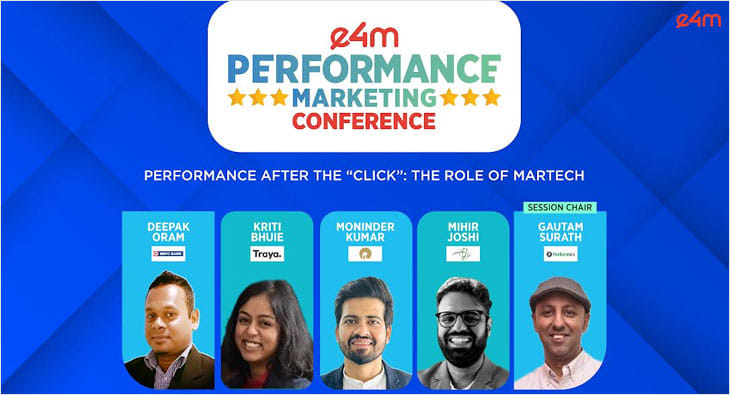

A panel of marketing leaders at e4m Performance Marketing Conference 2025 discussed the evolving landscape of marketing technology (MarTech) and its role in optimising digital marketing efforts after the click. The discussion centered on the key components of MarTech, including attribution, data warehousing, and execution.
The panellists included Deepak Oram, VP Growth Marketing & Marketing at HDFC BANK; Kriti Bhuie, Head Performance Marketing & Growth at Traya; Moninder Kumar, AVP-Digital Lead at Reliance Retail; and Mihir Joshi, Co-Founder of 1702 Digital. The session was moderated by Gautam Surath, COO at Performics India.
The discussion began with Oram sharing insights on attribution as the fundamental layer of MarTech. "After 20 years, I'm still surprised that the most critical and the most misunderstood part of MarTech actually is the web analytics or the app analytics," he said. "The problem with attribution is not understanding data but rather not being able to collect data.”
Oram highlighted the organisational challenges that hinder effective attribution, pointing to misaligned priorities between product and marketing teams. "Most organisations today have a product team, a tech product team, and of course, the digital marketing team or the marketing team. They both have different priorities. And this is what is the biggest problem for attribution," he explained. "Your data layer, your analytics codes go last and have five days to be implemented with no developers. But the design and the color of the carousel get six months to be discussed and implemented."
He emphasised the importance of web and app analytics as the foundation for all other MarTech efforts. "Once you have the data, then you can sell the product, optimise the funnel, imagine a better UI, and so on," Oram noted. He advised marketers to collaborate closely with their product teams, stressing, "Work on the app and the web analytics first. Because if that data collection doesn't happen, CDP has no data."
Following attribution, the discussion moved to data warehousing with Kumar sharing his perspectives on the broader MarTech ecosystem. "The attribution is the most important part, but half of the game is also done before the click," he pointed out. "We as advertisers, as brands are responsible for, one, what we are showing to the consumers, and second, identifying who is our consumer. Are we showing the right ad to the right people?"
Kumar elaborated on the importance of segmentation and targeting, noting, "The right kind of segmentation and right kind of creatives are very much needed where the MarTech overall tools come in place." He mentioned that his group works with several Customer Data Platforms (CDPs), including Blueconic, to achieve proper data segmentation.
He also emphasised the need for tailored attribution strategies based on business objectives. "Having the right knowledge of business and the right knowledge of tools to be used accordingly is very important," Kumar said. "For a brand like Tira, which is in the Reliance group, we might not go ahead with an attribution or an MMP, which we are using for any other brand, because the business objective as well as the media objective is something different.”
When asked about what parts of MarTech should be in-house versus outsourced, Bhuie emphasised the importance of data privacy considerations. "There are a couple of points here. One is what is the kind of data you have. I've been in industries before where you don't have as much PI data, so it's okay for you to outsource it," she explained. "The second part comes when you have PI data. Then, you can keep that data in-house."
She also highlighted challenges in attribution regardless of whether it's outsourced or kept in-house. "The issue very often becomes not being able to measure each and every touch point and what that leads to is you giving your last source or last click undue advantage," Bhuie noted. She emphasised the importance of comprehensive measurement, adding, "I think it's very important to also measure what happens before the click and before the last view."
Addressing the question about key performance indicators (KPIs) for MarTech, Joshi stressed the importance of customer-centric metrics. "One of the first things we learned is that the customer is at the center of everything you do in marketing," he said. "Overtime we forgot this basic lesson and a lot of KPIs that we started deciding in marketing became business first KPIs and not customer first KPIs."
Joshi criticised the over-reliance on return on ad spend (ROAS) as a primary metric. "Typically when you say KPI today, you jump to the word called ROAS. But ROAS inherently is not a customer KPI, it's a business KPI," he explained. "When you start measuring all your marketing campaigns from this lens, it gives you a very small picture of what you need to do because this does not keep the customer at the center."
He advocated for segmented KPIs tailored to different customer groups. "If I have a segmentation called “New users”, a metric like the time that they’ve spent on the website is far more important than ROAS," Joshi said. "However, if I have a segment called "Purchasers"—people who bought something in the last three months—then how often they open my app isn’t my main concern. What really matters is whether they’re buying a second product."
Joshi concluded by recommending a balanced scorecard approach to MarTech measurement. "While brands are trying to focus on a single KPI to simplify decision-making, I believe there’s now a need for a balanced scorecard," he said. "This approach allows for pillars on brand, customer, and business, each with its own KPIs, ultimately providing a single, more holistic number rather than an oversimplified answer."
Read more news about Marketing News, Advertising News, PR and Corporate Communication News, Digital News, People Movement News
For more updates, be socially connected with us onInstagram, LinkedIn, Twitter, Facebook, YouTube & Google News