Who gets the credit? Industry experts on the evolving attribution models in marketing
At e4m Performance Marketing Conference 2025, industry leaders highlighted the need for a balanced approach between measurement models and emphasised the importance of understanding business context
 by
by
Published: Mar 10, 2025 12:08 PM | 5 min read
 Follow Us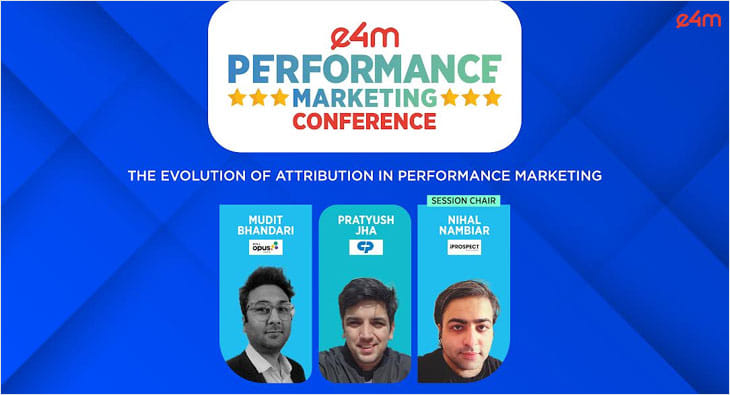

The e4m Performance Marketing Conference 2025 saw a panel discussion on ‘The evolution of attribution in performance marketing’. On the panel were Mudit Bhandari, Head Digital & Performance Marketing at Birla Opus, and Pratyush Jha, Lead - e-Commerce Marketing at Colgate-Palmolive (India) Limited.
The session, moderated by Nihal Nambiar, SVP - Strategic Solutions at Iprospect, delved into the nuances of attribution in modern marketing.
The discussion began with Nambiar posing a provocative question: Is performance marketing over-credited or under-credited? Bhandari approached this by taking a step back to examine the broader marketing landscape. "If I go by Les Binet and Peter Fields you realize that there's a long and short of it," he said, explaining how traditional thematic campaigns built brand saliency over time, while promotional activities provided revenue spikes.
He observed that with India's mobile penetration exceeding 90% and approximately 700 million people regularly using their devices, traditional marketing principles have evolved. "Undercredited, over credited is not the conversation where I would want to go for performance marketing. It is something that is constant," Bhandari noted, emphasizing that performance marketing is essential for maintaining revenue saliency from digital channels.
On attribution models, Bhandari highlighted that marketers often favor deterministic approaches like last-click attribution because they're easily measurable, though potentially misleading. "I would urge marketers to think that under or over is something you have to figure out for your particular business, the stage of growth your organization is in, and what are the revenue objectives and goals that you're chasing," he advised.
Jha agreed, adding a lighter perspective. He said, "Credit is like beauty, it lies in the eyes of the beholder," he said. He noted that without proper context, performance marketing could be either over or under-credited. "What is important is having the right context and the right objective as to why we are doing what we are doing," he emphasized.
He presented arguments from both sides of the debate, acknowledging criticisms that performance marketing is short-term and lacks brand-building capability, while also highlighting how many new-age brands have scaled successfully through performance marketing. "There are brands that have been built on the back of performance marketing. Multiple new age brands, which are household names now, wouldn't have been able to reach the scale that they are at today without performance marketing," Jha stated.
Nambiar then raised the fundamental tension between brand and performance marketing teams, where both claim credit for sales uplifts. He asked whether it's possible to build a single source of truth for attribution given the complexity of consumer journeys.
Jha responded that while theoretically possible, it's extremely challenging due to the complexity of modern shopper journeys. "Today's shopper journeys are so complex," he explained, citing the difficulty in connecting exposure to an advertisement with a subsequent purchase action that might happen days later through a different channel.
Bhandari agreed, using the tire industry as an example of how multi-touch consumer journeys make attribution difficult. "The way businesses are run, the way they operate, they're multi-touch in nature," he said, describing how a consumer might research tires online but ultimately make a purchase in a physical store.
"The shopkeeper will say, " I have sold well. " But that is not how it actually went about," Bhandari explained, highlighting the challenge of attributing the sale correctly when only seeing part of the customer journey. He cautioned that relying solely on available data can lead to fallacies, as it might not represent the complete picture.
When asked about appropriate attribution windows, Jha emphasized that it varies significantly by industry. "It is very industry specific," he said, noting that for consumer packaged goods, a 90-day window wouldn't make sense because purchase journeys are relatively short. "For FMCG companies, it might not be the case at all. It depends on categories and how you look at it," he added, suggesting that shorter windows of around 7-15 days are more appropriate for his industry.
The conversation then shifted to the debate between branded search and organic search attribution. Bhandari challenged the notion that SEO is free, pointing out the significant investments required in content and technology. "While everyone thinks SEO is free, it's organic," he said, "the truth is there's a lot of money that is still pushed in from a content perspective."
He explained that a brand's market position greatly influences its approach to SEO versus SEM (search engine marketing). "If there's a brand with a 70% market share," he noted, "the chances are that you don't need to do SEM because the long term impact of branding is resonating with people." Conversely, new brands with low awareness benefit significantly from SEM as "a short adrenaline boost for your sales."
Bhandari advised marketers to experiment based on their specific circumstances: "SEO and SEM is something you have to figure out through trial and experimentation for your brand correlated to market share," adding that "both are important for different reasons, for different brands at different growth stages."
Nambiar concluded by asking what marketers would do if major platforms retired last-click attribution. Jha emphasized that context remains crucial, illustrated with an example from Colgate's "Visible White Purple" launch. "If I were to take an example that a product sold via SEM at that point of time on a keyword like Colgate-purple-toothpaste, a last click will give all the credit to search, but that would not be the right thing to do because that search wouldn't have happened if the top funnel did not work," he explained.
He argued against completely abandoning last-click attribution, suggesting that the industry should move toward more sophisticated multi-touch attribution models enhanced by AI and machine learning. "We have AI and ML that have come in which can do those regression analysis in much quicker time versus the time that humans do. And as you feed in more data these models will become better and better," Jha concluded.
Read more news about Marketing News, Advertising News, PR and Corporate Communication News, Digital News, People Movement News
For more updates, be socially connected with us onInstagram, LinkedIn, Twitter, Facebook, YouTube & Google News