Are experiences taking over ads as the new creative currency?
The traditional 30-second commercial is now competing for budgets with concert sponsorships, pop-up activations, and fan meet-ups
 by
by
Published: Dec 9, 2025 9:09 AM | 12 min read
 Follow Us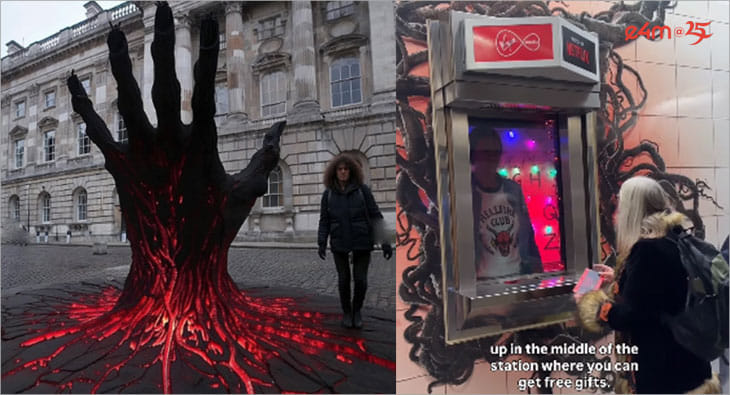

Last month, when Netflix transformed London's streets into a haunting preview of Stranger Things Season 5, it wasn't just outdoor advertising, it was environmental storytelling. The campaign combined eerie visuals, dim lighting, and the series' iconic red typography to turn typical urban locations into chilling, cinematic experiences that quickly went viral across social media.
Meanwhile, closer home, Diljit Dosanjh's Dil-Luminati Tour last year saw Lemonn, a new-age investment app, send its mascot dancing on stage with Diljit's backup dancers to his hit song 'Lemonade', turning a concert moment into a viral brand integration that had both concertgoers and social media buzzing. At Coldplay's Mumbai shows earlier this year, BookMyShow Live partnered with Indian Railways to launch an exclusive train service connecting western, central, and harbour lines directly to the venue at Ahmedabad, while brands like Tinder, Spotify, and Adidas strategically placed creative billboards across the city that referenced Coldplay's lyrics and resonated with fans heading to Mumbai's DY Patil Stadium.
View this post on Instagram
Explaining the brand perspective on how partnerships are being fundamentally reimagined, Rahul Ganjoo, CEO of District by Zomato, says: "Live entertainment brand partnerships have fundamentally shifted. It's no longer about visibility or product placement on-ground, it's about embedding brands into the experience itself, creating moments that feel native to the event rather than imposed on it."
The traditional 30-second commercial, once the gold standard of brand storytelling, is now competing for budgets with concert sponsorships, pop-up activations, and fan meet-ups. As experiential marketing gains momentum in India, particularly with 'going-out' platforms like District by Zomato bringing global music IPs like Rolling Loud to Indian shores, agencies and brands are being forced to rethink what creativity means when the canvas extends beyond a screen and into three-dimensional, real-time experiences.
According to the India Live Entertainment Report 2024 by FICCI-EY, the Indian live entertainment sector is projected to grow at a CAGR of 15.2%, reaching ₹14,000 crore by 2025. This growth is being fueled not just by consumer appetite for experiences, but by brands recognizing the unique value proposition that live events offer. Unlike traditional advertising that can be skipped, muted, or scrolled past, experiential marketing creates moments of genuine participation that audiences actively choose to engage with.
View this post on Instagram
The numbers tell a compelling story. A recent study by EventTrack revealed that 74% of consumers are more likely to purchase products after engaging with branded experiential marketing. For Indian brands navigating an increasingly cluttered media landscape, this conversion potential is proving irresistible. But the shift isn't merely about ROI metrics. It represents a fundamental reimagining of what brand communication can be when it moves from passive consumption to active participation.
From transaction to relationship
Suraj Nedungadi, AVP - Strategy at YAAP, frames this shift with remarkable clarity. "The shift of marketing spend in India from traditional ad films towards large-format experiences, community events, and Intellectual Property-driven festivals is not just a change in media allocation; it's a fundamental recalibration of brand-consumer relationship dynamics and the very definition of creative excellence for agencies," he explains.
At the heart of this transformation is a simple yet profound principle. "Communication is not a transaction, it's a relationship. Modern consumers have an acutely strong 'BS detector' and are saturated with transactional advertising. They know when they're being advertised to, and their attention has become the most valuable, and scarce, resource," Nedungadi notes. This saturation has fundamentally altered the competitive landscape for brands. In the digital ecosystem, a brand isn't just competing with its direct competitors, it's competing for attention against creators, influencers, meme pages, and news cycles.
Creating an experience or a scalable IP, Nedungadi argues, is a powerful way for a brand to move from being an advertiser to a culture contributor and a relationship builder. This transition addresses the core challenge facing modern marketing: how to earn attention rather than rent it. When brands create experiences that audiences actively want to participate in, they shift from interruption to invitation.
View this post on Instagram
From scripts to participation
The transition from film-based advertising to experiential marketing is forcing creative teams to fundamentally recalibrate their approach. Sundeep Sehgal, Senior VP and Executive Creative Director at VML India, captures this evolution with striking clarity. "The canvas has shifted, but the instinct remains the same. Earlier, we were squeezing big feelings into 30 seconds. Now we're stretching them across a football field, a three-day festival, or a five-minute creator handshake moment," he explains.
This expansion of the creative canvas has profound implications for how agencies conceptualize ideas. The question is no longer "What's the script?" but rather "What's the participation?" This shift demands a different kind of creative thinking, one that prioritizes audience engagement over audience attention. When brands invest in experiences, they're not buying eyeballs, they're buying emotions, memories, and the social currency that comes with being part of something.
The increase in spending on concerts, pop-ups, and community-led events is forcing agencies to pivot from pitching standalone, high-cost campaigns to developing durable ecosystems and assets. "Instead of focusing on a single 30-second script, the new agency pitch centres on creating long-term, scalable IPs, like a recurring festival or a content series, that can sustain a 365-day conversation," Nedungadi explains. This approach emphasizes ideas that allow the brand to own the platform and the narrative, generating invaluable first-party data and an organic owned content pipeline through user-generated content and event footage. The idea must be robust and valuable enough to actively cultivate a loyal fandom that anticipates and advocates for the brand year-on-year.
Sehgal points to an interesting paradox in this evolution. "What this shift has done is force us to stop thinking in rectangular frames," he notes. The creative process that once began with storyboards and shot divisions now starts with spatial design, audience flow, and moment architecture. The accountability factor in experiential marketing is also markedly different from traditional advertising. "The return of 'live' has made creativity more honest because you know immediately whether the idea works or falls flat. There's no edit button, no background score to rescue you," Sehgal observes. This real-time feedback loop creates both pressure and opportunity.
Creating culture, not interrupting it
"Every activation felt purpose-built for the culture, not just placed within it," Ganjoo notes. This distinction is crucial. When brands simply occupy space at an event, audiences see through the opportunism. When brands genuinely understand and contribute to the culture, they earn credibility and engagement. The challenge for brands and agencies is developing this cultural fluency, understanding not just what an audience likes, but why they like it and how a brand can authentically participate in that passion.
"When storytelling happens live, among fans, in real-time, the craft shifts from controlled messaging to creating spaces where audiences choose to engage. The bar is higher, activations need to feel authentic, add value, and respect the cultural context," Ganjoo explains. This requires a different skill set from agencies. Beyond creative concepting, they need expertise in spatial design, audience psychology, cultural anthropology, and real-time activation management. Done right, activations don't interrupt the experience, they enhance it.
Craft isn't dying, it's migrating
One of the most persistent concerns in advertising circles is whether this pivot to experiential marketing signals the death of craft. Sehgal challenges this notion head-on. "Craft in this era is not disappearing, it's migrating. From the edit bay to the experience floor, from dialogue writing to designing emotional choreography, from storytelling to story-structuring, from art direction to world-building," he argues.
Nedungadi takes this argument further, highlighting how brands are definitively prioritizing memorable moments over memorable scripts, leading to a redefinition of creative craft. "A memorable script aims to tell the consumer about the brand, but a memorable moment allows them to feel and embody the brand's values firsthand. The feeling of being part of a brand's major event creates a deep emotional imprint that a film struggles to match," he observes.
This shift reallocates creative focus in profound ways. "The 'Creative Director' evolves from a master storyteller of fiction to a master orchestrator of reality. The core craft skills now revolve around spatial design, physical UX, community management, and event technology integration," Nedungadi explains. The ultimate craft lies in flawlessly executing and designing an authentic environment that sets the stage for genuine, shareable moments, prioritizing the spontaneous and authentic energy of the crowd over the polished perfection of a staged film.
Art directors are now thinking about physical spaces rather than just frames. Copywriters are crafting brand narratives that unfold across multiple touchpoints rather than in a single linear story. The medium has changed, but the demand for exceptional creative thinking remains as high as ever.
What's particularly interesting is how this shift democratizes creativity in unexpected ways. In experiential marketing, the audience becomes co-creators, their reactions and participation shaping the story in real-time. "A moment is not the enemy of a script. A moment is a script, just written in real time," Sehgal points out. This collaborative dimension adds a layer of unpredictability that can be both exhilarating and terrifying for brands used to controlling their message with precision.
The metrics of success have also evolved. Traditional advertising measures reach, frequency, and recall. Experiential marketing adds layers of engagement depth, social amplification, and community building. A successful activation isn't just one that thousands of people attend, it's one that creates moments worth sharing, stories worth retelling, and connections worth maintaining long after the event ends.
How brands are embedding into experiences
The philosophy of live entertainment altering brand partnerships was put into practice at Rolling Loud India, where District orchestrated partnerships built on two pillars: utility and immersion. On the utility side, brands like MakeMyTrip integrated travel and hotel booking directly into the festival ticket purchase flow, solving genuine friction points for attendees traveling from Delhi, Pune, and Bangalore. Similarly, commute partners including Uber, DriveU, and Navi Mumbai Metro addressed last-mile connectivity challenges on festival day. "These weren't sponsorships in the traditional sense; they were functional enablers that improved the attendee experience," Ganjoo emphasizes.
The immersion layer took this integration even deeper. Budweiser's Brew District featured an exclusive viewing deck and live graffiti wall, while Casa Bacardi hosted mini-parties with top mixologists crafting signature cocktails. These weren't just branded spaces, they were destinations within the festival that offered unique experiences aligned with the brand's identity. The BUDX Dankies Skatepark let professionals showcase tricks and invited attendees to try their hand at skating, bringing a core element of hip-hop culture to life.
The diversity of activations demonstrates how brands can tap into different facets of a cultural movement. The Sprite Basketball Court turned casual fans into players. The Liquid IV Pickleball Court introduced a growing sport to festival-goers. The Thums Up X-Force Zone delivered high-adrenaline challenges. Red Bull's Energy Zone featured breakdancers battling live in Dance Your Style format, connecting directly to hip-hop's roots.
Beyond sports and competition, activations celebrated multiple dimensions of hip-hop culture. The Spotify Rap 91 Zone showcased local and global rap talent. Valorant offered immersive gaming experiences. Harley Davidson set up a Tattoo Shop for on-the-spot ink. Patron created the Hacienda experience with premium tequila tastings, while BBlunt's Loud Cutz gave attendees fresh cuts and styles.
The broader implications for advertising
This experiential turn raises fundamental questions about the future of advertising creativity. As budgets continue shifting from screens to spaces, agencies face both existential threats and exciting opportunities. Agencies that successfully pivot from making ads to making experiences position themselves as more holistic brand partners. This requires investment in new capabilities and a willingness to measure success differently, valuing depth of engagement over breadth of reach.
For brands, this shift offers a solution to one of advertising's oldest problems: how to cut through the noise. "Brands want moments. Because moments generate chatter, fandom, reels, and receipts. They travel faster than films. They feel truer. And they can't be skipped with a thumb," Sehgal observes.
This social amplification effect is particularly powerful in the Indian market. According to the IAMAI-Kantar ICUBE 2023 report, India has over 759 million active internet users, with social media usage driving significant engagement. When brands create experiences worth sharing, they benefit not just from the in-person attendees but from the exponentially larger audience that engages with content from the event. A Freeman study reveals that 77% of consumers say they have a more positive opinion about a brand after attending an event, and 91% feel more inclined to purchase after participating in brand experiences.
The fundamental question this shift poses is whether we're witnessing a temporary trend or a permanent restructuring of how brands communicate. The evidence suggests the latter. As younger consumers, particularly Gen Z and millennials, continue to prioritize experiences over possessions, brands have little choice but to meet them where they are. This demographic cohort, which represents a significant portion of India's consumer market, has different expectations around brand relationships. They want participation, not just messaging.
For creative professionals, this evolution demands adaptation without abandonment of core principles. The skills that made someone a great copywriter or art director remain valuable, but they need to be applied to new formats. Writing compelling dialogue translates to crafting engaging brand narratives that unfold across physical spaces. Art direction translates to creating visual identities that work in three-dimensional environments with real people moving through them.
"A film is craft on a screen, and an experience is craft in 360 degrees. Different tools, same soul," Sehgal concludes. This encapsulates the opportunity and challenge facing the advertising industry. The soul of creativity, the ability to move people emotionally and drive them to action, remains unchanged. What's changing is the toolkit required to achieve that goal.
As brands continue to invest in moments over messages, agencies must evolve from being storytellers to being story-creators, inviting audiences not just to watch their narratives but to live them. The creative currency of the future isn't measured in screen time, it's measured in shared experiences, authentic connections, and memories that outlast any commercial break.
Read more news about Marketing News, Advertising News, PR and Corporate Communication News, Digital News, People Movement News
For more updates, be socially connected with us onInstagram, LinkedIn, Twitter, Facebook, YouTube & Google News