65% of our every marketing dollar buys an experience, not an ad: Vineet Sharma, AB InBev
Vineet Sharma, Vice President of Marketing and Trade Marketing at AB InBev India, talks to e4m about building experiences in a competitive and fastest-growing markets
 by
by
Published: May 9, 2026 11:45 AM | 8 min read
 Follow Us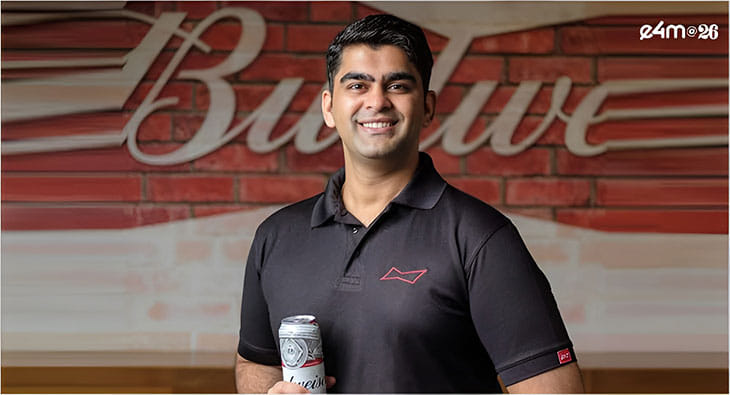

- Budweiser's marketing strategy in India allocates 60-65% of its budget to experiential marketing rather than traditional advertising, focusing on cultural movements rather than short-term campaigns.
- The company navigates India's surrogate advertising regulations by building long-term partnerships in music and sports, such as with Lollapalooza and the ICC, to create a consistent brand presence.
- Budweiser's recent entry into cricket, alongside its established focus on football and music, highlights India's growing importance in the brand's global strategy, as cricket offers significant consumer engagement opportunities.
- AB InBev emphasizes the need for a local approach in its marketing, adapting its strategies to fit Indian cultural contexts while maintaining a global brand identity, particularly in appealing to young consumers interested in non-alcoholic experiences.
There is a quiet but significant shift happening in how consumer goods companies are allocating their marketing spends in India. Nearly 60 to 65 per cent of Budweiser's marketing budget in India does not go toward television spots, digital banners, or search advertising but towards building experiences.
"We believe in going heavy with experiences, but the focus should not be on the event — it should be on a cultural movement," says Vineet Sharma, Vice President of Marketing and Trade Marketing at AB InBev India. For a consumer brand operating in one of the world's most competitive and fastest-growing markets, that allocation is a strategic statement as much as a budget decision.
It also speaks to a question that is reshaping marketing thinking across categories in India. When a generation can skip, scroll, and filter out every conventional ad, how does a brand actually get through?
For companies in the alcohol beverage category, this question carries an additional layer of complexity. India's surrogate advertising regulations prohibit the direct promotion of alcohol products, pushing brands to find indirect routes to consumers through music, sports, and lifestyle associations. What was once a compliance workaround has, for some companies, become the foundation of a more deliberate brand strategy altogether. "It is a brand that has stood on culture for the last 150 years," Sharma says.
"Whether it is music or sports, we partner where it jives with our values and where we can genuinely add value." AB InBev, the world's largest beer company and parent of Budweiser, is among the most deliberate examples of this shift. Culture, not advertising copy, has become its primary medium.
Culture as the medium, not the message
The vocabulary Vineet Sharma, Vice President of Marketing and Trade Marketing at AB InBev India, uses to describe the company's approach is telling. He does not speak of campaigns in the traditional sense. He speaks of cultural movements. The distinction matters. A campaign has a start date and an end date. A cultural movement is open-ended, accumulative, and measured not in reach but in resonance.
"We don't see these as events," Sharma says. "We are seeing them as cultural movements and campaigns. Our intent is to focus heavily on experiences, but we want the focus to be on a cultural movement, not just the event. That is where the real magic will come."
This framing has direct implications for how AB InBev structures its partnerships. Budweiser's association with music properties such as Lollapalooza, Boiler Room, Rolling Loud, and Tomorrowland now spans multiple years for several of these tie-ups. Its FIFA association runs four decades globally. The ICC and IPL deals extend three to five years. The NBA partnership, recently deepened in India through an activation called BudX NBA House, is designed with a similarly long horizon. "The consistency is deliberate," highlights Sharma.
"We are not interested in just putting a logo," Sharma says. "We want to build a community, come in and build it for the long term."
The logic of compounding, a concept familiar in finance but far less discussed in brand strategy, is central to how AB InBev justifies these multi-year, experience-heavy commitments. The idea is simple but worth examining carefully. A brand that shows up consistently at the intersections of music, sport, and lifestyle does not need to announce itself at each occasion. Over time, it becomes the ambient backdrop of those occasions, associated not through recall but through feeling. For a category operating under India's surrogate advertising regulations, which restrict the direct promotion of alcohol products, this ambient presence is not just a strategy. It is a necessity that has been refined, over years, into something that functions as competitive advantage.
The Strategic Logic Behind Sports Marketing
Perhaps the clearest illustration of how India is reshaping AB InBev's global marketing calculus is the decision to enter cricket. For the first time in the brand's history anywhere in the world, Budweiser has partnered with both the ICC and the IPL. For a brand whose global identity has been built primarily around football and music, this is a significant departure. It signals how central India has become to the company's broader growth narrative. The country is already the fourth largest market for Budweiser globally, growing at double digits year on year.
"We entered cricket after being 20 years here in India," Sharma notes. "It's not that on day one when we entered India, we started doing cricket. What we believe is that if we have a strong point of view about something, if we can add value to that partnership, then let's do it."
The qualifier is important. AB InBev is not entering cricket simply because cricket is popular. It is entering because cricket, in the Indian context, is one of the most powerful recruitment occasions available to a consumer brand, a moment when tens of millions of people are engaged, emotionally invested, and open to brand messaging in ways that everyday media consumption rarely produces. For a company that cannot advertise its core product directly, those windows of high engagement carry disproportionate strategic value.
The basketball bet operates on a different, longer timeline. The NBA's India ambitions are real but the sport's consumer base remains modest compared to cricket. Sharma is candid about the horizon involved. "Basketball is a growing sport in India. Brands who want to talk to young Indians, a lot of young people are wanting to explore sports outside cricket. Basketball, if you have seen or gone to a game, is a very fast-paced game. I think it is very meant for India." He draws a parallel with Budweiser's own growth trajectory. "We know how sports are built. We know how passion points are built."
The Long Game and What It Actually Costs
In a marketing environment where performance metrics and short-cycle attribution dominate budget conversations, AB InBev's approach in India represents a relatively unfashionable discipline — the willingness to invest in brand equity whose returns are not immediately measurable. The 60 to 65 percent of budget going into experiences is not producing the kind of trackable conversion data that a digital performance campaign generates week by week. It is producing something harder to quantify and, the company would argue, harder to replicate.
"These are not like a switch on switch off," Sharma says. "We have seen compounding effects happening if you continue to build a story. We have seen it in music. What is key is remaining consistent, but bringing a lot of fresh story every single time."
The multi-year nature of the partnerships is inseparable from this argument. A brand cannot claim cultural relevance through a single season of association. It has to earn it across enough cycles of a consumer's life that the association becomes instinctive. The Lollapalooza partnership is in its fourth year. The FIFA relationship is in its fortieth. The patience embedded in those numbers is, in itself, a strategic signal.
Thinking Global, Acting Local — and the Tension Between the Two
The glocalization challenge, how a global brand maintains the coherence of its identity while adapting meaningfully to local cultural contexts, is one that marketers discuss extensively but navigate unevenly. For AB InBev in India, the tension is visible in the choices it is making. The BudX NBA House activation, for instance, is an India-only construct. Although AB InBev and the NBA are global partners and NBA House activations happen in multiple markets worldwide, the specific BudX NBA branding exists only in India. It is a small but meaningful signal of the degree to which the Indian market is being treated as a context that requires its own strategic logic rather than an adaptation of a template built elsewhere.
"You need to think global, but act local," Sharma says. "We want to act local. We have never done cricket in the history of the brand and now we are saying, let's do cricket, because cricket is a big recruitment occasion for people to come in."
The non-alcoholic extension of the brand sits within the same framework. A growing segment of young urban Indians is engaging with the culture and social context of premium brands without necessarily consuming alcohol. A brand that can credibly occupy that space, through music events, sports activations, and lifestyle associations, without its presence being contingent on alcoholic consumption, has a materially wider reach than one that cannot.
For a category operating under significant advertising restrictions, the real question has never been whether to build brand equity through culture. It has always been how seriously to take that imperative. AB InBev's answer, measured by budget allocation, partnership tenure, and the deliberateness with which it is entering new sports and music territories in India, suggests it is taking it more seriously than most.
Read more news about Marketing News, Advertising News, PR and Corporate Communication News, Digital News, People Movement News
For more updates, be socially connected with us onInstagram, LinkedIn, Twitter, Facebook, YouTube & Google News