Shark Tank India’s Anupam Mittal on why CEOs & Founders stepping down isn’t failure
Anupam Mittal also highlighted that the skills required to build a startup in its early stages are not always the same as those needed to run a scaled company
.png) by
by
Published: Jan 27, 2026 3:41 PM | 2 min read
 Follow Us

Anupam Mittal, founder and CEO of People Group and Shaadi.com, challenged the long-held assumption that a founder stepping down as CEO signals trouble within a company. He argued that leadership transitions are often misinterpreted, particularly in India’s startup ecosystem, where founders are closely tied to the identity and success of their businesses.
In a LinkedIn post, Mittal explained that such transitions are a sign of organisational maturity, not failure. He also rejected the traditional Indian notion that “CEO = Founder = CEO,” describing it as “outdated” in the context of rapidly scaling companies.
Apart from founding Shaadi.com, an Indian online wedding service, Mittal has been a prominent investor on Shark Tank India Seasons 1, 2, and 3, backing over 250 companies.
Mittal highlighted that the skills required to build a startup in its early stages are not always the same as those needed to run a scaled company. He explained: “Startups today are growing faster than founders can grow as managers, what works at 10 people breaks at 100 & what works at 100 breaks at 1000.” Founders, he said, are typically highly effective in the early stages, but managing a larger-scale business is a different challenge, and they are often better served by bringing in professional CEOs.
Mittal pointed out that in the global economy, founder-to-professional CEO transitions are common and even encouraged. He cited companies such as Google, Apple, and Microsoft, where such transitions have contributed to the creation of enduring institutions. However, in India, he noted, these changes are often portrayed in the media as being “fired,” a “failure,” or even “fraud,” when in reality they are frequently proactive decisions aimed at putting the company’s best interests first.
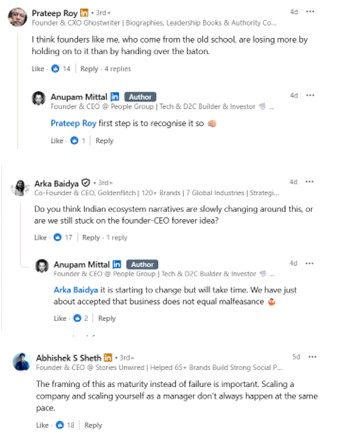
By reframing founder exits as a strategic shift rather than a setback, Mittal’s comments encourage entrepreneurs and investors to assess leadership changes based on long-term business needs, rather than perception or sentiment.
Read more news about Industry Briefing, Internet Advertising, Marketing, PR & Corporate Communication, Television Media
For more updates, be socially connected with us onInstagram, LinkedIn, Twitter, Facebook YouTube & Google News