Half a Nation, Whole Recognition
Why international law cannot legitimise a regime built upon the systematic exclusion of women
.png) by
by
Published: Sep 17, 2026 7:31 PM | 5 min read
 Follow Us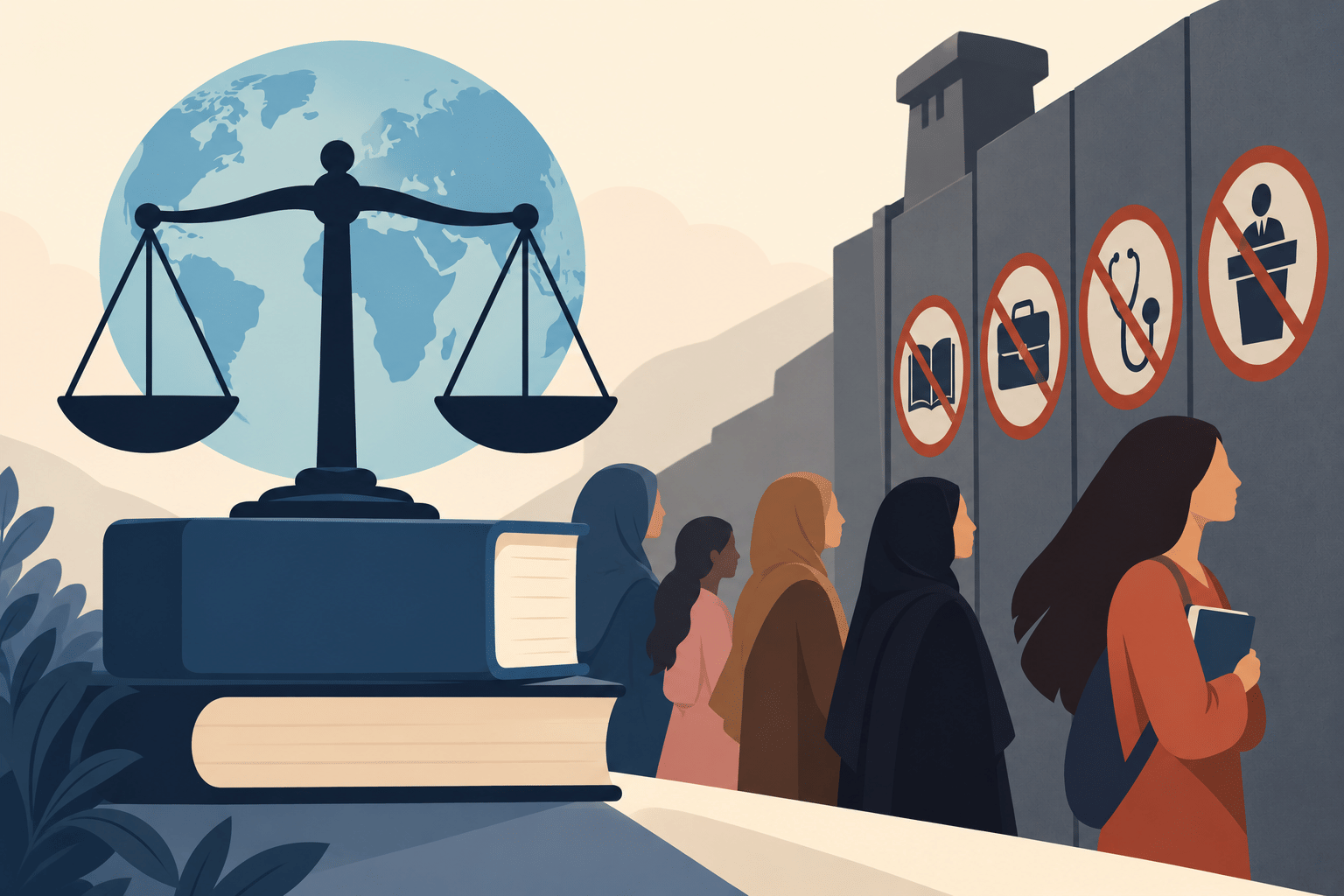

Fatema Mernissi, a Moroccan sociologist and feminist scholar, argued that struggles over women's rights were just struggles over power: over who possesses the authority to define women's place within society. The question then is not merely about women and freedom, but more so about the power of institutions and governments and legal systems whose public participation is held legitimately.
Afghanistan attests to this. In the new Taliban regime, the exclusion of women is not a mere consequence of skewed ideology or political instability or administrative failure, but is a deliberate mechanism of governance. Through restrictions on education, employment, movement, and public participation, the Taliban have transformed women's absence from public life into a defining feature of the state they seek to build.
The international debate around Afghanistan has been dominated by the human rights violation narrative, but truly it should centre around a more fundamental problem: should the Taliban be recognised as the country's legitimate government? Human rights lawyer Clive Stafford Smith has argued that this debate is too often about an absolute choice: legitimise the Taliban or isolate and slight innocent Afghanis. What if this was merely a fallacy? Diplomatic disengagement, sanctions, and political isolation have frequently inflicted their greatest costs upon ordinary Afghans while leaving the Taliban's authority largely intact. Humanitarian assistance, practical cooperation, and dialogue with those exercising de facto control may therefore be indispensable if the international community is to meet its obligations towards the Afghan people.
This distinction is vital. Engagement with a de facto authority is not the same as recognising its legitimacy. International law has long accepted that states may communicate, negotiate, and cooperate with authorities that exercise effective control without thereby endorsing the political or legal character of their rule. In fact, separating practical engagement from formal recognition may be essential where humanitarian concerns demand continued interaction with governments whose conduct remains deeply contested.
Yet this distinction also exposes a deeper dilemma. If engagement with the Taliban is necessary, does that compulsorily legitimise their governance of Afghanistan?
Traditionally, international law has approached recognition through the principle of effective control. Governments have been recognised because they exercise authority over territory and state institutions rather than because they satisfy particular moral or political standards. Recognition has therefore operated primarily as an acknowledgement of political reality, not as an endorsement of the character or quality of domestic governance. This approach reflects a longstanding reluctance to allow questions of legitimacy to become contingent upon contested normative judgments.
The contemporary international legal order, however, sits uneasily alongside this traditional understanding. The United Nations Charter, the Universal Declaration of Human Rights, and the network of subsequent human rights treaties establish that equality and human dignity are not merely matters of domestic political preference but universal legal commitments. Recognition can therefore no longer be understood as entirely detached from the normative framework within which states themselves claim legal authority. While effectiveness remains an important consideration, it has become increasingly difficult to maintain that recognition is wholly insulated from the values contemporary international law seeks to protect.
The difficulty presented by the Taliban illustrates this tension with unusual clarity. The central issue is not simply that the regime has committed serious human rights violations. International law has, throughout its history, recognised governments responsible for widespread and systematic abuses. The distinctive feature of Taliban rule is that the exclusion of women is not an incidental consequence of authoritarian governance but one of its defining constitutional characteristics. Women are not merely denied individual rights in isolated contexts; they are systematically excluded from education, employment, public office, and civic participation in ways that fundamentally redefine their legal and political status within the state. The question, therefore, is no longer whether a recognised government may violate human rights - a proposition that international practice regrettably answers in the affirmative - but whether a political order organised around the institutional exclusion of half its population can satisfy even the minimum normative assumptions upon which contemporary international legitimacy depends.
Recognising such a regime would consequently do more than acknowledge an existing political reality. Recognition carries both legal and symbolic consequences. It identifies those exercising sovereign authority as the legitimate representatives of the state within the international community and facilitates their participation in international legal and diplomatic relations. Where the defining characteristic of that authority is the systematic exclusion of women from public life, recognition risks communicating that such a model of governance remains compatible with international legitimacy. That implication sits in evident tension with the principle of equal citizenship that has become increasingly embedded within contemporary international law.
None of this requires abandoning Afghanistan or refusing all engagement with those exercising effective control. On the contrary, it demonstrates why continued engagement may remain both necessary and desirable. Humanitarian assistance, diplomatic communication, and practical cooperation are often indispensable for alleviating suffering, protecting civilians, and maintaining channels through which international pressure can be exerted. But accepting the necessity of engagement does not require the international community to confer legitimacy upon the political order responsible for that suffering. Engagement serves practical and humanitarian objectives; recognition performs a distinct legal function. The two should therefore remain conceptually and legally separate.
Mernissi recognised that struggles over women's rights are ultimately struggles over authority: who possesses the power to determine whose voices count within political and legal institutions. Afghanistan demonstrates that this question extends beyond domestic constitutional arrangements into the structure of international law itself. If recognition remains entirely detached from the systematic exclusion of women, equality risks becoming an aspiration rather than a principle capable of shaping legal outcomes. Recognition undoubtedly reflects political reality, but it also contributes to defining which forms of political authority the international community is prepared to legitimise. The question confronting international law is therefore not whether Afghanistan should be abandoned, but whether legitimacy can ultimately be separated from justice when the exclusion of women constitutes the organising foundation of governance.
Written by
Rajlaxmi Singh
Student of class XII.
(Views expressed are personal in nature )
Read more news about Industry Briefing, Internet Advertising, Marketing, PR & Corporate Communication, Television Media
For more updates, be socially connected with us onInstagram, LinkedIn, Twitter, Facebook YouTube & Google News