India's experiential industry set for 19% growth in FY25: Samit Garg
EEMA President opens up about growth, disruption, inclusivity and why India’s time as a global stage for experiences has arrived.
 by
by
Published: Jun 13, 2025 2:45 PM | 11 min read
 Follow Us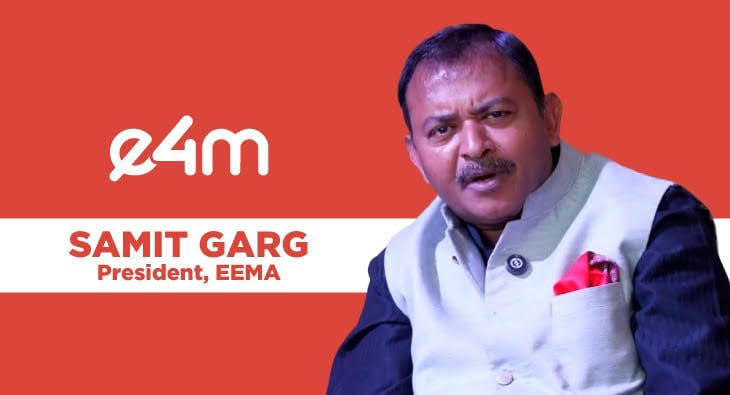

In the world of lights, stage and soaring ideas, where moments are designed and memories engineered, few voices echo with the conviction and clarity of Samit Garg. As the President of EEMA and a driving force in India’s experiential revolution, Garg doesn't just lead, he curates a vision for an industry that is at once creative and commercial, deeply rooted yet globally ambitious.
From shaping India's event narrative to uniting 4,500 companies under one umbrella, he speaks not as a businessman alone, but as a custodian of culture, a believer in Brand India, and a passionate architect of tomorrow’s experiences.
In this wide-ranging conversation, Garg opens up about growth, disruption, inclusivity and why India’s time as a global stage for experiences has not only arrived, it’s expanding.
Since taking over as President of EEMA, what would you consider your most meaningful achievements,both internally for the association and externally for the industry?
That’s a difficult one to answer in just a few lines, but there are a few key things we, as the National Executive Council (NEC) at EEMA,13 of us serving as principal bearers,take immense pride in.
First, we’ve been able to carry forward the torch lit by our predecessors with integrity and intention. Everything important and foundational that was initiated by past leaders, we’ve ensured to nurture and take ahead responsibly. That continuity matters to us deeply.
One of the most significant milestones during our tenure has been the formation of KREA, the Congress of Regional Event Associations. Through this, we’ve successfully unified the national ecosystem of stakeholders by bringing together nearly 25 regional event associations under one umbrella.
This has been a powerful and game-changing development. It now allows us, as a collective industry body, to confidently state that we represent the interests of over 4,500 organized event companies across India.
Beyond that, we’ve worked hard to establish EEMA as a body of advocacy, consistently engaging with the government at policy and strategic levels. Every month or so, we’ve had meaningful engagements with senior government officials, ensuring the voice of our industry is heard.
Scaling up our initiatives has always been a priority. If you look at the last two editions of Imagine, you’ll see how the platform has grown significantly, in terms of size, participation, and impact.
For all of this, both Karpie and I are extremely grateful to our members and the incredible support we've received from the extended team of bearers working alongside us.
With recent global conflicts directly impacting events and tourism, what is EEMA doing to build long-term safeguards for the Indian events ecosystem?
I don’t think EEMA is at a scale where it can create safeguards against natural disasters or such unforeseen events. And honestly, I don't believe it's even possible to have safeguards in place for situations related to national security.
What happened was unfortunate, but thankfully, it was short-lived. In that sense, we can say that God has been kind.
Revenue losses and insurance gaps agencies hard due to sudden cancellations recently. Are you in active dialogue with the government for policy-level financial protection or relief?
In situations like these, what dialogue can one really have? The truth is, there isn’t much anyone can say or do when a pandemic breaks out, or when there's an earthquake, a natural disaster, or an incident of this nature. Dialogue, in such cases, holds little relevance.
What we, as torchbearers of the industry, can do is focus on creating our own safety nets, through better planning, a deeper understanding of our environment, and being more judicious about the political and socio-economic landscape we operate in. It’s about taking more informed decisions.
I also believe that risk mitigation is something our industry hasn’t truly embraced yet. These episodes, as unfortunate as they are, serve as reminders that risk assessment should be a critical part of our decision-making, especially when it involves large financial commitments tied to events.
In your view, what are the biggest strengths of the Indian event industry right now?
The strengths of the Indian events industry are unique and the question of how we amplify what India does best is a whole conversation in itself.
When it comes to our core strengths, I’d say we are extremely adaptable and remarkably determined. We find solutions, no matter the challenge. Having worked in nearly 25 countries, I can say with both pride and conviction that the Indian events industry has an unmatched ability to achieve its goals, often against all odds.
This unwavering resolve is also bolstered by the current leadership and administration of our country, which continues to inspire confidence and ambition. Not many countries around the world display this kind of resilience and drive.
Secondly, we are an immensely creative and indigenous ecosystem. While we may sometimes take inspiration, or even borrow ideas we are, by and large, able to create and co-create meaningfully. This is an era of collaboration within the Indian events industry, and it is evolving at an extraordinary pace.
Now, in terms of carrying larger narratives to the world, one of the most powerful messages that India’s creative economy is taking global is rooted in our ancient wisdom.
Our civilizational knowledge base, cultural values, and heritage are now being adopted and translated into progressive, modern experiences.
We are crafting powerful stories,stories of India, that are both deeply rooted and globally relevant. And EEMA is proud to be at the forefront of this movement. It is our time. In fact, the time has already begun. We’ve started taking Brand India to the world."
With wedding tourism in destinations like and Baku currently affected, how do you see this disruption impacting Indian planners and allied vendors? Is EEMA offering any guidance or alternatives?
I have a slightly different take on this.
When it comes to Indian weddings going to international destinations like or Azerbaijan, honestly I don’t think Azerbaijan has hosted too many Indian weddings. It has primarily been a MICE (Meetings, Incentives, Conferences, Exhibitions) destination. That said, the MICE business going to Azerbaijan has certainly been impacted and in some ways, that’s a positive development.
Events may be postponed, canceled, or their destinations changed, but this disruption appears to be short-lived. What’s more significant here is the sentiment that has emerged across the board.
It’s heartening to see that the sentiment has been strong and largely unanimous. Because frankly, when someone supports an enemy nation, they can’t be seen as a friend. And this realization has resonated widely.
As far as and Indian weddings are concerned, I believe that ever since the Prime Minister launched the 'Wed in India' campaign about two years ago, nearly 90% of outbound wedding business had already begun to decline. So, I don’t think there’s a major cause for concern regarding the current situation, it’s simply reinforcing an existing shift.
The events industry has historically been male-dominated. Under your leadership, is EEMA taking steps to create a more inclusive and supportive environment for women professionals?
Good question and the answer is yes.
There are dedicated task forces within the EEMA system that are actively working towards this goal. Two of these task forces, in particular, have been very proactive in ensuring greater empowerment of women within the industry. They aim to encourage more women to step into leadership roles and take on increased responsibilities.
One of them is the 'We Care' mission, which you may be familiar with, it was initiated almost a decade ago. The other is the Artists Committee.
Both these task forces are deeply engaged with the issue, and their efforts are yielding results that are not only positive but also increasingly visible across the ecosystem.
For businesses in the live events and experiential space, what are your growth forecasts for the year ahead? What categories or regions do you believe will lead the charge this year?
I personally believe that across the five core pillars of our industry sports, MICE, corporate events, weddings, and government events,we should be able to achieve growth in the range of 17 to 19%.
In terms of regional performance, I anticipate that South India will demonstrate the highest growth. The southern states are becoming increasingly proactive and ambitious in the way they conceptualize and execute events. They are also actively investing in the development of new, viable destinations for hosting events.
This is not to say that the North isn't seeing progress. In fact, some major venues and excellent hospitality properties have emerged in the North in recent years.
However, in terms of relative growth, the South is poised to outpace the North in the coming years.
India is seeing a sharp rise in intellectual property-led events and festivals. How can we protect and nurture homegrown IPs in a crowded market?
EEMA cannot directly help people build IPs, but our role and perhaps 'responsibility' is the better word, comes into play in other meaningful ways.
We are actively taking steps to ensure that better talent, stronger skill sets, and deeper knowledge-sharing platforms are made accessible to our members. This enables them to learn from one another, partner effectively, and foster collaboration an essential driver in today’s event ecosystem.
We consistently emphasize the importance of original thinking in our forums. Through communication, workshops, leadership summits, and engagements with national and international experts, we are working to inspire a mindset shift within our community.
Because to truly develop original IPs, one must begin by thinking differently.
Someone who has spent their career doing commissioned, contract-based events may find it challenging to transition toward independent IP creation, where there are financial risks, reputational stakes, and the possibility of failure.
So, everything we do from leadership development to skill enhancement, is aimed at helping our members move toward that new way of thinking and operating. It's a continuous, deliberate effort and we’re committed to it.
You’ve spoken about India becoming a global destination for events. What’s the single biggest roadblock in getting there?
I don’t think there is a single largest roadblock.
In fact, “roadblock” might not even be the right word. It’s more accurate to say that we are in the process of preparing ourselves, to evolve and rise to global standards.
There’s already a visible shift in policy, and significant efforts and investments are being made in areas like infrastructure, connectivity, hospitality units, and supply chain logistics. But it’s a time-consuming process, and real transformation takes time.
Today, if you map out India’s wedding destinations, most people immediately think of Rajasthan, Goa, perhaps a few stations, or the backwaters of Kerala. But India has so much more to offer.
Unfortunately, many potential destinations are overlooked simply because there’s no proper connectivity, hotels don’t exist yet, or logistics remain a challenge. That’s the gap we need to close.
However, the encouraging part is that work has already started, particularly over the past year. By 2026, we may see at least five new viable destinations emerge, and by 2027, perhaps ten more.
When it comes to MICE (Meetings, Incentives, Conferences, Exhibitions), India is now home to several world-class convention centers that are at par with international benchmarks:The Jio World Convention Centre in Mumbai,The newly redeveloped Pragati Maidan (Bharat Mandapam) in Delhi,The Yashobhoomi (IICC) in Dwarka, Delhi.
These venues are not only ready to host global-caliber events, they’re already in demand, with full-year booking calendars in many cases. The Jio Centre and Bharat Mandapam, for example, are already seeing significant traction.
The fact that such venues now exist and function efficiently is already having an impact. They are not only serving national audiences but are also attracting international events to India.
Yes, the journey has been a little slow,but it’s definitely on the right path. The momentum is building, and the results will become even more visible in the years to come.
You’ve worked with luxury brands and governments alike,two very different stakeholders. How do you experiential strategy for each without compromising on creativity or commercial outcomes?
At the end of the day, one thing is common to both: we are creating experiences for a brand.
In one case, the brand might be an individual high-net-worth individuals or a corporate brand.On the other hand, the brand is much larger; it’s called Brand India.
In both these segments, the fundamental rule remains the same: I am working for a brand, and I need to create experiences for that brand’s audiences.
What changes are the purpose, the meaning, and the audience.
Our job is to intelligently recreate, or sometimes co-create, the best possible experiential solutions that meet both the micro and macro objectives, for government, for states, for individual families, or for corporate brands.
Overall, once you understand these parameters clearly, the inputs and ingredients can be adjusted and re-engineered accordingly.We’ve learned this over time, and now it no longer feels difficult at all.
Read more news about Experiential Marketing, Internet Advertising, Marketing, PR & Corporate Communication& Television Media.
For more updates, be socially connected with us onInstagram, LinkedIn, Twitter, Facebook YouTube & Google News